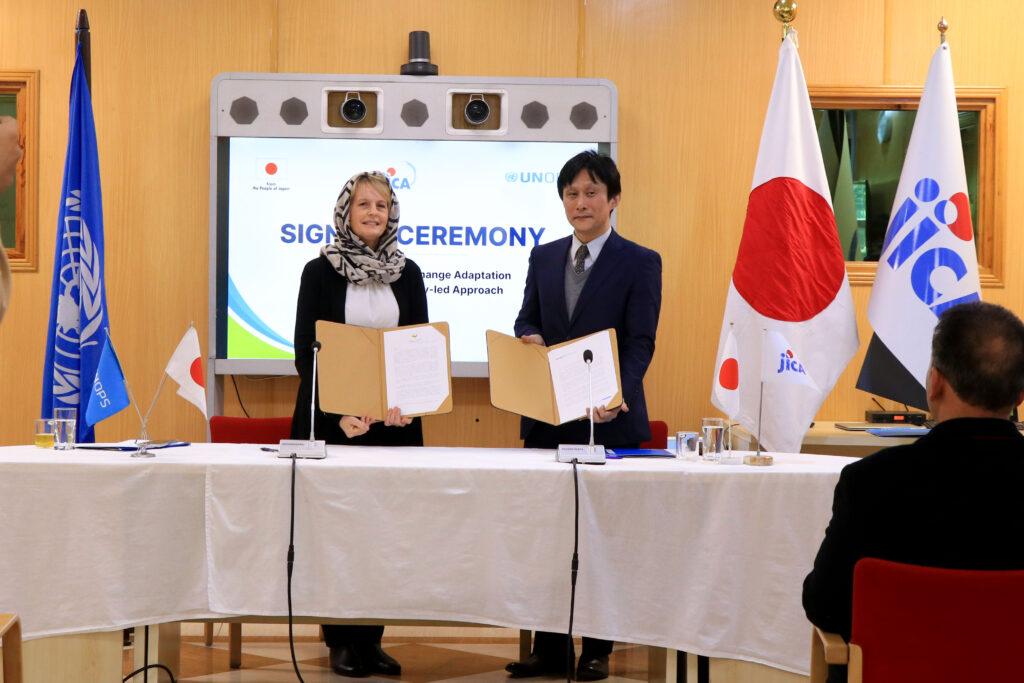

KABUL (Pajhwok): Japan and the United Nations Office for Project Services (UNOPS) have launched a $9.3 million, three-year project to strengthen climate resilience and water security in Kabul province through small-scale infrastructure and community-led disaster risk reduction.
The initiative, titled “The Project for Promoting Climate Change Adaptation through Community-led Approach,” aims to protect vulnerable communities from flash floods, prolonged droughts, and a deepening groundwater crisis that could leave Kabul facing severe water shortages by 2030.
Under the project, check dams, water reservoirs, irrigation canals, and riverbank protection structures will be constructed to recharge aquifers and control storm water.
Japanese expertise and technology will be integrated through collaboration with specialized organizations to introduce innovative water-saving and disaster preparedness solutions.
Japan’s Ambassador to Afghanistan Kenichi Masamoto said the project combines infrastructure development with knowledge transfer.
“Japan has shared its expertise in disaster risk management worldwide. Through this partnership with UNOPS, we aim to support Afghans in adapting to climate change through both vital infrastructure and shared know-how,” he said.
UNOPS Country Director Katy Webley said the initiative places communities at the center of adaptation efforts. “This project is about more than infrastructure. It empowers communities to lead their own responses to climate risks by combining UNOPS’ technical expertise with Japanese innovation,” she noted.
Key components of the project include construction and rehabilitation of small-scale infrastructure at rural sites in Kabul province, groundwater recharge measures to address the city’s annual 60 million cubic meter water deficit, and resilience support for 150,000 people, with at least 40 percent women beneficiaries.
The project will also train 30 practitioners, establish disaster risk management systems in 20 communities and generate short-term employment through cash-for-work programs, including afforestation and soil erosion control.
The initiative aligns with the Sendai Framework for Disaster Risk Reduction and Sustainable Development Goals 6 and 13, building on UNOPS’ experience of delivering more than 4,000 small-scale infrastructure projects across Afghanistan since 2022. By targeting Kabul’s rural outskirts, it seeks to stabilize livelihoods and environmental conditions amid rapid population growth.
pr/sa