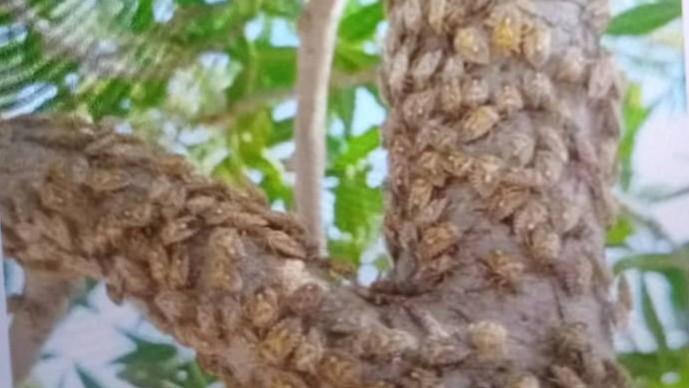

QALA-I-NAW (Pajhwok): Farmers in western Badghis province say an infestation of the wheat bug has destroyed parts of their wheat fields, fruit orchards and non-fruit orchards over the past week. Meanwhile, the provincial Department of Agriculture says it has cleared 800 jeribs of farmland from the pest.
Ghulam Nabi, a farmer in Qala-I-Naw, the provincial capital, told Pajhwok Afghan News that the insect infestation had completely destroyed five jeribs of his wheat crop and also severely damaged his orchards.
He said the ongoing situation has caused heavy losses to farmers, who lack the capacity to deal with the pest.
“We do not have the means to fight this pest; it has destroyed our agriculture. Although the government is making efforts to control it, we request more action and for organizations to step in so that we do not suffer further losses,” he said.
Another farmer in Murgab district, Mohammad Haidar Rahimi, also expressed similar concerns, saying the pest has recently caused significant damage to his fields, raising serious concern.
He warned that if the spread of the insect is not stopped soon, it could cause further damage to agricultural produce and push many farmers into economic hardship.
Rahimi urged the Ministry of Agriculture and aid organizations to increase their support in controlling the infestation.
“This pest first destroyed our crops like locusts did, and now the wheat bug has come and destroyed everything. It has eaten the wheat leaves and grains, causing us severe losses,” he said.
Meanwhile, Associate Prof. Moazzam Haqmal, an agricultural expert in Badghis, said the wheat bug is an annual pest in the province during the hot season and, if not controlled in time, can cause significant economic losses to farmers.
He said the insect feeds on wheat sap, reducing the quality of the yield.
Haqmal attributed the spread of the pest to rising temperatures, the presence of weeds, and climate change.
He added that timely identification of the pest, cooperation from farmers, removal of weeds, and the use of recommended pesticides could help prevent further spread.
However, Abdul Halim Halimzai, spokesperson for the Badghis Department of Agriculture and Livestock, said more than 800 jeribs of farmland have been cleared of the pest since the outbreak began, and operations to prevent its spread are ongoing.
He said: “Unfortunately, in recent days the wheat bug has appeared in farmers’ fields. The Department of Agriculture has taken immediate measures, technical teams have been deployed to the affected areas, and 600 insect-catching nets have been distributed for public response. Our teams are present in the areas, and so far more than 800 jeribs have been cleared, and the campaign is ongoing.”
He added that last month’s locust infestation also caused damage to farmers’ crops in Badghis, but timely intervention by the agriculture department helped prevent further destruction.
sa