
KABUL (Pajhwok): The Islamic Emirate of Afghanistan (IEA) on Sunday presented the major achievements and activities of the Ministry of Communications and Information Technology, Ministry of Economy, Ministry of Labour and Social Affairs, Ministry of Interior Affairs, National Statistics and Information Authority, Kabul Municipality and Afghan Post during the 1447 Hijri lunar year.
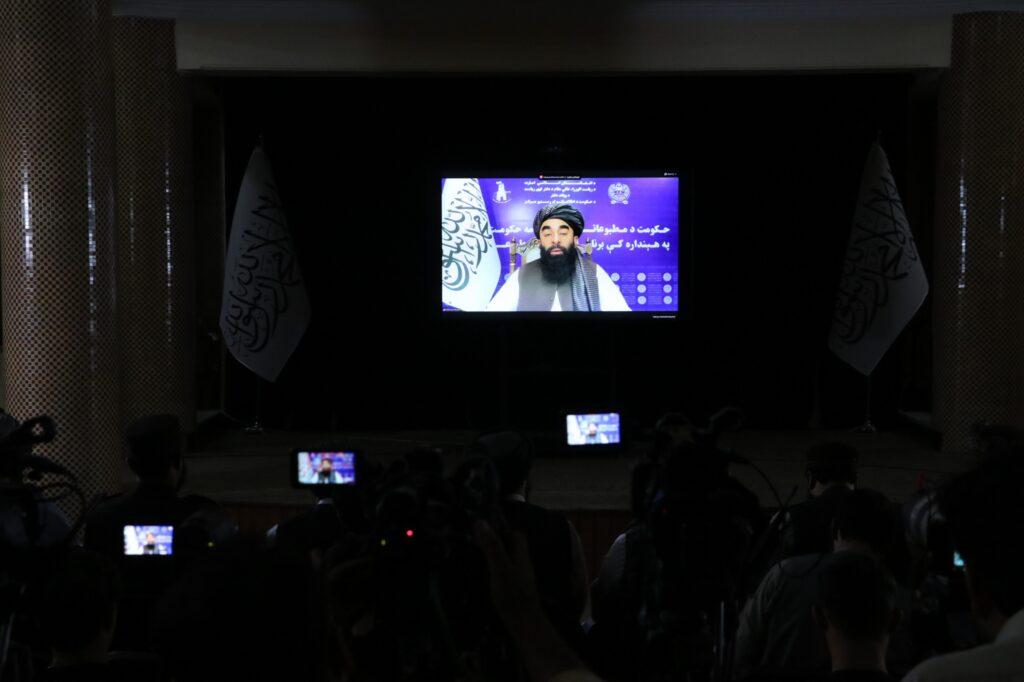
IEA chief spokesman Zabihullah Mujahid presented the activities of each institution separately through the “Government in the Media Mirror” programme, as follows:
Ministry of Communications and Information Technology
Services:
During 1447 Hijri, around 350 telecommunications antennas were activated in underserved and remote areas of the country using the ministry’s development budget, while work is underway to activate another 150 antennas.
In addition, 500 new telecommunications antennas were activated with financial support from telecommunications companies, bringing previously underserved areas under telecommunications and internet coverage.
Development of telecommunications infrastructure:
During the year, 851 kilometres of fibre-optic network were laid in various parts of the country to expand telecommunications infrastructure. E-Band frequencies were also allocated to telecommunications and internet service providers to improve the quality and capacity of telecommunications sites.
In addition, 2,932 telecommunications towers were constructed across the country with support from telecommunications companies, internet service providers and the Afghanistan Telecom Regulatory Authority (ATRA), and are being used to expand telecommunications and internet services.
Services for returnees:
To provide telecommunications facilities to returning Afghans, 491,126 SIM cards were distributed by ATRA and public and private telecommunications companies.
Employment:
During 1447 Hijri, 184,000 direct and indirect employment opportunities were created through the country’s telecommunications market.
Ministry of Economy
Operating licences:
During 1447 Hijri, 84 domestic and two foreign non-governmental organisations operating in the social, health, agriculture, irrigation, livestock, education and humanitarian sectors were issued operating licences as part of efforts to regulate the activities of non-governmental organisations in the country.
Employment:
As a result of the activities of domestic and foreign non-governmental organisations, 140,000 direct employment opportunities were created.
Ministry of Labour and Social Affairs
Work permits:
During 1447 Hijri, 62,739 work permits were issued to Afghan and foreign nationals. To facilitate the process, the issuance of work permits was also digitised, and distribution offices were expanded across the country’s zones.
In addition, based on labour-market needs, the ministry and partner organisations provided technical and vocational training to 45,355 people. Around 24,000 graduation certificates were also distributed to participants in technical and vocational training programmes.
Ministry of Interior Affairs
Passport issuance:
During 1447 Hijri, a total of 650,860 ordinary passports, 3,345 business passports and 512 student passports were issued to applicants.
During the same period, the visas of 16,717 foreign nationals were extended. Along with simplifying the process, the Passport General Directorate also provided the necessary facilities in this area.
Passport services:
To improve services and provide greater convenience, the registration process was moved online and reduced from nine pages to one.
A department for verifying paper identity documents was also established and made operational at the Passport General Directorate. Home delivery of passports was launched in Kabul and the provinces, while special facilities were provided for the elderly, students, traders, patients, pilgrims, people with disabilities, athletes and government employees.
In addition, technical equipment and other facilities worth a total of 154 million afghanis were procured to develop infrastructure and speed up operations. New buildings for passport offices were also constructed in Herat, Logar, Zabul and Khost provinces to expand services.
Driving licences and vehicle documents:
During 1447 Hijri, the General Directorate of Traffic issued 145,000 driving licences and documents for 388,000 vehicles.
As part of reforms to improve service delivery, the process for processing vehicle documents was reduced from eight steps to five, while the time required to issue documents was cut from around 10 days to one or two days.
Providing technical inspections in all provinces, simplifying the guarantee process, and digitising services and vehicle archives were among the major measures taken in this sector.
In 1404, the General Directorate of Traffic took extensive measures to improve traffic discipline, reduce accidents and regulate driving. These included painting roads and highways, road marking and lane management, installing traffic barriers, distributing containers equipped with traffic equipment, and establishing 24-hour mobile patrols.
Vehicles were also regularly inspected for roadworthiness before travelling, while overloaded vehicles, drivers’ and vehicles’ documents, health cards, cargo weights and other relevant matters were monitored. These measures played an important role in improving road safety and reducing traffic accidents.
National Statistics and Information Authority
Identity documents:
During 1447 Hijri, around two million electronic identity cards were distributed, including 1.5 million to men and 500,000 to women.
During the same period, nearly one million paper identity cards, including new and replacement cards, and 20,000 paper identity cards for nomads were distributed.
Last year, in-person services were provided to 139,000 people and online services to nearly 214,000 people for the correction of paper identity cards.
During 1447 Hijri, more than 126,000 birth certificates and around 25,000 death certificates were issued.
To provide greater convenience and speed up services, an Easy Service Centre was opened in the Shahr-e Naw area of Kabul last year, while four other centres became operational in Balkh, Herat, Helmand, Nangarhar, Kunduz and Farah provinces. Work to launch two additional Easy Service Centres in Farah and Kunduz provinces is also nearing completion.
Kabul Municipality
Urban management:
During 1447 Hijri, crowded areas of Kabul city were cleared of street vendors as part of efforts to regulate markets and improve urban order.
In addition, 13,970 businesses of various types were issued operating permits across Kabul’s 22 municipal districts. The municipality also identified 3,933 unlicensed businesses, while the activities of 4,884 businesses were temporarily suspended for violating price lists and they were given the necessary instructions.
Greening:
During 1447 Hijri, 531,580 saplings and ornamental flowers were planted to expand green spaces and improve the city’s greenery. Irrigation systems were also installed in various parts of Kabul to support the development of green areas.
Waste management:
During 1447 Hijri, 622,111 tonnes of solid waste were collected and transported to the Gazak area. During the same period, 27,305 metres of canals and 425,680 metres of roadside drainage channels were cleared and cleaned in various districts of Kabul.
Afghan Post State-owned Corporation
Delivery and services:
During 1447 Hijri, Afghan Post facilitated the delivery of more than five million domestic items and 5,853 parcels to foreign countries.
The figure included 2,677,243 official government items, 22,184 personal items, 812,226 passports and 1,277,634 electronic identity cards.
In addition, Afghan Post provided services related to the verification of 193,884 educational and academic documents submitted by the Ministry of Higher Education, Ministry of Education and the Technical and Vocational Education and Training Authority, as well as the authentication of 234,733 various documents by the Ministry of Foreign Affairs.
To improve services and provide greater convenience, regular and express service departments and a customer service centre were established. Home delivery of documents was also launched in Kabul and the provinces.
sa