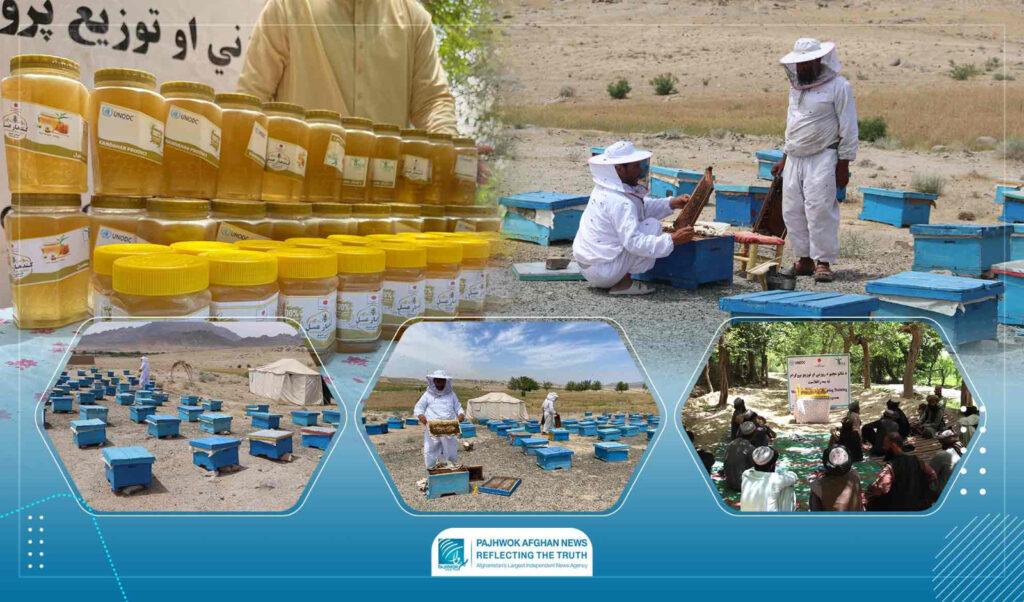

KANDAHAR CITY (Pajhwok): A number of farmers in Shah Wali Kot district of southern Kandahar province say their economic conditions have improved after receiving honeybee colonies and starting honey production.
They say continued support for such initiatives could discourage farmers from turning to illegal cultivation.
Mohammad Hanif Haqmal, spokesman for the Kandahar Department of Agriculture, Irrigation and Livestock, told Pajhwok Afghan News the beekeeping project was launched as an alternative to narcotics cultivation, aiming to provide farmers with lawful and sustainable sources of income.
He said the United Nations Office on Drugs and Crime (UNODC) distributed honeybee colonies to 20 low-income farmers in Shah Wali Kot district about five months ago, and the beneficiaries have now started harvesting honey.
“We are trying to create alternative opportunities for farmers that generate legal income and help ease their economic difficulties,” Haqmal said. “Beekeeping is well suited to Kandahar’s climate and has already shown encouraging results.”
Qudratullah Bahadar, UNODC’s livestock officer, said the initiative is part of an alternative livelihoods program designed to create sustainable and lawful economic opportunities for farmers.
He said around $16,000 had been invested in the project, adding that efforts were underway to encourage economically vulnerable families to adopt reliable sources of income.
One farmer from Shah Wali Kot, Mohammad Awaz Mardan, said the project had significantly improved his family’s financial situation.
“We previously struggled economically, but now we are earning an income through honey production,” he said. “Pomegranate blossom honey is of high quality and sells at good prices.”
Another farmer, Abdul Rahman, said beekeeping had given local farmers renewed hope, but emphasized the importance of continued support.
He told Pajhwok they had produced pomegranate blossom honey for the first time and believed that if similar programs continue, farmers would no longer need to cultivate poppy or other narcotic crops.
According to the farmers, they have so far collected dozens of kilograms of honey, although some hives have yet to be harvested.
They said one kilogram of honey sells for between 600 and 800 afghanis, while pomegranate blossom honey fetches about 300 afghanis more per kilogram due to its distinctive quality.
Honey production specialist Engineer Mohammadullah Noori said Kandahar’s climate is highly suitable for natural honey production, with honey from basil, palosa, green shrubs, and pomegranate blossoms commonly produced across the province.
“Kandahar’s climate is very favorable for honeybees,” he said. “The bees gather nectar from a variety of flowers here, especially basil flowers, whose honey is particularly well known.”
Economic analysts also believe that alternative livelihood programs not only help reduce narcotics cultivation, but also strengthen rural household economies, create employment opportunities, and stimulate local markets.
Following the decline in narcotics cultivation in Kandahar, the Agriculture Department has also promoted saffron, asafoetida, mushrooms, as well as amlook and pistachio orchards, as profitable alternative crops.
sa