
KABUL (Pajhwok): The Ministry of Industry and Commerce (MoIC) says that over the past five years, the number of factories in Afghanistan has increased from around 3,000 to 6,500, providing employment for nearly 450,000 people in the industrial sector overall.
However, economic experts identify shortages of electricity and capital, inadequate transportation infrastructure, and a lack of skilled labor as among the major challenges facing the sector.
The Islamic Emirate of Afghanistan (IEA) returned to power on August 15, 2021, and five years have now passed since then. In this report, Pajhwok Afghan News examines the state of Afghanistan’s industrial sector during this period.
Increase in the number of manufacturing factories
Qari Mohammad Asif Elias, spokesperson for the Ministry of Industry and Commerce, told Pajhwok that around 3,000 factories were operating in the country before the Islamic Emirate returned to power.
Over the past five years, however, the number of active factories has increased to 6,500, and they are now operating in all provinces of the country. According to him, most factories are located in Kabul, Herat, Balkh, Kandahar, and Nangarhar.
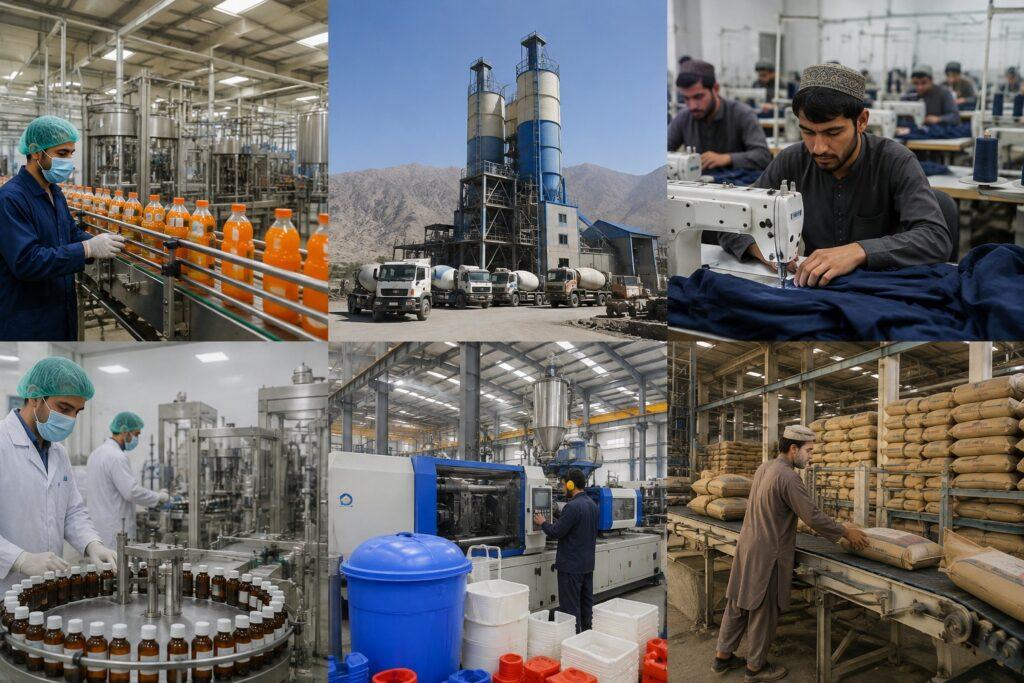
He said these factories operate in sectors including food, plastics, cement, construction materials, pharmaceuticals, cleaning products, machinery, agriculture, iron smelting, PVC, soft drinks, petroleum products, clothing, furniture, stone, ceramics, and other industries.
Asif Elias said: “Overall, nearly 450,000 people have been provided with direct employment in the industrial sector.”
He attributed the increase in domestic production to efforts to reduce Afghanistan’s dependence on countries within and outside the region, saying that Afghanistan has now achieved self-sufficiency in the production of 330 types of goods.
According to him, several years ago, Afghanistan even imported products such as ice cream, soft drinks, and similar goods from abroad. Today, however, a number of the hundreds of products manufactured domestically—including non-alcoholic beverages—are being exported to several Asian countries, the United States, Europe, and other regions.
He added: “Currently, around 40 percent of medicines are produced and consumed domestically.”
Impact of the increase in factories on the economy
Economic affairs expert Abdul Nasir Rishtia described the increase in manufacturing factories as important for strengthening the country’s economy. He said countries with high production capacity also have stronger economic and political positions.
He said an increase in manufacturing factories can reduce the outflow of foreign currency to pay for imports and lessen Afghanistan’s dependence on imported goods.
According to Rishtia, when goods that were previously imported are produced domestically, the money spent on imports remains in circulation within the country, employment opportunities expand, and economic growth is strengthened.
Another economic expert, Qais Mohammadi, also described the increase in factories and domestic and foreign investment as important for Afghanistan. He said increased domestic production could reduce Afghanistan’s dependence on neighboring countries for imports.
He added that as domestic production increases, goods that were previously imported can be manufactured inside the country, which can contribute to increases in gross domestic product and per-capita income.
According to Mohammadi, the more investment increases in the country, the more employment opportunities expand and the poverty rate can decline.
He added that increased investment and domestic production could also increase government revenues, as the expansion of economic activity leads to higher tax revenues.
Mohammadi said increased domestic production also reduces the outflow of dollars from the country.
He explained: “The greater domestic production becomes, the fewer dollars leave Afghanistan. For every product we import from other countries, we have to pay in dollars, and every dollar that does not leave the country can contribute to investment inside Afghanistan.”
According to him, the circulation of money within the country can help increase incomes and improve people’s economic conditions.
Challenges facing the industrial sector
Mohammadi said investors in Afghanistan face a number of challenges, including shortages of electricity and energy, transit and transportation problems, a lack of capital, and weaknesses in the banking system.
He added that the lack of sufficient and affordable electricity increases production costs because some producers are forced to generate the electricity they need themselves.
According to him, Afghanistan’s transportation infrastructure is also insufficient, and the lack of affordable transportation options—particularly railways—has resulted in raw materials and products being transported by trucks.
This comes as road construction projects are ongoing in various parts of the country.
Mohammadi also identified a shortage of capital and investment as another constraint, saying that the banking system has still not been fully developed and that providing loans to investors remains difficult.
He further said that some of Afghanistan’s skilled workforce has left the country, and the lack of sufficient efforts to retain these workers has negatively affected the country’s productive capacity.
Manufacturers: Domestic production has increased, but electricity shortages remain a problem
Ibrahim Amarkhel, deputy head of Alif Pearl Pharma, said construction of the pharmaceutical factory began in 2018 and that it was inaugurated and became operational in 2024. He added that around $20 million has been invested in the factory and that it currently provides direct and indirect employment to around 500 people.
According to Amarkhel, the factory has five production lines for various medicines and has the capacity to produce 50,000 bottles of liquid syrup, 30,000 bottles of dry syrup, two million capsules, two million tablets, and 20,000 sachets of dry powder each day.
He added that following restrictions on Afghanistan’s trade relations with Pakistan, the Afghan market has become largely dependent on domestic production, particularly pharmaceuticals. According to him, more than 80 percent of the country’s pharmaceutical needs had previously been met through imports from Pakistan.
He said this situation has helped standardized factories increase and expand their production levels.
However, Amarkhel identified the lack of a stable and sufficient electricity supply and delays in the arrival of pharmaceutical raw materials as major problems facing drug manufacturers in the country.
Wahibullah Fazli, general manager of the Tahsin Pirzada Factories Group, said the group was established in Kabul in 2019 and operates in the production of non-alcoholic beverages and healthcare products.
Fazli said conditions for industrialists have improved compared with the past and that increased security and stability in the country have created better opportunities for factories and domestic investors to operate.
He added that this situation has enabled industrialists to make plans with greater confidence to expand their activities.
According to Fazli, one of the positive changes has been increased attention to domestic products, and there are now favorable opportunities for the growth of domestic industries.
However, he also identified electricity shortages and the lack of a reliable power supply as major problems for industrialists. He said factory operations are heavily dependent on electricity and that shortages increase production costs and disrupt factory operations.
He also identified high raw material prices and the cost of transporting materials from abroad as other challenges for industrialists. He said increasing people’s purchasing power and providing greater support for domestic products could help boost sales and expand factories.
In response to Pajhwok’s questions about the problems faced by industrialists, Ministry of Industry and Commerce spokesperson Mohammad Asif Riyaz said the ministry’s leadership had raised the issue of electricity shortages with the leader of the Islamic Emirate.
He added that the leader of the Islamic Emirate had instructed government institutions to install solar power systems so that reliance on government-supplied and imported electricity could be reduced and more electricity could be allocated to factories.
However, he did not provide information regarding the high prices of raw materials or transportation costs.
sa