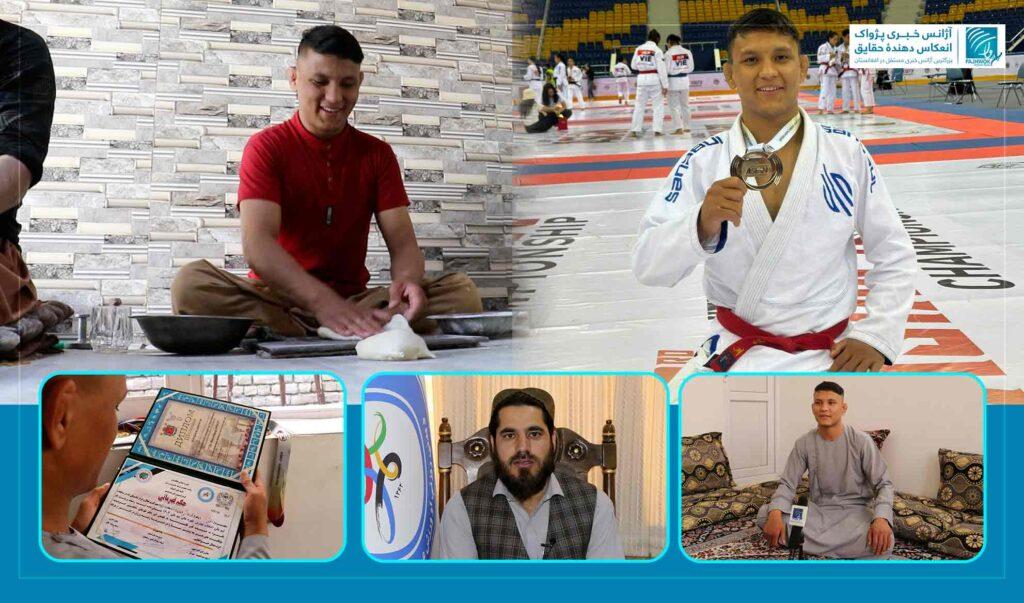

KABUL (Pajhwok): Mustafa Wakili, a 25-year-old Afghan jujitsu athlete, says he works at a bakery to cover his living expenses and support his family while training and participating in competitions. Despite financial difficulties and a lack of facilities, he has no intention of giving up the sport.
Wakili is originally from Shewa district of central Bamyan province and currently lives in Kabul city. He has been involved in jujitsu for the past nine years and says he continues to train despite financial difficulties and inadequate facilities.
He studied up to eighth grade at a school in Bamyan but was unable to continue his education due to financial problems. He then started working to contribute to his family’s income.
Every day, he works from 8:00am to 4:00pm at a bakery near his home, where he is involved in kneading and preparing dough for bread.
Beginning his sporting career
Mustafa Wakili, who took up jujitsu in 2017, said he became interested in the sport because his elder brother, Mehdi Wakili, was also a jujitsu athlete.
“Jujitsu is a Japanese sport. I was also interested in it, and my elder brother, who was my role model and travelled abroad, encouraged me to take up the sport,” he said.
Recalling the days when his elder brother returned from competitions abroad and people gathered to welcome him, Wakili said: “At that time, I would say to myself, ‘O God, when will I return from a competition abroad and have people, my mother and father come to welcome and encourage me?’ Thank God, my wish came true, and when I returned from a competition, people came to welcome me.”
Winning medals in international competitions
Wakili has competed in different weight categories, from 33kg to 69kg, and now competes in the 56kg category as a member of the first team in the sport.
He said that, in addition to domestic competitions, he had participated in several international events and achieved good results.
He said his first international competition was held in St. Petersburg and Moscow, where he won a bronze medal.
Wakili also participated in a jujitsu competition in China in 2022, where several world champions competed. However, he failed to win a title because the level of competition was very high.
He also recalled participating in a jujitsu competition in Almaty, Kazakhstan, where he won a bronze medal.
According to him, three Afghan athletes participated in the competition, which brought together athletes from 28 countries.
Wakili described his Kazakh opponent as one of the toughest opponents he had faced so far.
He said he trained for one month to prepare for the competition in Kazakhstan and trained three times a day during his preparations.
Wakili stressed that the medals he had won might seem ordinary to others, but he had endured many difficulties to win each of them.
Family support
Wakili considers his family’s support one of the main factors behind his continued involvement in sport. He said his parents’ prayers and the support of his sisters, brothers and wife had always been with him.
He added that his family was happy and proud of his achievements and that his elder brother was currently working and supporting the family so that they could continue pursuing their sporting careers.
Lack of facilities and training difficulties
Wakili pointed out that athletes needed proper nutrition for training and competition preparation, but providing suitable conditions for some athletes in Afghanistan was difficult.
He added that before each competition, athletes had to lose weight, which brought its own challenges alongside intensive training.
Although his sporting career is now intertwined with his work at a bakery, he stressed that he would continue training and participating in competitions and hoped to achieve his major goals in jujitsu in the future.
He stressed: “It is very difficult in Afghanistan, but I am continuing with sport. I still have goals, I will continue and I will never give up this sport.”
Speaking about his financial difficulties, he added: “We athletes also work to earn a living and support our families, but athletes in other countries only do sport and devote all their attention to their training.”
He urged officials to establish a training centre for athletes in the sport so that they could train there before competitions.
Officials’ response
Atal Mashwani, spokesperson for Afghanistan’s General Directorate of Olympic, Physical Education and Sports, told Pajhwok that the country’s sports administration had always supported Afghan athletes.
He explained that all competitions, including selection events at provincial and district levels as well as national-level competitions, were held with the support and cooperation of the sports administration. He added that training camps were also organised for athletes participating in competitions abroad, providing them with the necessary training opportunities to prepare better.
Mashwani noted that athletes who achieved results in international competitions were encouraged by the sports administration, and special programmes were arranged for them.
He added that such encouragement included both moral and material support.
Acknowledging the economic problems faced by athletes, Mashwani said: “We accept that Afghan athletes face economic difficulties to some extent. We are trying to support athletes through various means, particularly in cooperation with the private sector, so that some of their economic problems can be addressed.”
kk/sa