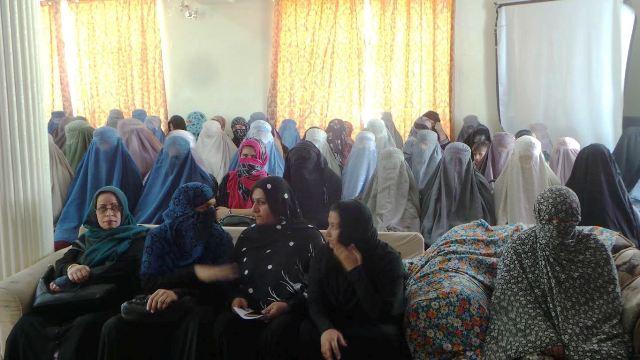

KANDAHAR CITY (Pajhwok): The women affairs officials in southern Kandahar province say women in the provincial capital had little access to some facilities, but they were deprived of any facilities in rural areas.
Ruqia Achakzai, the provincial women affairs director, in an exclusive interview with Pajhwok Afghan News, said that women’s life condition in Kandahar city was somehow good, but they were faced with many problems in rural areas.
Violence against women in rural area was a serious problem because women have been deprived of most of basic rights such as education, inheritance and healthcare services, she said.
There is no a single girl school in remote districts except in some nearby areas to Kandahar city which created a tragedy for the society, Achakzai said, adding that some families even in Kandahar city did not allow their daughters to seek education after they grew adult.
“Around 30 percent of women in Kandahar getting education but unfortunately more than 4,000 female students are prevented by their families to get education every year and some have to leave their classes incomplete,” she said.
Girl’s education in Kandahar was hampered by multiple challenges including the issue of restriction imposed by their families, she added.
On the other hand, Achakzai said that most of women in districts were deprived of healthcare services as the women there were not shifted to hospitals until they reached to the serious condition.
There was either limited number of clinics or the families do not shift their female patients to the healthcare centers on time, therefore most of women lost their lives.
In addition, many women with 80 percent of them in districts suffered from family or social violence, Achakzai added, 198 cases of violence against women had been registered with her office this year which showed an increase compared to the past.
Murder, denial of a share in inheritance, elopement, child marriage, force marriage and others are among the cases happened with women, she said.
She linked increase in such cases to ongoing conflict, joblessness, low education level, cultural extremism and other similar issues in the country.
Achakzai said that the number of women officers were also limited in Kandahar due to security problems and bad traditions.
The number of female workers was high only in the education and health sectors compare to other areas, she added.
Currently 200 women had been working in government departments and 534 in non-governmental offices, she said. In military, 75 women worked as soldiers, eight as officers, 36 as sergeants, seven as captains and six others as intelligence officers.
She said that currently 18 girls’ schools were active in Kandahar city where more than 61,000 girls were getting education by 900 female teachers.
However, she said that needed facilities were still not available so women felt unsafe during their duties with the government organs in Kandahar.
She said that a recent security incident in Kandahar in which five female workers of Kandahar Airport had been killed, left negative impact on women workers.
The women and their driver who were working in Kandahar Airport civil terminal were killed by armed men when heading to their duty from home in Kandahar City on December 17.
Lack of proper job environment for women was another problem, she said, adding that one or two women did not show interest to work in an office with a large number of male workers.
Kandahar women, civil society activists and independent human rights commission also believed that the women’s situation was faced with problems in the province.
Kandahar Independent Human Rights Commission deputy head, Fakhruddin Faiz, said that women had been id difficult condition and their social problems were on the rise.
“There maybe two facts; either the violence against women has increased or women are now more aware and share their problems with judiciary and security organs,” he said.
However, he said that the number of violence against women were still on the rise and efforts were needed to control them.
Muska, 35, a resident of Kandahar city, said that there were hundreds of educated women in Kandahar but they could not work due to the lack of a safe environment.
The first requirement for women workers was a security which did not exist, she said, adding that some people also did not allow their female family members to work in offices in Kandahar.
Wafa, a resident of Maiwand district of the province, said that women in districts had access to very limited facilities. “Women here are only for the house or for the grave,” she said.
Women are not seen even as a human in most families, women should work as a servant and whenever they fall ill no one would take them to hospital for treatment until they getting close to death, she said.
Wafa added that preventing women to get education was another problem. Some families even do not let their sons to get education, she said.
She added that she personally sent her children to Kandahar city for getting education. Some families with poor economy or patriarchy do not allow their daughters to get education.
Rangina Ahmadi, a civil society activist in Kandahar city, said that women were also faced with economic problems as their handicrafts market had turned cold.
She said that a company named Kandahari Khazana, she opened few years ago for promoting women handicrafts in Kandahar was now faced with collapse.
She said that previously 500 women were working in producing handicrafts in Kandahar city and districts and 20 other women in designing and processing with the company. Ahmadi said that 300 of the women were recently fired due to absence of market.
Kandahar women affairs officials and women civil society activists asked the government and the international community to help women and improve their livelihood.
mds