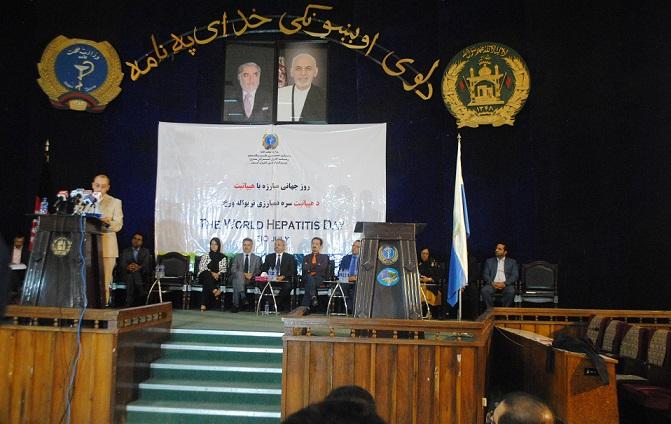
KABUL (MoPH) on Monday expressed concern about increase in the number of patients infected with different types of hepatitis disease in the country, asking the people to test their blood to be sure.
Marking World.”
He said decades of conflict, open borders, low literacy, poverty, economic problems, social restrictions, internal displacement, migration and use of narcotics were factors behind the surge in hepatitis diseases.
Blood of 12 million people tested in Afghanistan over the last seven years showed 40,000 people were infected with hepatitis-B and around 18,000 with hepatitis-C, he added.
Firoz said the World Health Organization and the UN had developed a program to reduce hepatitis-B vases to lowest level in Afghanistan until 2030.
According to reports, around 300 million people around the world carry hepatitis virus and 1.5 million of the infected lose their lives each year.
The MoPH said around 5,000 people were given anti-hepatitis-B vaccine in 1396 solar year and 6,000 others would be administered this year.
Minister Firoz said his ministry has for the first time started implementation of anti-Hepatitis-B vaccination for 20,000 people in the country.
According to health officials, the MoPH has launched hepatitis prevention services in 16 provinces including Kabul, Herat, Balkh, Kandahar, Nangarhar, Kunduz, Ghazni, Badakhshan, Kunar, Paktia, Helmand, Parwan, Khost, Nimroz, Farah and Daikundi.
Dr. Naqibullah Hamdard, head of National AIDS Control Program at MoPH, talking about the ministry’s future plans, said: “The MoPH is committed to implementing the WHO contract about prevention and diagnosis of hepatitis in cooperation with international organizations.”
“Improving public awareness about the transmission and prevention of hepatitis, collection of figures and information for managing the program and decision making, prevention of the disease from being transmitted to other people and providing treatment services for those infected are part of MoPH programs,” he said.
Dr. Rik Peeperkorn, WHO representative for Afghanistan, who attended the ceremony, said hepatitis virus mostly targetted refugees and those using narcotics.
He hoped the disease would be eliminated with the help of international community in Afghanistan until 2030.
mds/ma
GET IN TOUCH
NEWSLETTER
SUGGEST A STORY
PAJHWOK MOBILE APP