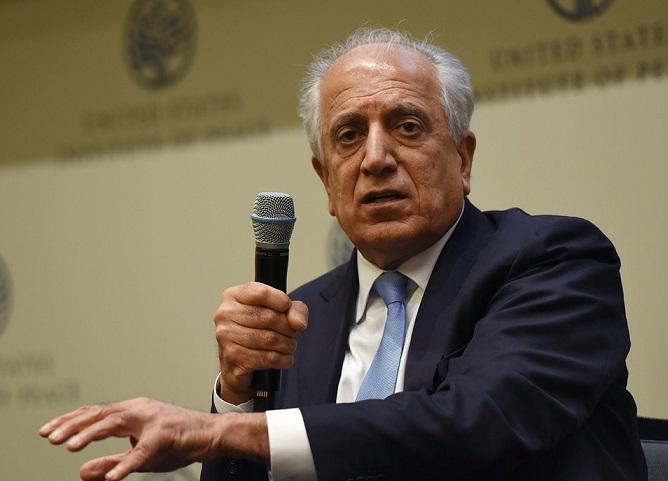

KABUL to re-establish an Islamic emirate is a red line for the international community.
In a free-wheeling interview an Afghan TV channel ToloNews, the American diplomat said on Wednesday there was international consensus on the issue of preventing Taliban reviving the Islamic Emirate. “So I don’t think this will happen.”
Speaking to TOLO News on Wednesday, the envoy touched on a variety of topics related to the US-Taliban peace agreement, including counterterrorism operations, intra-Afghan talks a prisoner exchange and the current political deadlock between Ashraf Ghani and Abdullah.
Intra-Afghan talks:
“In order to end the war, there is a need for a compromise to reach a political settlement,” he said. “I personally hope this issue (intra-Afghan negotiations) will be resolved within 100 days. We want this issue to be resolved during the first phase of the withdrawal of US forces from the country…”
The ambassador, however, explained the pullout of all US troops from Afghanistan in 14 months was condition-based. The agreement will open the door to intra-Afghan talks, he hoped. “I think this will happen, but we can only celebrate after it is completed.”
About the Taliban pact, Khalilzad said: “If an agreement (peace agreement between Afghans) is reached for a dignified and longstanding peace, then the day the US-Taliban agreement was signed will be remembered as an important event in the modern history of Afghanistan.”
Terrorism:
The Taliban, as part of their commitments held out in the peace deal, assured the Americans they would fight against terrorism and keep Al Qaeda elements out of Afghanistan.
Asked if the US and Taliban would fight together against Al Qaeda, he replied: “We have reached an agreement on how they (the Taliban) will deal with such issues. We have joint channels in Doha where meetings are held on a daily basis…”
To the question whether the US provided financial assistance to the Taliban to fight terrorism, Khalilzad said: “Currently we are not providing any money to the Taliban.”
US withdrawal:
He was reluctant to delve into the US troop withdrawal from Afghanistan for security reasons, because there were domestic and external elements, who wanted to impede successful implementation of the agreement.
He called the Afghan government a legitimate and strategic US partner, saying that the Taliban were at and thus it would be better to end the conflict through intra-Afghan talks.
Ceasefire:
In line with the US-Taliban treaty, the scale of the war should be reduced, saying they wanted to see whether the Taliban could rein in violence and honour their pledged.
Khalilzad warned: “If they (the Taliban) launch attacks on Afghan forces, we will be there to defend the Afghan forces), so we are mounting pressure on the Taliban to not resort to violence.”
Under the agreement, he said, a ceasefire would be enforced once the Afghan government and the Taliban sat down across the negotiating table. After a political agreement was reached, there would be a permanent ceasefire, the envoy added.
Prisoners:
Khalilzad said: “The Taliban wanted 5,000 of their prisoners to be released by the government — out of 13,000 to 14,000 prisoners — on the day of talks, to build trust, or to create a conducive environment for talks.”
In response to its demand, the US told the rebel movement they were prepared to help in this matter, said Khalilzad.
Negotiating team:
He believed sending a single team for talks with the Taliban would be better. The ambassador said he had talked about it with various sides. Despite problems in the political sphere, everyone preferred one team for talks, he claimed.
Election crisis:
The diplomat claimed trying his best to create an understanding between Ashraf Ghani and Abdullah before they took oaths at parallel ceremonies on Monday. However, he said, the political foes had enough time to sort out their differences.
Despite his strenuous efforts, Khalilzad acknowledged he could not convince them to reach a conclusion. Both sides told him they wanted to talk out their rifts. “We are seeking ways to find a solution to the issue.”
He was confident that Ghani and Abdullah had the intention to find a solution, as the whole world, including the Afghan people wanted them to give peace a chance.
Political differences between the two sides could undermine the peace process and the security of Afghanistan, Khalilzad argued. “It’s the time for the two sides to focus on the interests of Afghanistan.”
pk/mud