

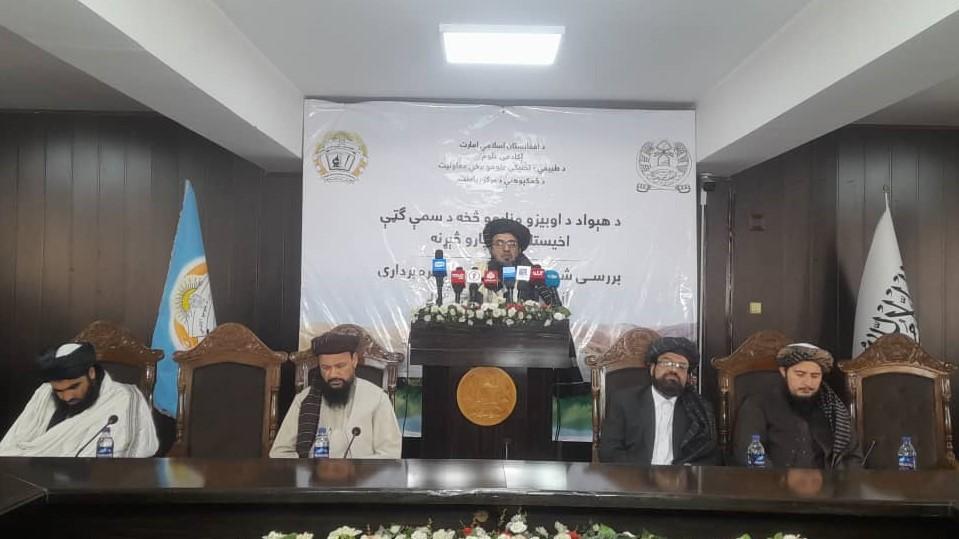

KABUL (Pajhwok): Participants of a scientific-research seminar in Kabul on Wednesday emphasized the importance of water management, conservation, and construction of large-scale infrastructure in the sector.
They said a proper management of water resources could strengthen regional economic cooperation.
The seminar, titled “Research on Ways to Properly Utilize the Country’s Water Resources”, was organized by the Academy of Sciences of Afghanistan.
Maulvi Amir Jan Saqib, deputy head of Afghanistan Academy of Science, said the seminar was organized in light of the country’s agricultural situation, drought, and other factors, with the goal to improve management of the sector.
He said: "The Islamic Emirate of Afghanistan, in a responsible manner within the framework of a responsible government, is committed to addressing vital national issues that affect both men and women of the country. The Ministry of Water and Energy, as well as all concerned parties, are working tirelessly day and night to solve this problem. They are making efforts to build both large and small dams”."
The Deputy Head of the Office of the Prime Minister, Qari Abdul Satar Saeed, read out a message from Prime Minister Mullah Mohammad Hassan Akhund, which said: "It is important to value every blessing, especially water. Since the country is experiencing drought, water management must be prioritized. Proper water management can improve the economic situation and lead to self-sufficiency."
The message emphasized that proper water management was crucial as improper use could lead to a host of problems.
Acting Minister of Water and Energy, Mullah Abdul Latif Mansoor, also spoke at the seminar, stressing that Afghanistan, being an agricultural country, required large amounts of water. Therefore, proper management of water resources was vital for farmers and the country as a whole.
He elaborated on government's efforts regarding water management: "In a meeting of senior officials, it was decided that if we cannot build large dams, we will build a check dam in each district to control floodwaters and store water. “
“This will also rejuvenate our springs, qanats, and irrigation systems. Approximately 355 check dams, which we assigned to three ministries, are nearing completion, with very little work remaining."
He said the ministry had already invested millions of dollars in large dams, some of which had been incomplete for years.
He cited the examples of Kamal Khan and Shah Wa-Aros dams, which are now nearly finished and will be inaugurated soon.
He also pointed out that the underground water resources in Afghanistan are being misused and wasted. He emphasized that Islam mandates water conservation and prohibits waste.
Deputy Minister of Foreign Affairs Mufti Mahbullah Wasiq read out a message from the ministry, which stated: "Since water is a major national asset, it is essential to manage Afghanistan’s water resources sustainably. Furthermore, in the 21st century, the significance of water in national policies, along with the anticipated impacts of climate change and growing domestic demand for water, requires the development of large-scale infrastructure projects."
The message stressed that proper water management could strengthen regional economic cooperation, improve cultural and economic ties, and contribute to better relations between neighboring countries.
He also added that Afghanistan had not made adequate use of its river waters, and as a landlocked country, it was crucial to invest in large-scale infrastructure to fully benefit from its water resources.
He noted: "Shared waters between countries can become a means of cooperation. Proper water management and collaboration can serve as a tool for peace and stability in Afghanistan’s relations with its neighboring countries. This kind of cooperation, which is effective and cross-sectoral, will be achieved through strong infrastructure."
Dr. Ahmad Shah Omar Wardak, a senior researcher at the Academy of Sciences, presented a scientific paper titled The Vital Importance of Water and Best Practices for its Use.
He said that water, after oxygen, is one of the most vital substances for life. He further added that, although the earth appears blue and covered with water when viewed from space, much of this water is not usable. Every possible effort must be made to conserve water.
He explained: "Out Earth’s 510 million square kilometers of surface area, nearly 350 million square kilometers are covered by water, while the remaining 150 million square kilometers are land. Despite this, the supply of fresh water requires significant investment, as 97 percent of the earth's water is in oceans and is salty, making it unusable.
Only two percent of the Earth's water is locked in polar ice caps, and it is not accessible, leaving only 1percent of the Earth's water as fresh and usable."
He called on every Afghan to conserve water, suggesting that if each person saved just one liter of water per day, it would result in a total saving of 40 million liters of water across Afghanistan each day.
sa/ma


GET IN TOUCH
NEWSLETTER
SUGGEST A STORY
PAJHWOK MOBILE APP