

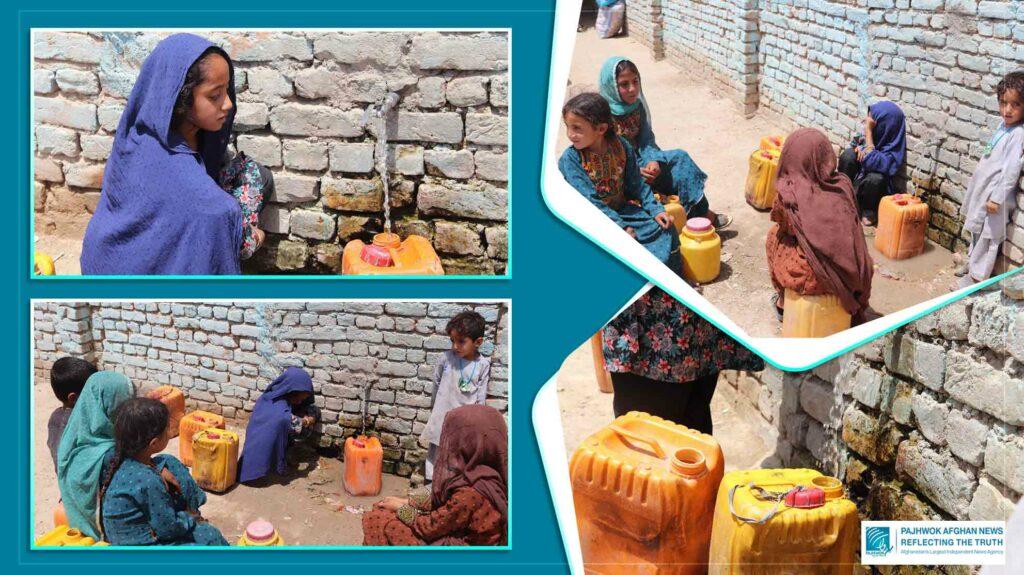

KANDAHAR CITY (Pajhwok): Residents of Kandahar city, the capital of southern Kandahar province, report groundwater levels have plummeted beyond 100 meters, with most wells having dried up.
Locals now face severe difficulties in accessing water, either by transporting it from distant areas or purchasing it at high costs.
In recent years, Afghanistan has faced a worsening drought, significantly impacting water availability for drinking, agriculture and livestock.
Kandahar is among the provinces most affected, where many residents lack access to clean drinking water.
Mohammad Akram, a resident of 9th municipal district in Kandahar city, told Pajhwok Afghan News: “We initially had a 50-metre-deep well at home, which dried up. We then dug a 120-metre-deep well, but that too dried up within a year. We can no longer afford to dig another one, so now we fetch water from elsewhere, which is very expensive.”
He added that this year, groundwater levels in many areas of Kandahar city dropped beyond 100 metres, compared to about 70 metres last year.
“If this issue is not addressed, the situation will more worsen in coming years,” he warned.
Hayatullah, an inhabitant of 11th municipal district, said: “We neither have a well nor access to piped water at home. Previously, we used to collect water from a nearby well, but it has also dried up. Now we have to buy water from tankers, which costs 500 to 600 afghanis per delivery.”
He explained that the water was stored and used over a period of two to three weeks.
Syed Anwar, from the 10th district, said he could not afford to purchase water. With all nearby wells dried up, his children were forced to walk nearly a kilometre each day to fetch water from a mosque.
“They carry the water in jerry cans, which sometimes causes them hand pain,” he said.
Eleven-year-old Gulsima, a resident of the 9th district, said she walks hundreds of metres daily to fetch water.
“My hands and feet sometimes ache, especially during the intense midday heat. I don’t want to fetch water, but my mother insists because we have none at home. So, my sister and I go every day,” she said.
Meanwhile, Deputy Director of Water Supply Department of the province Eng. Niaz Mohammad said only about 16,000 households have access to piped drinking water in 11 municipal districts of the provincial capital.
“While piped water systems exist in parts of the city, many residents rely on private wells. However, even these are failing due to rapidly falling groundwater levels,” he added.
He blamed unregulated and unauthorised well drilling for the sharp decline in water levels.
“Although the government has banned unlicensed drilling, some people continue to do so. Public cooperation is essential to tackle this issue,” he stressed.
He said permits for drilling wells were now only issued in areas facing extreme need. Since last year alone, groundwater levels in Kandahar reportedly dropped by around 30 metres.
Environmental affairs expert Engineer Mohammadullah Noori said that five years ago, groundground in Kandahar was found at depths of 20 to 30 metres — far less than current levels.
“This drastic decline is due to poor water management, decreased rainfall, and environmental changes,” he said.
He recommended banning deep-well drilling, harvesting rainwater, supplying water through piped systems, and regulating well-drilling in districts.
Noori also called for public awareness campaigns on water conservation and highlighted the expansion of the Dahla Dam project — including a water supply initiative for Kandahar city — as vital to mitigating the crisis.
These concerns come amid warnings from the National Environmental Protection Agency, which said early last year that 21 million Afghans were facing shortages of clean drinking water due to climate change.
kk/ma


GET IN TOUCH
NEWSLETTER
SUGGEST A STORY
PAJHWOK MOBILE APP