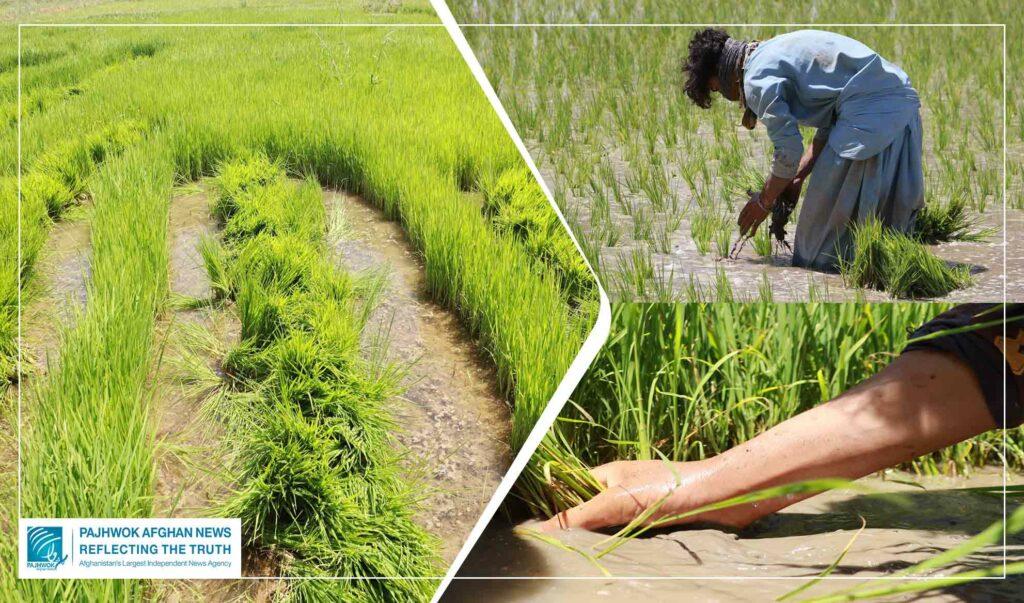

HERAT CITY (Pajhwok): The prolonged drought and declining groundwater levels have led to a sharp decline in rice cultivation across western Herat province, fueling concerns among local farmers.
Several rice growers told Pajhwok Afghan News that due to the worsening water crisis and rising fuel costs, they are unable to irrigate their fields using water wells — their primary alternative to traditional irrigation systems.
Sharif Ahmad, a farmer in Guzara district who supports a 12-member family through agriculture, said his rice cultivation decreased significantly this year.
“This year, the land I planted with rice is far smaller than last year,” he said. “Most farmers in the district have also reduced rice planting due to drought and a lack of water.”
Ahmad noted that rice cultivation in Guzara has dropped by nearly 70% compared to the previous year, blaming it on the closure of the Salma Dam and a steep decline in groundwater levels.
Sayed Abdullah, another rice farmer in Guzara, said that although water levels are low, he was compelled to grow some rice because other crops have yielded poor returns.
“Last year, I cultivated two and a half jeribs (about 1.25 hectares), but this year I planted just one jerib. I hope to harvest around one and a half tons of rice,” he said.
Abdullah also expressed concern over the rising prices of fuel, fertilizer, and pesticides, which have made farming increasingly unaffordable. “Many farmers simply can’t afford the high costs of cultivation,” he added.
In Injil district, farmer Mohammad Naeem voiced frustration over the low market price of locally grown rice compared to cheaper imported varieties.
“We invest heavily in rice farming, but sell our harvest at rock-bottom prices,” he said, noting that while he planted 12 jeribs of rice last year, this year he could manage only five.
He added that despite the superior quality of local rice, it still fetches a lower price than imported one.
Meanwhile, agricultural expert Engineer Shafi Rahmani warned that rice farming is accelerating the depletion of water resources. He advised farmers to shift toward drought-resistant and high-income alternatives.
He recommended crops such as henna and hing (asafoetida), which require less water and hold strong commercial value.
“Given the current water scarcity, these crops can provide sustainable income while conserving precious groundwater,” Rahmani said. “Farmers must move away from water-intensive crops to help mitigate the effects of the drought.”
Officials at the Herat Directorate of Agriculture, Irrigation, and Livestock confirmed a sharp decline in rice cultivation across the province.
Bashir Ahmad Ahmadi, the director of agricultural promotion, said that due to water shortages, rice cultivation this year has fallen to 1,500 and 2,000 hectares — down from 3,149 hectares last year.
He added that most of the remaining rice fields are located in the districts of Guzara, Injil, Chesht, and Obe.
Ahmadi emphasized that the directorate is working to support affected farmers and promote sustainable agricultural practices.
This decline follows a 2023 (1402) government decision to ban rice cultivation in Herat and several other provinces due to extreme drought and high water demand for rice farming.
sa/ma