

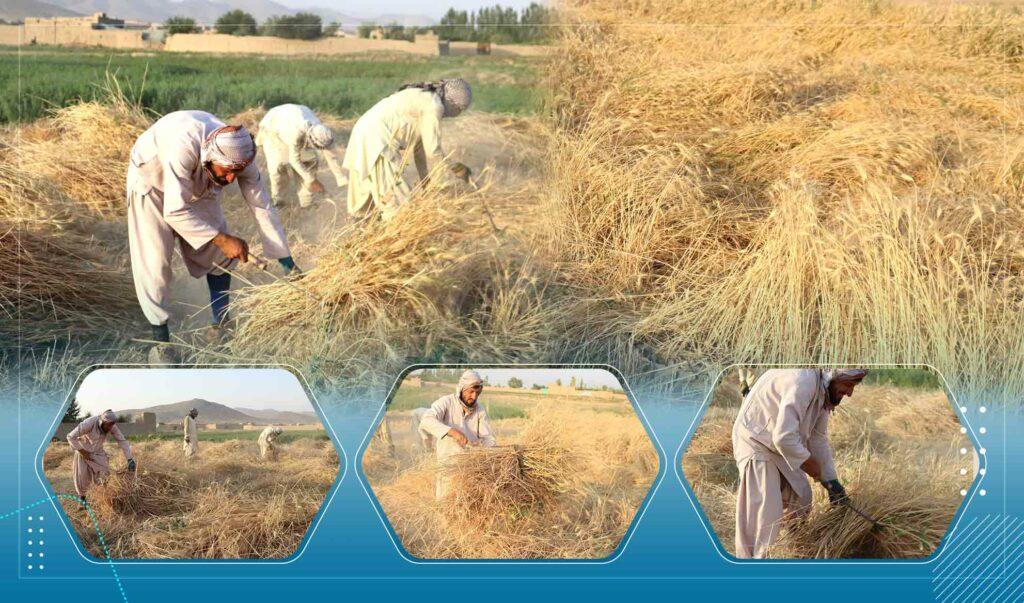

GHAZNI CITY (Pajhwok): A number of farmers in southern Ghazni province say their wheat yields significantly declined this year due to drought, calling on the government and aid organisations to provide them with drought-resistant seeds and other forms of support.
Ghazni is one of Afghanistan’s key agricultural provinces, with approximately 80 percent of its population engaged in farming and livestock rearing.
Ahmad Javed, a farmer from the Arzo area of the provincial capital, told Pajhwok Afghan News that his land used to produce more than 3,500 kilograms of wheat. However, this year he harvested only 1,400 kilograms due to the drought.
He added that in previous years, he cultivated 12.5 acres of land, yielding around 140kg per half-acre, but this year, due to a lack of rainfall, he harvested just 56kg per half-acre.
Similarly, Noor Mohammad, a farmer from the Sarda area of Andar district, said his wheat crop was weak this year due to drought, and he was unable to irrigate it at critical stages.
Sultan Mohammad, a resident of the Seh Kecha area in Muqur district, said rain-fed wheat relied entirely on rainfall, and this year’s shortage led to a severe drop in yield.
He added that although he had planted rain-fed wheat this year, the drought prevented him from even recovering the money he had invested.
Abdul Khaliq, a resident of Giro district, said that in the past, rain-fed wheat was widely cultivated in the plains of Zankhan, Deh Yak, Andar, Giro and even Qarabagh districts. Now, however, due to the persistent drought, little or no wheat was being grown in these areas.
He noted that farmers who sowed rain-fed wheat faced poor yield that even failed to meet their costs.
Several other farmers also complained to Pajhwok about the drought and its devastating impact on wheat production. They urged officials and aid agencies to support Ghazni farmers by providing improved seeds and reliable access to water.
Agricultural expert Eng. Faiz-ur-Rahman Ibrahimi said the drought not only threatened wheat production in Ghazni but also posed a serious risk to food security across the country.
He explained that a lack of rainfall or irrigation prevented wheat plants from growing properly, ultimately leading to reduced yields. Drought also causes soil degradation and a decline in land fertility.
He urged the government to distribute drought-resistant seeds to farmers and to improve water resource management.
Maulvi Izatullah Saeedi, spokesman for the governor, also confirmed to Pajhwok that both irrigated and rain-fed wheat yields in the province had dropped significantly due to drought.
He stated that in previous years, Ghazni produced around 223,000 metric tonnes of wheat annually, but this year, only 200,000 metric tonnes are expected.
He added that, in response to the ongoing drought, the provincial administration has developed several plans. These include promoting alternative crops, launching water management projects, constructing agricultural reservoirs, distributing drought-resistant seeds, and running public awareness campaigns.
Saeedi encouraged farmers to adopt water-saving irrigation methods such as drip and sprinkler systems, and to focus on cultivating crops that require less water and are more resilient to dry conditions.
kk/ma


GET IN TOUCH
NEWSLETTER
SUGGEST A STORY
PAJHWOK MOBILE APP