

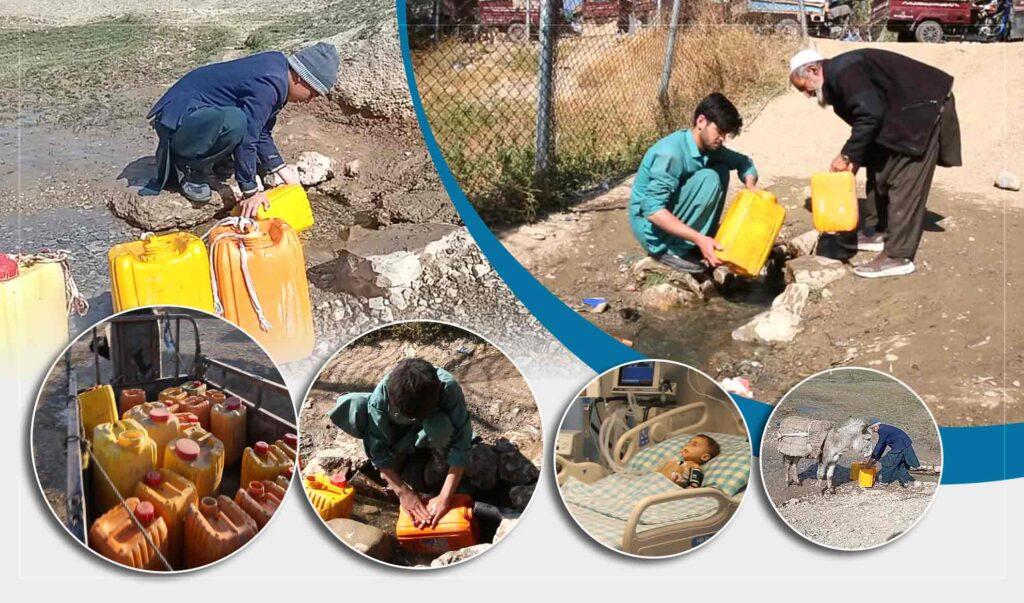

FEROZKOH (Pajhwok): Residents of Shurabak village in Darah Qazi area of Ferozkoh, the capital of western Ghor province, say consecutive droughts have made access to safe drinking water increasingly difficult. As a result, water-borne illnesses such as diarrhea have become common among children.
A doctor at the provincial hospital also acknowledged a rise in diarroeal cases, urging families to boil water before drinking to reduce the risk of diseases.
Shurabak families call for water supply project
Ismail Karimi, a resident of Shurabak village, told Pajhwok Afghan News that repeated droughts had caused groundwater levels to fall, making it harder for people to access clean drinking water. In some cases, he said, people were forced to drink contaminated water.
He added: “It’s been several years of drought. The water in our village has diminished and we now use water from springs or salty wells for drinking.”
Speaking about the increase in diarrhoea cases among children, he said: “You know the weather is hot these days. Our children drink from open, polluted springs. Every household has several children suffering from diarrhoea. I’ve taken my own children to the doctor several times.”
He urged the caretaker government and relevant organisations to implement a water supply project in the village to ensure they had access to clean and safe drinking water.
Other villagers share similar concerns
Raz Mohammad, 47, another resident of the village, shared a similar concern.
He said that in the past two years, village wells dried up, forcing people to walk three to four kilometres to fetch water.
He added: “The well water we used two years ago, though salty, was at least available. Now those wells have dried up, and we have to bring water from far away or use river water, which was not clean at all.”
He also called on the government to address the issue, saying that due to the use of unsafe water, many children and even adults in the village had contracted microbial diseases, particularly diarrhoea.
Ghor hospital doctor: Over 30 diarrhea cases come daily
Fazl-ul-Haq Farjad, an internal medicine specialist at the Ghor Provincial Hospital, told Pajhwok that over 30 people suffering from diarrhoea and waterborne diseases visit the hospital each day. In recent days, with rising temperatures and increased environmental pollution, the number has nearly doubled.
He said: “Unfortunately, in recent years—especially this year—the water in drinking wells has significantly decreased and is no longer safe. Most wells are shallow and easily contaminated with microbes, which lead to illnesses such as diarrhoea and vomiting.”
Dr. Farjad recommended that the best and simplest way to prevent many of these diseases was to boil water before drinking. If families lack access to purification systems, he advised boiling water for at least ten minutes to kill harmful bacteria and microbes. He also mentioned that disinfectants such as chlorine can be effective.
Official: Efforts underway to resolve the issue
Rural Rehabilitation and Development Director Maulvi Mohammad Idrees Shariat urged local residents to submit formal requests to the department.
He said they would strive to implement a safe water supply project in cooperation with aid organisations.
He added: “Most water supply projects are carried out by organisations, but this year fewer projects have been available. We ask residents of this area to submit their requests to us.”
He continued if assistance was received from any supporting body, their teams would be immediately dispatched to assess the situation and take necessary steps to resolve the problem.
kk/ma


GET IN TOUCH
NEWSLETTER
SUGGEST A STORY
PAJHWOK MOBILE APP