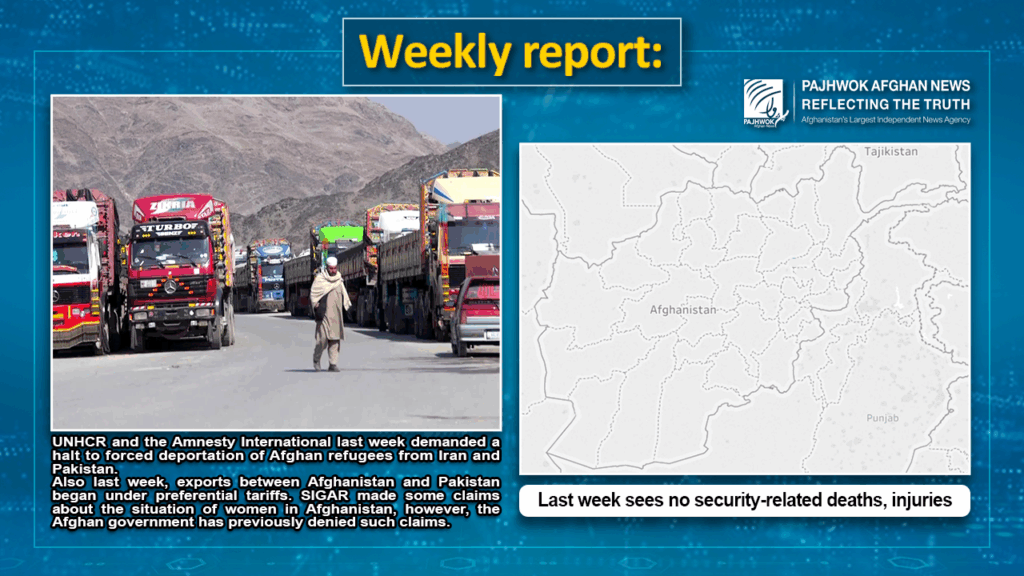

KABUL (Pajhwok): UNHCR and the Amnesty International last week demanded a halt to forced deportation of Afghan refugees from Iran and Pakistan.
Also last week, exports between Afghanistan and Pakistan began under preferential tariffs. SIGAR made some claims about the situation of women in Afghanistan, however, the Afghan government has previously denied such claims.
Last week’s major events
- Kabul to host tripartite talks on Afghan refugees
- AI urges Iran not to forcibly deport Afghan refugees
- Muttaqi: Deportation of Afghan refugees from Iran worrying
- Ministry: 1.8m Afghans deported from Iran alone
- SIGAR’s claim about situation of women and girls in Afghanistan; IEA has previously denied such claims
- Exports between Afghanistan and Pakistan begin under preferential tariffs
- Meeting held on reactivation of ‘Afghanistan CANSA’.
- Muttaqi: Besides humanitarian aid, Afghans need development
Casualties
Last week, 17 people lost their lives and 56 others were injured, including a foreign tourist, in traffic accidents and drownings in Nangarhar, Faryab, Parwan, Kandahar, Ghazni, Daikundi and Bamyan provinces, but Pajhwok received no reports about other incidents and casualties.
This comes at a time when six people were killed and 18 others were injured in an armed clash between two families over land ownership in Nangarhar in the previous week. Similarly, a woman was killed and three others were injured in a dispute between two families in Laghman.
Local officials said in the previous week, one person lost his life in a physical clash in Badakhshan, unknown gunmen killed one person in Kandahar, and an old mine explosion in Maidan Wardak killed one person and injured another.
Before the regime change in 2021, hundreds of civilians, insurgents and security forces would get killed and injured every week.
Afghan refugees
Iran has recently stepped up expelling Afghan refugees from the country. Reports indicate that in the past three months alone, Iran deported about 1.8 million Afghan refugees. Pakistan also deported nearly 185,000 Afghan refugees and Turkey 5,134.
The deportations are ongoing and Iran has extended the deadline for the deportations to September 15 of this year.
Officials say over 55,000 Afghan refugees returned from Pakistan and Iran on Saturday, Sunday, Tuesday, Wednesday and Thursday of last week, with the bulk coming from Iran.
Last week, Arafat Jamal, the head of the United Nations High Commissioner for Refugees in Afghanistan, said that Iran had expressed readiness for a trilateral technical meeting on Afghan refugees, and that the meeting was scheduled to be held soon in Kabul between representatives of the Islamic Emirate, Iran and UNHCR.
The United Nations Children’s Fund (UNICEF) said in a report that the unprecedented returns had put severe pressure on resources and basic services at Afghanistan’s borders, and a severe shortage of financial resources had hampered the ability of aid agencies.
Last week, Amnesty International sent a letter to Iranian authorities under the title “Urgent Action” calling on them to immediately halt the deportation of Afghans there.
According to reports, Maulvi Mahmudul Haq Ahadi, the head of planning and policy at the Afghan Ministry of Refugees and Repatriation, and Alistair Burnett, the head of the British Humanitarian Aid, discussed the self-reliance of forced returnees from Iran and Pakistan and the resolution of their problems.
Similarly, last week, acting Afghan Foreign Minister Maulvi Amir Khan Muttaqi in a telephone conversation with his Iranian counterpart, Abbas Araqchi called the deportation of Afghan refugees a matter of concern and stressed that the process should be gradual and respectful.
The Iranian Foreign Minister also pledged to try to ensure that the deportation of Afghan refugees from the country was gradual and respectful.
The Ministry of Refugees and Repatriation said that in the past three months, about 1.8 million Afghan refugees were forcibly deported from Iran, about 185,000 from Pakistan, and 5,134 from Turkey.
In addition, last week, officials from the ministry said that about 300 Afghan refugees who had been imprisoned in Pakistani and Iraqi prisons were released and returned to their country.
Afghan national cricket team player Mohammad Nabi donated one million afghanis to Afghan refugees who returned to the country from Iran through his charity foundation.
SIGAR report on situation of women
Last week, the US Special Inspector General for Afghanistan Reconstruction (SIGAR) claimed that the acting government violated the rights of Afghan women and girls in nearly four years of its rule.
In its 68th quarterly report submitted to Congress, the agency claimed women and girls in Afghanistan have been deprived of public life due to restrictions.
The report said human rights situation was linked to economic and humanitarian crises and Afghan women were ‘disproportionately affected’ by the decline in international aid.
The Islamic Emirate has not yet responded to the SIGAR report, but maintains that the rights of women and girls in Afghanistan are protected based on Islamic Sharia law.
Development projects in Afghanistan
Last week, acting Foreign Minister Maulvi Amir Khan Muttaqi in a meeting with John Aylieff, the head of the World Food Program in Afghanistan, said that besides emergency humanitarian assistance, attention should also be paid to the development sector.
He said many problems had been done away with in Afghanistan now and a good opportunity existed to implement development projects.
The head of the World Food Program said his organization would try to talk to donors about attracting development and humanitarian aid.
Afghanistan, Pakistan begin exports under preferential tariffs
The Afghan Ministry of Industry and Commerce said yesterday that exports of four types of agricultural products between Afghanistan and Pakistan have started under preferential tariffs based on recent agreements between the delegations of the two countries.
This important step will lead to an increase in trade volume, strengthening economic cooperation and marketing for farmers of both countries.
The Afghan Embassy in Pakistan said last week that a preferential agreement was signed between the commerce ministries of the two countries, under which the tariff on exports of grapes, pomegranates, apples and tomatoes from Afghanistan to Pakistan and imports of mangoes, quinoa, bananas and jackfruit from Pakistan to Afghanistan will be reduced from about 60 percent to 27 percent.
Coordination meeting on ‘Afghanistan CANSA’
Last week, the National Environmental Protection Agency held a coordination meeting with representatives of national and international organizations on the reactivation of ‘Afghanistan CANSA’ and also asked UNAMA and CANSA officials to make efforts for the participation of the Afghan delegation in the COP 30 meeting.
CANSA is one of six platforms operating in South Asia on environmental issues, especially climate change, and has eight member countries: Afghanistan, India, Pakistan, Bangladesh, Sri Lanka, Bhutan, Nepal, and Maldives.
Afghanistan became a member of CANSA in 2017, but its activities were suspended after the political change and has now resumed its activities under the title “Afghanistan CANSA” under the leadership of Engineer Ezatullah Siddiqui.
Meanwhile, UN Deputy Special Representative Andrika Ratwatta called on the international community to help Afghanistan develop renewable energy to help protect the country’s environment.
ma