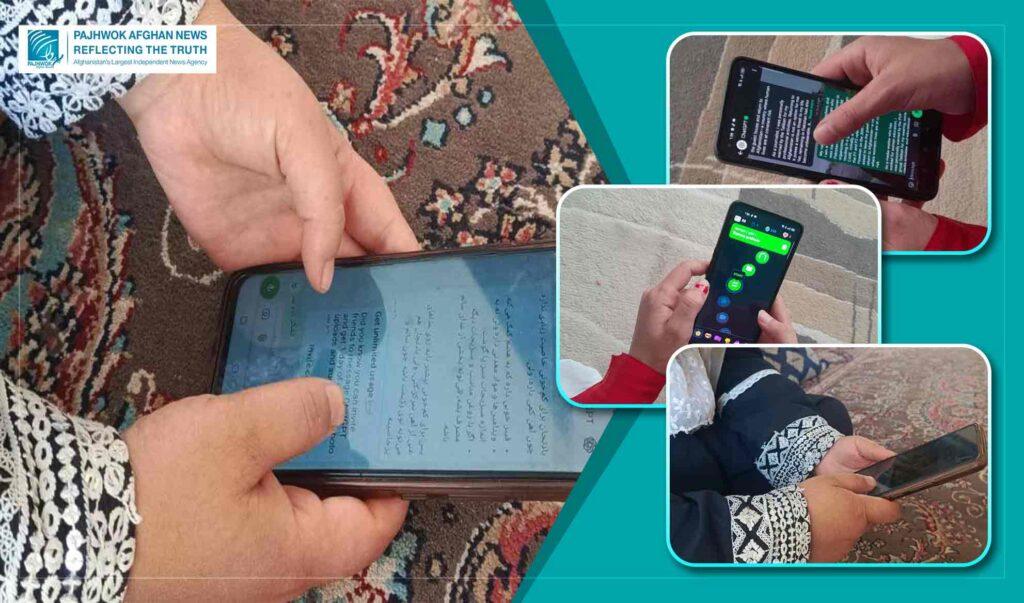

NEILI (Pajhwok): In the heart of central Daikundi’s towering mountains, where internet services and educational facilities are limited, a number of girls and women use various educational applications to learn new skills, opening up a fresh path for their academic and professional growth.
Daikundi is a mountainous province with a difficult geography, whose residents are deprived of some basic facilities and amenities. However, technological advancements have removed part of these obstacles and opened a new chapter of hope.
In the city of Neili and some districts of the province, a number of girls have been using technology to learn various skills and enhance their capabilities.
Learning via Apps: Stories of success
Rahima Hashimi, one of the girls in Daikundi, told Pajhwok Afghan News that she uses various apps to improve her skills, and this has helped her learn many things.
She said she currently uses the “Duolingo” app to learn German and English, and also uses “Coursera” to take short-term courses. At present, she is enrolled in two courses: Project Management and Social Media Management.
Rahima explained that through these programs she has been able to fully master some skills and learn others to a great extent.
She said that by acquiring these skills, she was able to work for several months as a trainer with an organization, teaching a number of girls how to use technology online. Because she does not have access to in-person training, her only current path for growth and advancement is through these programs, so she can further improve her abilities.
She added that she spends more than four hours a day learning through these applications.
Rahima noted that there are currently online education centers for learning languages and other basic and advanced skills, and that girls can use them either for free or at a small cost.
She stated that girls can use these programs to learn skills in medicine, business, digital marketing, digital media and languages, adding: “My request to other girls is to make the most of this limited opportunity.”
Apps: A new opportunity, especially for female journalists
Farzana Farahmand, a journalist working for a private radio outlet in Daikundi, said that she has learned most of her media skills through various apps.
She added: “I learned most of my skills from different channels and mostly use YouTube, artificial intelligence, and other programs. Since I work as a journalist, I learned how to edit audio, photos, and videos through these apps, and now I can easily do my work, whereas at first I didn’t know any of these skills.”
She said that to develop her thinking and increase her capacity, she spends at least three hours a day learning through these programs.
Farzana said: “These programs are very good and useful because they provide fresh, relevant and necessary information. Any information we need for our work can be found there.”
She added that if each program is used properly, it has many benefits, but YouTube and artificial intelligence are particularly good options for learning because they provide essential information without spending much time.
Farzana believes that while these programs cannot replace in-person education, they are a suitable alternative for learning and training.
She said: “My request to other girls is to use the available resources in the current situation – for example, YouTube and artificial intelligence, which are great sources of information. Let’s use them to learn skills and look for online classes.”
Using Apps in the health sector
Meanwhile, some women and girls in Daikundi say that by using certain applications, they have been able to meet their informational needs, including learning about the prevention and treatment of certain illnesses.
Fatema, one of the young women in Daikundi, said that she recently started using an artificial intelligence app (ChatGPT) and has been able to fill some of her knowledge gaps, especially in the field of healthcare.
She added: “When my children got sick, I used to take them to the doctor or call for advice, but I didn’t fully understand. Recently, I’ve been using the artificial intelligence program – I write down the symptoms, and it immediately gives very detailed information and treatment methods. I follow it, and it’s as if I’ve become a doctor myself.”
She said through the guidance of this program, she has been able to prevent or treat minor illnesses of herself and her family.
She explained: “If everyone could at least use technology this much – to understand matters related to health and life – it would be very useful. I call on all families and literate mothers to use this method. For minor illnesses, there’s often no need for a doctor; you can be your own doctor.”
Internet problems and the consequences of misusing Apps
Anisa Najafi, a social activist in Daikundi, said that due to limited access to information resources for girls, using apps is very beneficial and can improve their skills.
She added that although these applications are not a substitute for in-person training, they are a very good alternative for girls and women to learn skills.
She urged girls to enroll in online skill-building courses and other useful programs, but noted that the only major problem is that internet services in Daikundi are very weak.
She said: “In Daikundi, apart from the city of Neili and some parts of Miramoor and Shahristan districts, people in other areas do not have internet access and cannot even use simple antennas. If the internet were better, girls could make much better use of apps.”
However, some technology experts in Daikundi say that while various platforms have benefits, they also have drawbacks.
Qudratullah Mousavi, a tech expert in Daikundi, said that internet-based apps have good advantages for girls and their users have been able to learn useful programs in addition to entertainment. But overuse also has harmful effects that most users do not notice.
He said: “Everything in the world has its benefits and harms. Unfortunately, the culture of using apps properly does not exist among people. Many spend their days on games and exchanging useless messages. On the other hand, internet costs are very high, and given people’s economic situation, the expense is heavy.”
He added that overuse of these programs can make a person addicted, unable to go even a moment without them, and that according to studies, excessive use can cause depression, and harm to the eyes and spine.
Mousavi also said that the culture of proper use of social platforms is lacking and that they cause unnecessary harassment for girls, who are the main victims of this problem.
Mousavi noted that internet services in Daikundi are very limited, and most people do not have access to the internet to be able to use these apps.
He added: “In some districts, the word ‘internet’ is unfamiliar to people. In some places there is internet, but it is so weak that it’s only good for sending simple messages, and it’s not possible to use other programs. The electricity problem is also serious, and most people do not have power to charge their phones and computers, which is a serious barrier to using internet programs.”
Govt plans to address telecom, internet problems
Officials in Daikundi also acknowledge that internet services in the province are limited and that residents of some areas do not have proper access to them.
Sayed Abdul Ghani Alawi, Daikundi’s representative for ATRA (Afghanistan Telecom Regulatory Authority), told Pajhwok that five telecom networks are active in the province, but only two private networks provide 4G services in Neili city, the provincial center.
He said that in addition to the provincial center, internet services are only active in the districts of Miramoor, Shahristan, Ashtarlay, and Pato, but there are serious problems in other districts, including Khadir, Sangtakht and Bandar, and Kajran.
Alawi added: “In villages, mostly only 2G services are active, and some areas have no internet coverage at all. Efforts are underway to convert services to the microwave system and then upgrade to 3G.”
He stated that in order to improve internet services across Daikundi, telecom companies have been repeatedly reminded to increase their service quality.
He also said that several telecom sites are currently under construction in the province, and these will be upgraded to 3G once completed.
Meanwhile, Enayatullah Alkozai, spokesman for the Ministry of Telecommunications and Information Technology, said that ATRA is working to expand telecom services across the country. The ministry has planned construction of several new telecom sites in some provinces, some of which are completed while others are under construction.
He added that the plan includes building 12 new telecom sites in Daikundi province, which will significantly resolve telecommunications and internet problems there once completed.
sa/ma