

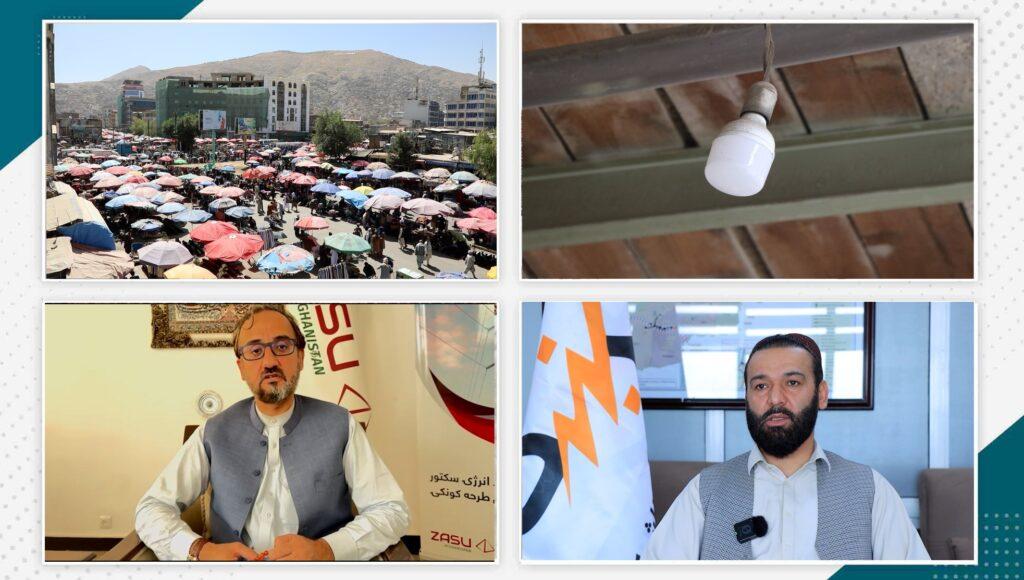

KABUL (Pajhwok): A number of residents of Kabul have voiced their concern over ongoing power outages and called for a permanent solution to the problem.
Officials and experts at Da Afghanistan Breshna Sherkat (DABS) say the main causes are electricity shortages and rising demand.
For many years, demand for electricity has surged during both warm and cold seasons, leading to longer outages and frequent public complaints.
Residents of the capital say the current summer heat has made the blackouts particularly difficult.
Syed Mujtaba, a resident of Shahr-i-Naw area of Kabul, told Pajhwok Afghan News: “We only get about five hours of electricity during the day, and even that is unstable.” He called the outages “frustrating” and urged the Islamic Emirate of Afghanistan (IEA) to take urgent action.
Similarly, Bashir Ibrahimi, from Khairkahan area, said: “We have electricity for only six hours a day. There’s no electricity in my shop, so I rely on solar panels for lighting. At home, we can’t run the cooler, fans, or air conditioning.”
Yar Mohammad Wafa, from Arzan Qimat, said: “We get only about three hours of electricity a day, and at night it comes when people are asleep.” He called on the caretaker government to take practical steps to improve supply.
Syed Ahmad Nasari, from Dasht-i-Barchi, said: “We have just three hours of power each day, and at night it arrives very late. I urge businesspeople to invest in domestic electricity generation to help resolve this problem.”
Behzad Ibrahimi, from Charahi Alwddin, said: “We have no electricity during the day, and at night it comes very late.” He added that the lack of power had also disrupted water access, making life even harder.
Former DABS chief Amanullah Ghalib said shortages and rising demand in Kabul were the key factors behind the outages, forcing the company to rotate electricity distribution. “To reduce blackouts in the short term, overloaded transformers must be replaced immediately, and DABS should coordinate closely with the municipality,” he said.
He also urged investors to meet their own power needs for projects until transformer capacity was improved.
Ghalib said the long-term solution lies in developing domestic power sources. “If solar projects and the 500-kilovolt transmission line from Pul-i-Khumri to Kabul are completed, the problem will be greatly reduced.”
Meanwhile, Khan Jan Alokozay, a board member of the Afghanistan Chamber of Commerce and Investment, said importing electricity from neighbouring countries could not meet Kabul’s needs. Until domestic energy projects are operational, he warned, outages would continue to disrupt industry.
He noted that limited supply in industrial parks during summer had halted machinery and caused production losses.
Alokozay added: “Azizi Group has pledged to invest up to $10 billion in Afghanistan’s electricity sector. If fulfilled, this could help ease the national power crisis.”
Eng. Faridullah Sharafmal, head of investment at DABS, told Pajhwok that Afghanistan currently needs more than 2,000 megawatts of electricity — a figure expected to rise to 10,000 megawatts in the future to support industrial and commercial growth.
“Due to limited resources and increasing demand, we must distribute electricity according to a set schedule. We are working on serious plans to address this,” he said.
He added that the 500-kilovolt transmission line from Turkmenistan to Kabul was 95 per cent complete and would be operational within a year. Solar, wind, gas, and coal-based projects were also underway and would be connected to the national grid within two years.
Sharafmal said growing domestic and foreign investment in the energy sector meant Afghanistan would be free from load-shedding within two years. These projects, he added, would ensure a stable electricity supply and boost economic growth.
On 23 June, DABS announced on its official X account that it had activated the 105-megawatt Tarakhil thermal power plant to help reduce blackouts in Kabul.
kk/sa


GET IN TOUCH
NEWSLETTER
SUGGEST A STORY
PAJHWOK MOBILE APP