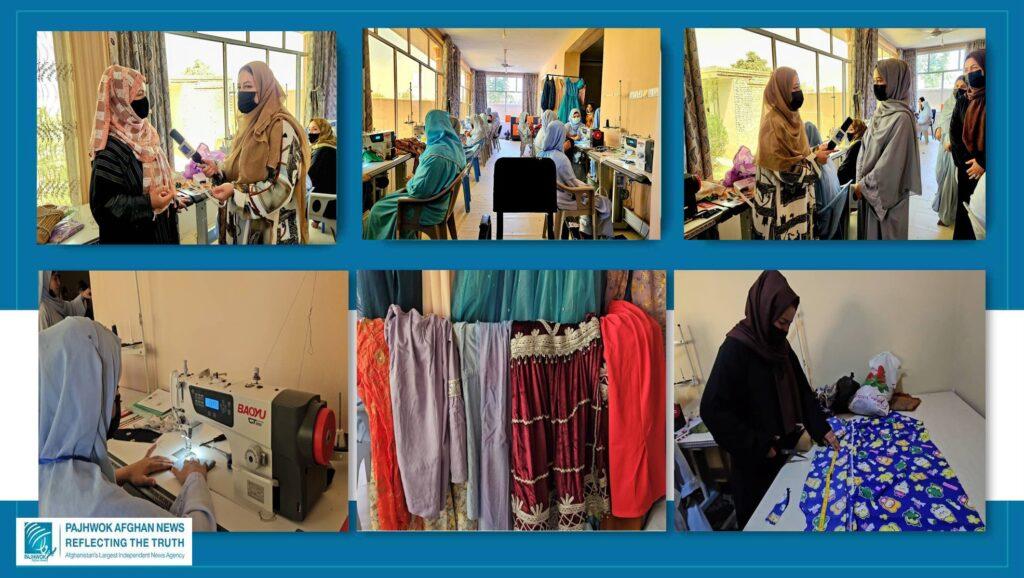

SHEBERGHAN (Pajhwok): A woman entrepreneur in Sheberghan City, the capital of Jawzjan, has established a sewing workshop for dozens of returnee women from Iran, providing them with employment opportunities.
She says that with support, she plans to expand the workshop to employ even more women.
In Banovan-i-Watan-dost (Women of the Patriotic Workshop), women are busy sewing—women who were forcibly expelled from Iran and returned to their homeland amid poverty and uncertainty. Now, with needle in hand and hope in their hearts, they have decided to rebuild their lives.
Fareshta Mohammadi, the head of this workshop, told Pajhwok Afghan News that the workshop was established to support women expelled from Iran and women in need.
According to her, 60 women are currently working in the workshop in sewing, beadwork and embroidery.
Mohammadi has called on international organizations and partner institutions to cooperate with and support her in expanding this workshop and creating more job opportunities for returnee women.
She added: “I have personally witnessed many women struggling to make a living due to lack of income. I decided, with the little capital I have, to do something that will both help them and allow us to preserve our traditional and artistic skills.”
Several women and girls working in this workshop share similar stories: the pain of expulsion, loss of property and now their efforts to rebuild their lives.
Mina, a 15-year-old girl who was expelled from Iran with her six-member family, says she lost her home, education and schooling in a single day after living in Iran for years.
She added: “Now, sitting behind the sewing machine with hope for a new future, I want to rebuild my life. In Iran, I was in grade eight, and in one day, I lost everything. We returned to the country empty-handed, but now I want to learn a trade and become self-sufficient.”
Expressing happiness about the creation of this employment opportunity in Sheberghan, she said that although she returned to the country empty-handed, she hopes that through sewing and beadwork, she can at least help meet her family’s basic needs.
Meanwhile, Zuhal, another 23-year-old woman working in the sewing workshop, says: “Before coming to this workshop, I was idle at home. Now, I am grateful to be working. Learning a trade in these circumstances can make us girls self-reliant and give us a bright future.”
She added that having suffered from unemployment and economic hardship, she had developed depression, but now her depression has eased, and her economic problems have also decreased.
She calls on aid organizations and the government to provide more opportunities for women and supply them with raw materials so that their production can double.
Similarly, Zainab, one of the instructors in the sewing workshop, welcomed the establishment of the workshop and said she can now earn a lawful living for her family through this work.
Having recently returned from Iran and having faced economic challenges, she considers the creation of this workshop a positive step toward improving the lives of impoverished families.
She added: “I am a housewife with seven children, and I contribute to the household economy. I am very happy and satisfied with my work. Through this, I can support my husband, and I ask the Islamic Emirate officials to allow other women to work as well. Through sewing, I earn a little income that I spend on the house and my children.”
She added: “Most of the women in this workshop are returnees from Iran who are widows and impoverished. We need modern machines and raw materials. If provided, we can double our production and enroll more students in this workshop.”
Meanwhile, Latifa Sarwarzada, head of the Women’s Chamber of Commerce and Industries in Jawzjan province, reports a significant increase in women’s workshops in the province.
She says the chamber, in coordination with government institutions, is working to develop women in trade and investment.
She states that currently, about 200 workshops are active in the city and districts of Jawzjan, with 100 workshops registered under the Women’s Chamber of Commerce, employing around 3,500 women. These workshops operate in sewing, carpet weaving, agriculture, livestock, and cooking.
She believes that expanding these initiatives will not only improve family economies but also highlight the role of women in society.
sa