
KABUL (Pajhwok): Some member states of the United Nations Security Council (UNSC) voiced concern over the presence of “terrorist groups” in Afghanistan last week, but the Islamic Emirate of Afghansitan (IEA) rejected those concerns.
Meanwhile, Iran announced plans to expel two million more Afghan refugees by the end of this year, while Kabul hosted the sixth meeting of the foreign ministers of Afghanistan, China and Pakistan.
Lask week’s key events
- Afghanistan-China-Pakistan FMs’ talks held in Kabul.
- China: Afghanistan should be formally included in the “Belt and Road Initiative”.
- Wang Yi: China’s security concerns should be understood; Afghanistan poses no threat to others: PM.
- Maulvi Muttaqi: Pakistan should prevent violations of Afghan refugees’ rights.
- Statements by some countries about “terrorist” groups in Afghanistan, and IEA rejection.
- Rahman: Forced deportation of Afghans will harm Kabul-Islamabad ties.
- Iran: Two million more Afghan refugees to be expelled by the end of this year
Casualties:
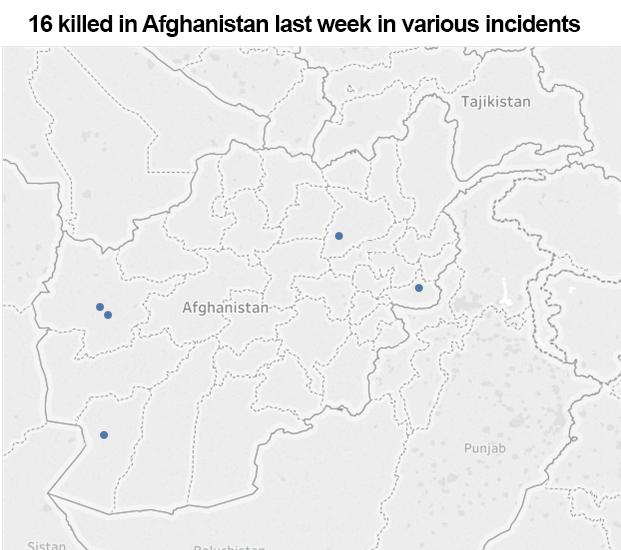
Last week, sixteen people were killed and one injured in various incidents of violence across Afghanistan.
Local officials said six members of a family were killed by unidentified gunmen in Surkh Rod district of eastern Nangarhar province, four people were killed and one woman wounded in central Kapisa due to a personal feud and in Nimroz, a man killed his wife before taking his own life.
Security forces said two armed men were killed in western Herat province and three armed robbers wer shot dead in northern Balkh.
However, Pajhwok received no reports of casualties due to criminal and security incidents in Afghanistan in the previous week.
Before the regime change in 2021, hundreds of civilians, insurgents and security forces would get killed and maimed every week in addition to criminal incidents.
Afghanistan–Pakistan–China meeting in Kabul
Last week, Kabul hosted the sixth trilateral dialogue of the foreign ministers of Afghanistan, China and Pakistan.
The meeting reviewed previous commitments and stressed the strengthening of political, economic and transit cooperation.
Afghan Foeign Minister Maulvi Amir Khan Muttaqi said the trilateral mechanism provides Afghanistan with an opportunity for practical and focused discussions to further expand cooperation.
China’s Foreign Minister Wang Yi described his country’s ties with Afghanistan as developing and noted that cooperation in several fields had already expanded.
Pakistan’s Foreign Minister Ishaq Dar also called the meeting important, describing it as a good opportunity to broaden cooperation among the three nations.
In addition to the trilateral talks, Wang Yi also held separate meetings with Afghanistan’s Prime Minister Mullah Mohammad Hassan Akhund, Foreign Minister Muttaqi and Interior Minister Khalifa Sirajuddin Haqqani.
The discussions covered long-term relations, economic, trade, transit and security cooperation, counter-narcotics, border security and coordination of border forces, trade, agriculture and training programmes.
Wang Yi said his country was eager to officially include Afghanistan in the “Belt and Road” project.
In his meeting with PM Akhund, Wang Yi said China remained steadfast in its friendship with Afghanistan, but hoped its security concerns would be understood.
For his part, Mullah Hassan Akhund said that the two countries were old friends and stressed that the Islamic Emirate does not allow the Afghan soil to be used against any other country – something, he said, had been proven in practice over the past four years.
Meanwhile, Foreign Minister Muttaqi urged Pakistan to take practical steps to resolve issues affecting trade, transit and joint projects.
Statements about “terrorist” groups in Afghanistan:
Reports indicated that during last week’s UN Security Council session, Pakistan, China and the UN Secretary-General’s deputy expressed concern over the presence of Daesh and other “terrorist” groups” in Afghanistan, calling on the Islamic Emirate to act.
Separately, Iran’s permanent representative to the UN, Amir Saeed Iravani, claimed that some militants were being transferred from Syria to Afghanistan.
Zabihullah Mujahid, chief spokesman for IEA, dismissed such concerns as baseless, saying:v“While we reject these allegations, we call on all those raising such concerns not to try to portray Afghanistan as unstable without evidence. There is no proof to substantiate these claims. We ask: in whose interest, and for what purpose, are baseless concerns being raised? Instead of unfounded accusations, let us consider Afghanistan’s current security and progress as an opportunity for cooperation.”
Afghan refugees
The forced expulsion of Afghan refugees from Iran and Pakistan continues.
Officials said that last week alone, around 34,500 Afghans returned from the two countries, most of them from Iran.
In Islamabad, Maulana Fazl-ur-Rahman, leader of Jamiat Ulema-e-Islam, warned at a joint press conference with other parties that forced deportations would damage relations between Islamabad and Kabul.
Meanwhile, Iran’s interior minister said that over six million Afghan refugees currently live in Iran and that two million of them would be deported gradually by the end of this year.
He stated: “Under the agreed programme, the first phase will see around two million undocumented and illegal migrants expelled. Managing these over six million Afghans in Iran naturally requires serious national and international cooperation.”
Earlier, on 30 July, Afghanistan’s Ministry of Refugees and Repatriation announced that in just the past three months nearly two million Afghans had returned from Iran and Pakistan, of whom around 1.8 million were forcibly deported.
kk/ma