

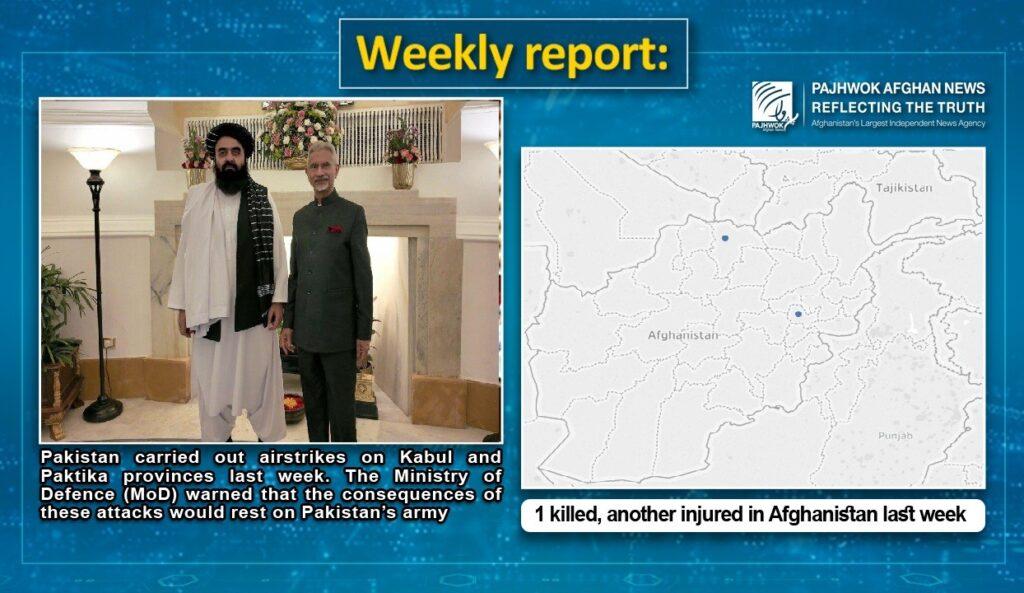

KABUL (Pajhwok): Pakistan carried out airstrikes on Kabul and Paktika provinces last week. The Ministry of Defence (MoD) warned that the consequences of these attacks would rest on Pakistan’s army.
Meanwhile, India announced it would upgrade its technical mission in Kabul to embassy level, and Afghan Foreign Minister Maulvi Amir Khan Muttaqi travelled to India after attending the Moscow Format meeting in Russia.
Key events of last week:
- Pakistan airstrikes: MoD warned Pakistan’s army would be held accountable for attacks on Kabul and Paktika.
- India: New Delhi announced it would upgrade its Kabul mission to embassy level.
- Moscow Format: Muttaqi urged the region to avoid repeating past policy mistakes.
- Industry and Trade: Minister Noorudin Azizi attended the World FZO Congress in China.
- World Bank: Regional economies, including Afghanistan and Pakistan, show signs of positive growth.
Casualties:
Last week, one person was killed and another wounded in separate incidents in Afghanistan.
The Ministry of Interior (MoI) said political analyst Saleem Paigar was injured in an attack in Kabul.
Meanwhile, a robber was killed in an armed clash with security forces in northern Balkh province.

A week earlier, four people had been killed in various incidents across the country.
Before the regime change in 2021, hundreds of civilians, insurgents, and security forces were killed and injured every week in addition to criminal incidents.
Pakistan airstrikes
Explosions were heard in Kabul last Thursday night. The Islamic Emirate of Afghanistan (IEA) chief spokesman Zabihullah Mujahid wrote on his X account that an explosion had been heard in Kabul, adding that investigations were underway and no casualties had yet been reported.
Local sources said the strikes had been carried out by Pakistan.
Local sources also told Pajhwok Afghan News that Pakistani aircraft bombed the Marghi Bazaar area of Barmal district in southeastern Paktika province the same night, burning down three shops but causing no casualties.
In response, MoD said: “Once again, Pakistan has violated Afghanistan’s airspace, bombing a civilian market in the Marghi area of Barmal district in Paktika province near the Durand Line and also breaching the airspace of the capital, Kabul.”
Separately, Pakistan’s military spokesman, Ahmed Sharif Chaudhary, responding to a question about the previous night’s explosions in Kabul, told Geo News that “necessary actions will be taken to protect the lives and property of the people of Pakistan,” without providing further details.
He claimed: “Afghanistan is being used as a base for terrorism against Pakistan. There is evidence and documentation to support this.”
Afghans across the country strongly condemned Pakistan’s attacks, saying they would remain united against any aggression.
The airstrikes came as Afghan Foreign Minister Maulvi Amir Khan Muttaqi was on an official visit to India.
During a press conference with Indian Minister of External Affairs Dr. S. Jaishankar, Muttaqi said: “I am pleased to be in Delhi today. This visit will further enhance mutual understanding between our two countries and open a new chapter in our relations. We hope that Afghanistan and India will strengthen their official and sectoral cooperation and increase mutual understanding through dialogue.”
“India is fully committed to the sovereignty, territorial integrity, and independence of Afghanistan,” Jaishankar told Muttaqi in his opening remarks.
“Closer cooperation between us contributes to your national development, as well as regional stability and resilience,” he said, adding that India’s “technical mission” in Kabul was being upgraded to an embassy.
Moscow Format meeting in Russia
The seventh Moscow Format meeting on Afghanistan was held on Tuesday, with participants expected to discuss steps toward national reconciliation in Afghanistan and expanding cooperation between Kabul and regional countries across all spheres of interstate relations.
The Moscow Format includes Russia, India, Iran, Kazakhstan, Kyrgyzstan, China, Pakistan, Tajikistan, Turkmenistan, and Uzbekistan.
In a joint declaration, the member states reaffirmed their support for an independent, united, and peaceful Afghanistan.
Russian Foreign Minister Sergei Lavrov emphasized the importance of regional stability and warned that any foreign military presence in Afghanistan posed a threat to both Afghanistan’s and the region’s security and development.
He recalled that US President Donald Trump had repeatedly said that Bagram Airbase was strategically vital because of its proximity to China and had warned of “serious consequences” if it was not returned to US control.
IEA responded by saying that, instead of repeating failed experiences, rational and practical policies should be adopted.
“Under the Doha Agreement, the United States pledged not to use force or threats against Afghanistan’s sovereignty and political independence and not to interfere in its internal affairs. Therefore, it must remain committed to its promises,” Afghan officials said, stressing that not an inch of Afghan soil would be handed over to any country, especially to the US.
Lavrov also called on Western countries to unfreeze Afghan state assets and remove restrictions on its banking system.
Addressing the Moscow Format meeting, Muttaqi said political engagement was the only option for countries wishing to maintain ties with Afghanistan.
He reiterated that the IEA sought mutual respect in its ties with all countries and assured that Afghan soil posed no threat to anyone.
He urged nations suffering from insecurity to shoulder their own responsibilities.
On the sidelines of the meeting, representatives from China, Iran, Russia, and Pakistan held a four-party discussion, expressing support for a stable, independent, and peaceful Afghanistan, free from foreign interference.
World FZO Congress in China
Addressing the World Congress of the Free Zones Organization (FZO) in China, Minister of Industry and Commerce Noorudin Azizi last Friday emphasized the fundamental role of free economic zones in economic and trade growth and achieving sustainable development.
He highlighted the need for practical measures to develop special economic zones in Afghanistan, pointing to digital infrastructure, strengthening the private sector, and coordination and regional cooperation as core priorities.
Economic growth
The World Bank (WB) in a recent report said that the economies of the Middle East, North Africa, Afghanistan, and Pakistan were moving towards positive growth.
According to the report, the region’s economic growth rate increased from 2.3 percent in 2024 to 2.8 percent in 2025 and is expected to reach 3.3 percent next year.
It added that Afghanistan and other countries in the region could achieve economic stability only if job opportunities increased and labor forces were utilized.
kk/sa


GET IN TOUCH
NEWSLETTER
SUGGEST A STORY
PAJHWOK MOBILE APP