

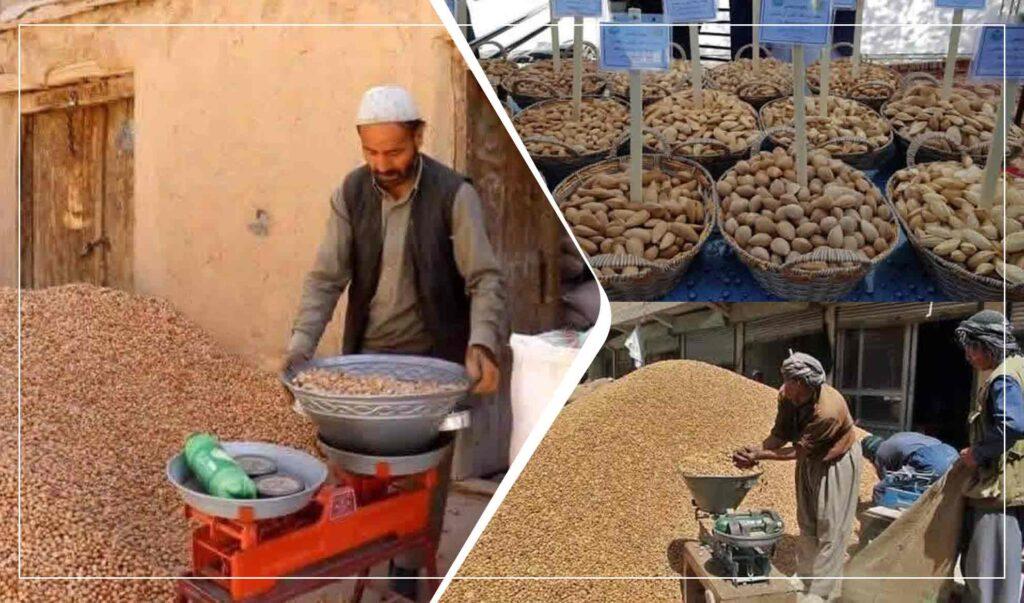

NEILI (Pajhwok): Orchard owners in Daikundi say almonds have proved resilient to water shortages and remain the only crop sustaining local livelihoods, even as recent droughts have severely affected agriculture in the central province.
Daikundi, one of Afghanistan’s central provinces, has in recent years faced a sharp decline in rainfall and the drying up of water sources.
However, almond trees— known for their tolerance to drought— have survived in parts of the province and continue to serve as a main source of income for many families.
Farmers in Daikundi say drought has significantly affected agricultural production, including almonds, reducing their incomes.
Mohammad Akbar, a farmer from Miramor district, said that due to a shortage of water, some of his almond trees had dried up and his harvest had fallen compared to previous years.
He said: “We have been growing almonds for a long time and they used to produce good yields, but in recent years production has dropped because of water shortages. Some trees have completely dried up, but at least the little that remains still helps us meet our daily expenses.”
He added that as water sources have dried up, many farmers have abandoned the cultivation of wheat, barley and maize, and have turned to growing almond trees instead.
According to him, almonds are currently the only crop that farmers continue to grow despite the severe drought conditions.
He emphasised that those farmers with large almond orchards now have relatively stable living conditions and meet all their expenses through almond production.
Given the ongoing drought crisis, Akbar considers almond cultivation the most suitable option for agriculture and horticulture in Daikundi.
Syed Ahmad, another farmer from Neili city, the provincial capital, said that although almond yields have declined due to water shortages, the crop still plays a key role in sustaining the local economy.
He said: “Springs and underground water sources have decreased drastically and are no longer sufficient. In the past, we used to have good harvests of wheat and barley — now there’s none. Although almond yields have fallen in many areas, it is still almonds that keep people’s livelihoods alive.”
He added that in recent years, new almond varieties have been introduced among farmers to cope with water scarcity, and some landowners have earned a good income through these improved types.
He called on the government to help farmers by promoting drought-resistant crops and supporting agricultural development suited to the province’s climate.
Farmers in Daikundi also urged the government to attract foreign investment and facilitate the export of almonds so they can sell their products at better prices.
Agricultural experts in Daikundi say that although drought and natural pests have severely affected almond trees, the crop remains a ray of hope for farmers’ livelihoods.
Mitham Mohammadi, an agricultural expert in Daikundi, said that in recent years climate change and drought had had serious impacts on farming, including reduced yields and increased diseases and pests.
He added that almonds are among the trees most resistant to drought and adapt better to water scarcity compared to other fruit trees, but adequate water is still needed for healthy growth and quality production.
“Although drought has drastically reduced agricultural cultivation,” he said, “almonds have survived to some extent because of their resilience and are now the main crop sustaining Daikundi’s farmers.”
He further noted that prolonged drought affects both the quantity and quality of almonds, making the kernels lighter and reducing their market value.
Mohammadi said: “Using modern agricultural systems such as drip irrigation can prevent water wastage, deliver water directly to the roots, reduce evaporation and improve productivity even under water-scarce conditions. These methods can be highly effective in mitigating the impact of drought.”
He added that introducing improved and new almond varieties could greatly help sustain horticulture in Daikundi.
He urged both the government and farmers to promote high-yielding almond varieties that fetch better prices in local and international markets.
Meanwhile, officials at the Ministry of Agriculture, Irrigation and Livestock (MoAIL) said more than 23,000 metric tonnes of almonds were harvested in Daikundi this year.
Maulvi Sher Mohammad Hatami, spokesperson for the ministry, said there were over 15,000 hectares of almond orchards in the province, from which 23,300 metric tonnes of almonds had been harvested.
He said production had not changed significantly compared to last year but acknowledged that drought had affected almond yields.
Hatami said despite challenges such as drought and pest infestations, Daikundi’s almonds — because of their high quality and distinctive taste — still enjoy a special place in both domestic and international markets.
He added that Shahristan, Neili and Miramor districts were the main producers of almonds in the province.
According to the ministry, the government has made extensive efforts to tackle water scarcity by introducing drip irrigation systems and building check dams to store water in various parts of Daikundi.
Officials said several awareness and training workshops had been organised to improve farmers’ technical knowledge of horticulture.
They noted that more than 80 percent of Daikundi’s population depends on agriculture and livestock, with almonds being the main source of livelihood for most families.
kk/ma


GET IN TOUCH
NEWSLETTER
SUGGEST A STORY
PAJHWOK MOBILE APP