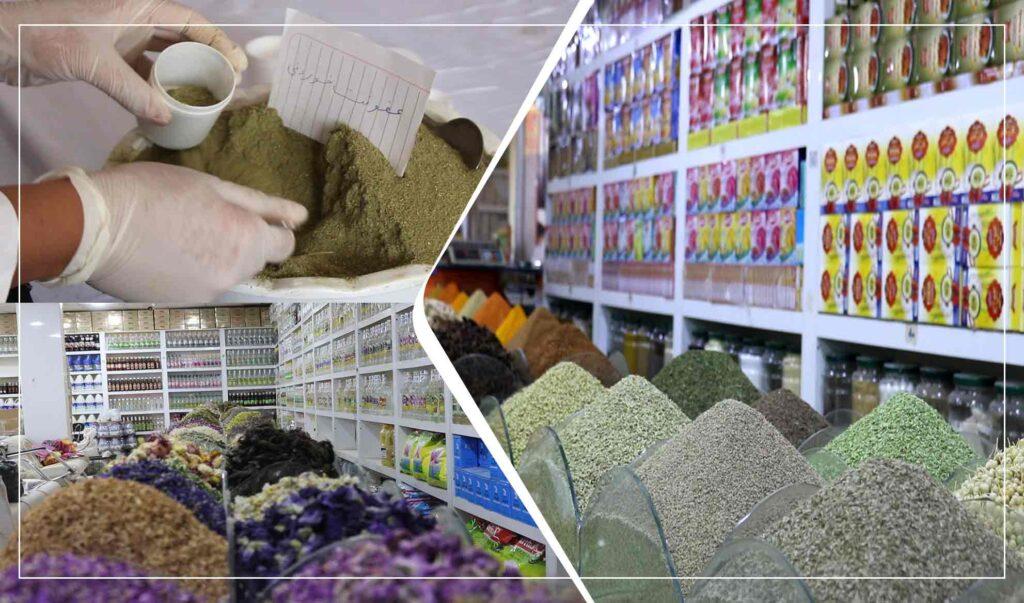

HERAT CITY (Pajhwok): The use of herbal medicines in Afghanistan has a long history, but doctors say the unregulated prescribing and sale of such medicines by individuals without medical expertise can create problems for patients.
Meanwhile, the Ministry of Public Health (MoPH), by establishing a General Directorate for Unani Medicine and beginning the evaluation of practitioners, is trying to standardize and ensure the safety of this sector.
Unani medicine—primarily based on the use of medicinal plants—is a traditional healing system rooted in ancient Greek medicine and later developed during the Islamic era by scholars such as Avicenna (Ibn Sina).
Why do people visit Unani or herbal practitioners?
Some people say they use herbal medicines and visit Unani practitioners to treat certain illnesses.
Milad, a resident of Herat city who was visiting a Unani medicine shop to buy medicine, says he has been compelled to use herbal treatments because of the poor quality of chemical medicines, the failure to diagnose his illness, and his family’s difficult economic situation.
He believes that herbal medicines have been effective for him and considers the purity of their ingredients one of their advantages, claiming they are free from chemicals or commercial additives and therefore harmless to the body.
Abdul Razzaq Zargar, another resident of Herat, says the low cost and higher public trust are the main reasons people prefer herbal medicine.
He states that chemical medicines lack proper quality and are expensive.
He uses herbal medicine for common conditions but says he goes to the hospital if he develops a more serious problem.
Similarly, Shah Mohammad Cherkhi, a resident of Taimani area in Kabul, says:
“For some illnesses that occur in our family, we use Unani medicines because they have no side effects, are useful, and are economical.”
However, he also adds that he consults a doctor for serious illnesses.
Residents in other provinces of the country also seek treatment from Unani practitioners.
Herbal medicines: Cure or threat?
Doctors warn against the unsupervised use of herbal medicines and consulting untrained individuals. They say that although the use of herbal remedies has a long history in Afghan culture, chemical medicines are more effective and scientifically proven in treating diseases.
Dr. Ghiyas Hakimi, a doctor in Herat, said: “The unsupervised use of herbal medicines may not only fail to cure the illness but in some cases may cause new problems for the patient. Every illness requires accurate diagnosis and scientific treatment.”
According to him, many patients come to the hospital in worse condition after misusing herbal medicines.
Unani medicines: Traditional experience without formal education
The production and use of herbal medicines and Unani treatments have a long history in Afghanistan, but the lack of formal education has made providing safe services a challenge.
Wahidullah Hamdard, a Unani practitioner in Taimani, Kabul, says he has no official license from the Ministry of Public Health, but he does have a license from the Traditional Medicine Union. He says 15 patients visit him daily for treatment.
He claims that herbal therapy is effective in treating many diseases.
Hamdard notes that Unani medicine is not taught as a formal educational field in Afghanistan, and most practitioners have learned it traditionally from their fathers and ancestors.
He says: “The Ministry of Health should give us licenses, but until this field is formally taught and universities exist, obtaining a license is difficult. This is one of our major problems that must be solved so that herbalists can be distinguished from ordinary spice sellers.”
He called on the Islamic Emirate to support Unani practitioners, saying:
“We have spent many years in this profession, yet we still have no official documentation. At the very least, herbalists should be tested and given legal certificates.”
Quraish Nabizada, a female producer of herbal medicines in Herat, says she has been producing herbal products for over five years and holds a business license from the Women’s Chamber of Commerce and Investment.
She says herbal medicines have “no particular side effects” and are beneficial for the public.
From inspections to standardization: MoPH actions for unani practitioners
Dr. Sharafat Zaman, spokesman for MoPH, told Pajhwok that the ministry is working to provide standardized and equitable health services, and that implementing all regulations and principles is necessary to achieve this.
He said: “For this reason, a General Directorate for Unani Medicine has recently been established within the ministry so we can standardize Unani and traditional medicine.”
He added: “Unfortunately, some Unani treatment centers in the country are run by individuals who are unprofessional, untrained, and unlicensed by the ministry. We are conducting serious monitoring in Kabul and the provinces to standardize their activities.”
Dr. Sharafat Zaman, without giving specific numbers, said that some Unani practitioners do have licenses.
He continued: “What the public needs to know is that the Ministry of Health is working to ensure standards are implemented, service quality improves, and standardized services are provided. Our goal is to professionalize practitioners, not to prevent them from working.”
He said that due to public complaints, the ministry inspection teams have reviewed Unani treatment centers in Kabul and the provinces.
He added: “Most of the medicines used in Unani treatment are made by non-professionals. Many of their popular medicines—which had many clients—unfortunately proved to be substandard when examined in our laboratory, and their results were negative. We ask the public to visit only registered centers that meet the standards. Some centers are unregistered and do not follow standards.”
According to him, the ministry has given a specific period of time for those who are yet to meet the standards to comply.
Kazemi: Ministry’s decision a major step toward professionalizing traditional medicine
Mohammad Rafiq Kazemi, former adviser to the Unani Traditional Medicine Union in Afghanistan, says that an estimated more than 10,000 Unani practitioners are active across the country.
He also said the MoPH has started evaluating practitioners, and according to new procedures, only those with educational documents of grade 12, 14, or 16, who pass the exam and evaluation, will receive licenses to practice Unani medicine.
He said the ministry’s recent achievements in this field are unprecedented in the past two decades and that preventing unqualified individuals from making decisions about people’s health is a major improvement.
He added that a dedicated university for traditional medicine is expected to be established in the coming months.
Kazemi emphasized that herbal medicines can be useful only when taken according to the prescription of a professional practitioner or doctor; otherwise, self-medication is “completely wrong and accompanied by side effects.”
sa/ma