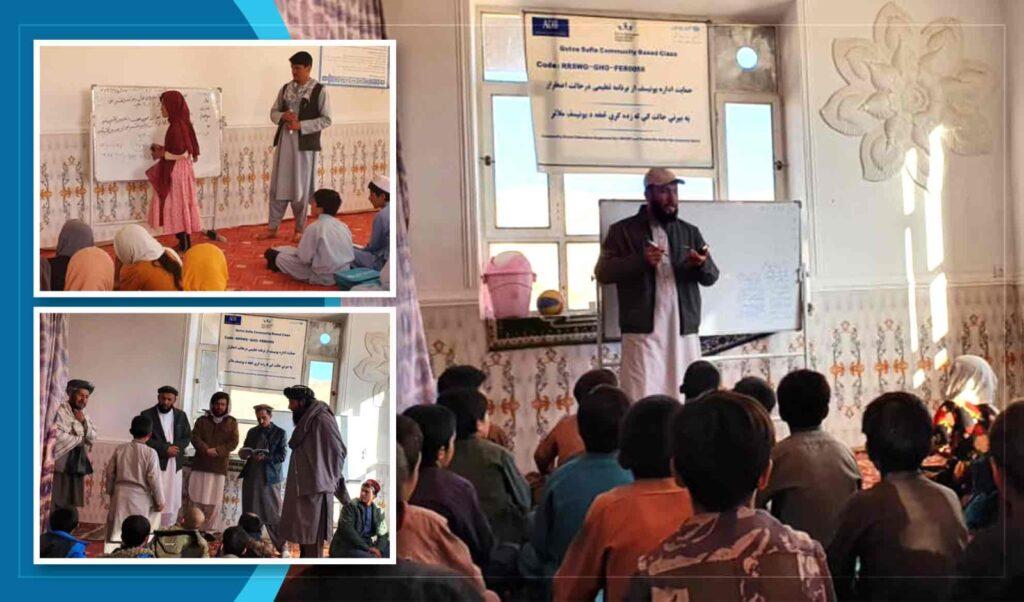

FEROZKOH (Pajhwok): The establishment of supplementary classes in western Ghor province has been widely welcomed by students, parents and education experts alike, who believe these sessions are affective in enhancing children’s learning and call for their expansion.
Supplementary classes are organised for students who attend school but have learning levels below classroom standard or those who have missed lessons due to absence and need to catch up with the curriculum.
This report explores the importance of supplementary classes— programmes that plays a key role in addressing educational gaps and supporting students facing learning difficulties. Officials say these classes are launched in cooperation with different organisations.
RRSWO is one such organisation operating in the province
Ali Ishraq, head of education and training at Rah-e-Rahnaward Social Welfare Organization (RRSWO) in Ghor, told Pajhwok Afghan News: “Fortunately, we are running two educational projects in Ghor province, with more than 350 supplementary learning classes active in Murghab, Dawlatyar, Charsada, Tulak, Saghar and Dawlina districts and Ferozkoh, the provincial capital and they are supported by donors.”
He said the supplementary classes programme of the organsiation was funded by the United Nations Children’s Emergency Fund (UNICEF).
He added that all supplementary classes were equipped with advanced educational facilities, including learning packages for students and teachers, as well as hygiene kits.
According to him, all the established classes are active in remote areas of Ghor and currently more than 10,000 students are engaged in learning through these supplementary classes.
He stressed that most of the students attending these classes have made noticeable progress in their learning.
A young man’s efforts to nurture education in Ghor
In Qatmas village, located 12 kilometres from Ferozkoh, the provincial capital, the sound of flipping pages and children’s laughter is the outcome of a supplementary class taught by a young man named Aziz Saqib.
Saqib, 38-year-old man and a graduate from Chemistry Faculty of Ghor university, said he had been working for five years with RRSWO on supplementary classes, teaching the subjects of mathematics, science, general education, history, geography and Islamic studies to students from Grade 1 to Grade 5.
He added that even before that, he had been voluntarily teaching school subjects—especially sciences—for several years.
While teaching grade 3 Mathematics to 28 boys and girls, he said: “This supplementary class has been established to address learning weaknesses and boost students’ motivation. I am happy that my efforts have produced good results.”
He added: “There should be a light of knowledge in every home. Our province should have the highest number of educated young people. This is one of my dreams.”
Saqib continued: “In most families, either the mother, father, or both are illiterate. I try my best to help students learn better and progress well in school.”
He, who also works on farmland with his father during free time, said he teaches children and teenagers of his village every day from 1:00pm to 5:00pm, delivering various subjects at different times.
A promise of change: Stories of two students from Ghor
In one of the supplementary classes in the province, a quiet but motivated students named Navidullah shares a simple yet inspiring story— a story of transformation and gaining the courage to learn.
Navidullah, a resident of Qatmas village and a student of grade 3rd, who was practising Mathematics with 27 other students in a supplementary class, said: “My parents are illiterate. I had problems in Maths before, but now my problem is solved and I understand the lessons much better.”
He said he once struggled seriously with Mathematics and was sometimes even punished by his teacher, but after nearly two months of attending the supplementary class, his problem was largely resolved.
In Kandiol village, one of the remote areas near Ferozkoh city, children are also attending supplementary classes.
Qurban, a 13-year-old boy and a student of grade 5th who joined the supplementary class in his village, said that he had difficulties in science and mathematics and no one at home could assist him because his parents were illiterate.
He said: “I have been studying in this class for one year, which was set up by RRSWO. Our teacher teaches us very well. We also receive free pens, books and notebooks.”
Parents: Supplementary classes improved our children’s learning
Khudadad, a resident of the village, smiled deeply while watching his child studying with enthusiasm.
He said: “My son had serious problems in mathematics, but since this class was established, he has shown great improvement and learns his lessons very well.”
Similarly, Abdul Rauf, father of two students attending supplementary classes in Qatmas village, said: “Since this free class started, the kids have learnt very well and now, praise be to Allah, they no longer face problems in their school lessons. Most of my children had difficulties in Mathematics.”
Both individuals voiced appreciation for RRSWO and the Education Department of the province and called for an expansion of such educational programmes.
Education expert: Supplementary classes— an effective solution for improving learning
Mir Ahmad Rahimi, an education expert in Ghor province, believes that supplementary classes play an important role in improving students’ learning—especially for those children who lack assistance at home or live in areas where no active educational courses are available.
He added that supplementary classes help fill educational gaps and enhance students’ motivation to learn.
He said: “Supplementary classes encourage children and teenagers who had learning difficulties, stopped attending school, or lost interest, to return to school, as the teachers in these classes provide more support.”
Rahimi stressed the need to increase supplementary classes throughout the province and called on the Education Department and supporting organisations to focus on this area.
He emphasised on the establishment of these classes because most parents in the province were illiterate or hae a low educational level, and therefore could not help their children with their studies, which leads to learning problems.
Education Department: 977 local, supplementary, accelerated classes active with over 28,000 students
Mufti Mohammad Hafiz Saberi, head of education and training at the Ghor Education Department, said: “There are 977 local, accelerated and supplementary classes in Ghor supported by four organisations, where 28,355 students are actively studying. These classes are very beneficial and the students’ capacity is even higher than those in government schools.”
Accelerated classes are organised for children who have missed formal education or have never had the chance to go to school. In these classes, basic and foundational subjects are taught in a short period to enable students to reach the level of their peers and enter formal school grades.
Local classes are those held within villages or remote areas where children cannot access main schools due to distance, lack of proper roads or facilities.
He added that supplementary classes were conducted in areas where most students faced learning challenges.
Saberi emphasised the continuation of such classes and called on organisational officials and teachers to support these programmes, as he believes they can significantly contribute to improving the quality of education in Ghor.
Regarding public demand for increasing supplementary classes, the head of education and training said that the establishment of supplementary classes depends on organisational support and the Education Department is striving to encourage organisations in this regard.
Supplementary classes are also active in other provinces of the country.
Pajhwok Afghan News contacted the Ministry of Education (MoE) for information, but no response has yet been received.
kk/ma