

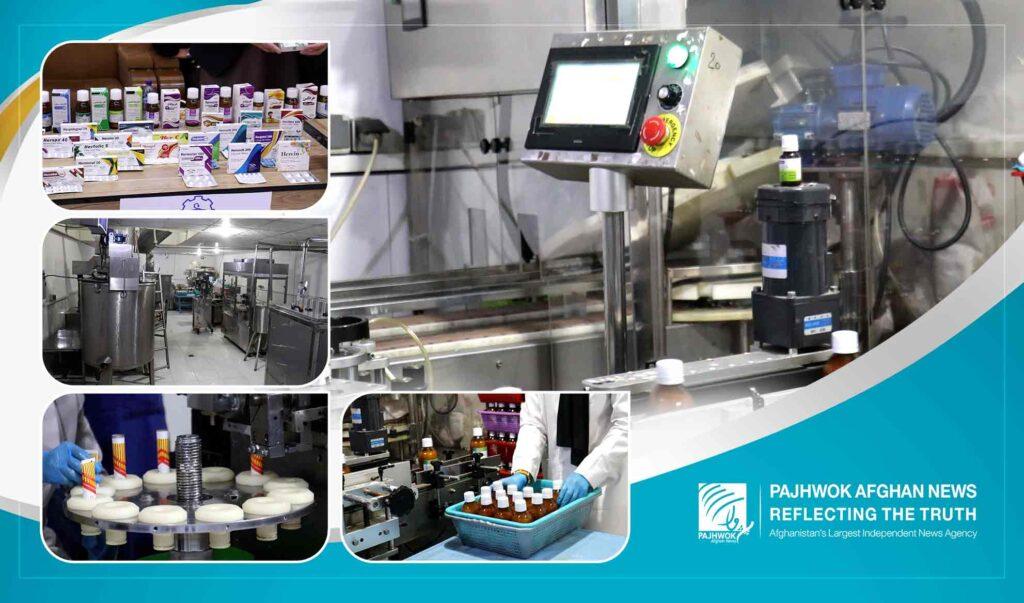

KABUL (Pajhwok): Fresh figures from the Ministry of Public Health (MoPH) show 130 pharmaceutical factories are currently operating across Afghanistan, producing more than 600 types of medicines.
However, health expert stress that improving the quantity and quality of domestic pharmaceutical products is crucial to substituting imported products.
On 13 November, the Ministry of Finance (MoF) announced that medicines imported from Pakistan would no longer be processed through customs after three months, following a directive from the Office of the Deputy Prime Minister for Economic Affairs.
Importers have been instructed to settle their commercial dealings within this period and seek alternative supply routes.
Efforts are also underway to increase the import of medicines from other countries and further boost domestic production.
MoPH: We support domestic pharmaceutical production
Dr. Sharafat Zaman, spokesman for the Ministry of Public Health (MoPH), told Pajhwok Afghan News that the ministry has intensified efforts to develop local pharmaceutical production and fully supports domestic manufacturers.
He said significant work had been done in recent months to improve the quality of locally produced medicines and increase the number of pharmaceutical products.
He added: “Compared to the past, the production of medicines has increased. More than 600 types of medicines are currently being produced inside the country and about 130 factories are manufacturing medicines and medical equipment.”
Dr. Zaman said that to further enhance the quality and standard of medicines, factories meeting international requirements recently received Good Manufacturing Practices (GMP) certification, which will also allow their products to be used abroad.
He also noted progress in preventing the smuggling of medicines.
He added that MoPH was now working to monitor all medicines--- whether imported from abroad or transported between provinces--- so that domestic products receive proper support and opportunities for growth.
He urged Afghan investors at home and abroad to invest in the domestic pharmaceutical industry, assuring them of full cooperation from MoPH.
Similarly, speaking at the “Afghan Health” exhibition in Kabul on December 4, Deputy Minister of Commerce and Industry Mawlawi Shahabuddin Saqib said the ministry was working to strengthen domestic products by creating opportunities and expanding cooperation between the Islamic Emirate of Afghanistan (IEA) and the private sector.
He said the views of manufacturers and traders were being heard and their challenges addressed, emphasising the Ministry of Commerce and Industry’s (MoCI) commitment to supporting the private sector and providing necessary facilities.
Factory owners: Power shortages, delays in raw material supply major challenges
Abdul Mubin, head of the Kimyagar pharmaceutical factory in Kabul, told Pajhwok that the factory was established nearly 24 years ago. It produces various types of medicines and has attracted an investment of more than 4 million US dollars and employs around 54 workers.
He said: “Our raw materials are sourced from different countries—including China, India, Iran, Pakistan, Germany, Uzbekistan and Russia.”
Pointing to major challenges, he said: “Our main problem is electricity shortages. We are a production factory and need a stable power supply because all our machinery runs on electricity. Another issue is delay in clearance of raw materials at customs. We urge the officials to assist us in this regard.”
Ghulam Ahmad Zarifi, director of Armin Pharma in western Herat province, said they established their factory a year ago with an investment of $16 million, employing around 95 workers.
He said they produce 100 types of medicines, including antibiotics, analgesics, multivitamins, neurological drugs, cough syrups and other syrups.
Zarifi said their factory meets international standards and plans to export medicines in the future. Their raw materials are imported from India, China and Iran.
Experts: Trust, quality, scale of domestic production must be strengthened
Neurosurgeon Dr. Rahmatullah Salah Noorzi told Pajhwok that many medicines produced in Afghanistan meet international standards.
He said: “The medicines produced in Afghanistan are good, but they are not enough to meet the needs of the population. Afghanistan still receives medicines from different countries, so meeting national demand in a short time will be difficult, but time will provide answers.”
He said the biggest problems were limited access to medicines and people’s lack of awareness about domestically produced products, as most people were more familiar with foreign brands.
He added that building public trust in domestic medicines would take time and effort.
Regarding raw materials, he said: “Our raw materials are not as standardised as those in other countries. But if MoPH and the private sector work jointly, standards will improve in the future.”
He urged the ministry to prevent low-quality medicines that harm public health from circulating in the market.
Health expert Dr. Mohammad Hashim Wahaj said that Afghanistan’s pharmaceutical factories currently produce 20–25 percent of the country’s medicine needs. Even though they operate only one shift (eight hours), if they work two or three shifts, they could produce 50–60 percent of the needed medicines.
However, he criticised MoPH, saying: “My complaint to the ministry is that it does not use domestic medicines. If factories are producing low-quality products, close them. If they produce good-quality medicines, why government hospitals are using foreign medicines?”
Wahaj said major obstacles to domestic production were electricity shortages, limited raw materials and competition with imported medicines.
He added that government’s encouragement was weak. If the government uses domestic medicines in its hospitals--- where medicines are given to people free of charge--- public familiarity and trust in local medicines will increase.
He stressed that the ministry must monitor and control pharmaceutical production, noting that some Afghan factories now produce medicines even better than foreign companies.
A three-day national and international exhibition titled “Sehat Afghan” was held in Kabul on December 2, where medical products, medicines and both domestic and foreign companies’ products were showcased.
kk/ma


GET IN TOUCH
NEWSLETTER
SUGGEST A STORY
PAJHWOK MOBILE APP