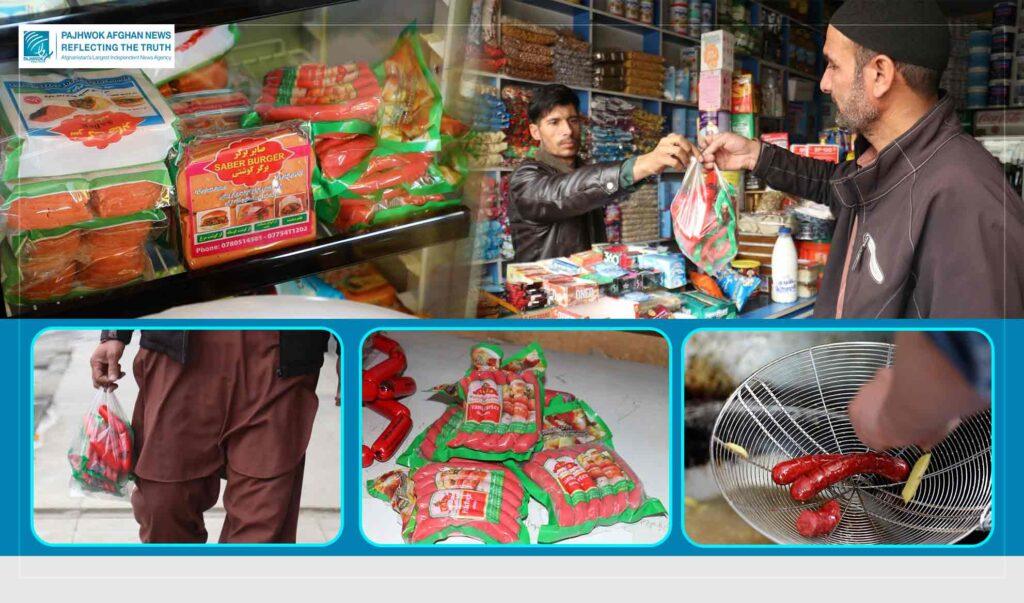

KABUL (Pajhwok): A number of Kabul residents and health experts have raised concerns about the quality of some sausage and burger meat available in the market, calling for stricter oversight by the Ministry of Public Health (MoPH).
Officials say more than 62 percent of such products were previously substandard, but the situation has improved following the introduction of monitoring programmes and capacity-building measures for factories.
Burgers and sausages—popular fast foods among some young people, teenagers and children due to their quick preparation and appealing taste—are usually consumed with chips, vegetables, ketchup and similar items.
However, some residents of the capital complain about the quality of sausages and burger meat.
Suhail Ahmadi, an inhabitant of the Taimani area of Kabul, told Pajhwok Afghan News he was concerned about the quality of these products.
“Several times when I took them home, their taste was very bad and their quality was poor. We ate them two or three times, but they were spoiled; the colour had changed. My family did not like them anymore because they were rotten, so after that I stopped buying them,” he said.
He added that some of his friends had suffered food poisoning after consuming sausages and burger meat.
Similarly, Abdul Ahad, a resident of the Qala-i-Fathullah area of Kabul, said: “Sausages and burger meat are commonly consumed and we used them too, but one day when I brought them home, my son developed severe diarrhoea and vomiting. When we took him to the doctor, they asked what he had eaten and when we mentioned sausage, they said it could be the cause of the illness.”
Mohammad Fahim, a resident of the Macrorayan-e-Awal area, said: “I really liked burger meat and sausages, but last year I brought them home several times and their colour changed and they smelled bad, as if the meat had swollen. Since then, I have not used them.”
All interviewees stressed that companies producing burgers and sausages must strictly observe hygiene standards and that the government should exercise serious and thorough oversight of the production and import of these products to protect people from diseases caused by unsafe food.
Vendors’ views on burger, sausage market in Kabul
Khushaluddin, a shopkeeper in the Tahiya-e-Maskan area of Kabul, said: “The sausages are locally produced and their quality and ingredients are good. We have two types of sausages—beef and chicken. We source these products from a factory in Pul-e-Charkhi, and the factories are clean and well organised.”
He added: “Previously, imported burger meat was of poor quality, but now its import has significantly declined, and most products available on the market are locally produced with better quality.”
Meanwhile, Juma Khan Habibi, another shopkeeper in Kabul, said: “We bring sausages and burger meat from Herat province. There are about four types of burger meat, and people mostly buy beef sausages. The company we source from is clean, and so far no one who has bought from us has complained.”
Consumption of substandard sausages, burger meat threatens health: Doctors
Dr. Syed Farid Shah Rafiei, a specialist in general internal medicine at Wazir Mohammad Akbar Khan Hospital in Kabul, said low-quality and even spoiled sausages and burger meat were sold in some shops and markets in the city.
He warned that consuming such foods could cause digestive diseases, diarrhoea, vomiting and other health problems.
“Unfortunately, we have had cases where individuals came to us with these symptoms—especially severe gastrointestinal problems such as nausea, vomiting and diarrhoea—and when we took their medical history, it became clear they had recently consumed sausages or burger meat,” he said.
He added that even consumption of these products in apparently safe conditions could cause health problems if done frequently, due to high salt content used for preservation, the use of unhealthy fats and chemical substances in production, and the lack of healthy proteins, as these products mainly provide calories.
He urged citizens to consume more natural foods and, if they choose to eat such products for taste, to purchase them only from reputable eateries with official health licences.
He also stressed the need for strict and regular control of production factories and imports.
Dr. Faridullah Omari, a trainer and infectious disease specialist at the Antani Hospital in Kabul, said continuous consumption of fast food worldwide—particularly among regular consumers—leads to various stomach problems.
He warned that if such foods were of poor quality, they could even cause cancers of the digestive system.
“Many of our fellow citizens complain of stomach problems. When we take their medical history, most of them have consumed fast food, burgers and sausages—foods that it is unclear how they were produced or whether they are safe,” he said.
He advised citizens to avoid consuming sausages and burger meat if expiry dates have passed, the products have not been properly refrigerated, or their origin is unclear, in order to protect their health. He stressed that these products must be properly inspected, noting that in some cases it is alleged that spoiled or rotten meat is used in their production.
Significant share of locally produced sausages, burger meat previously substandard
Engineer Syed Niamat Hussainian, a food science capacity-building and public awareness expert at the Food and Drug Authority of MoPH, said during a programme: “Previously, unfortunately, sausages and burger meat produced across Afghanistan were largely substandard. About 62 percent did not meet MoPH standards; most were produced using spoiled meat and lacked clear production dates and batch numbers.”
He said expert assessments showed that more than 62 percent of sausage and burger meat factories were using spoiled meat and unsafe water sources—even snow collected from rooftops—in their products.
“In this regard, we carried out activities and held capacity-building programmes, and to some extent succeeded in steering food production companies, especially those producing sausages and burger meat, towards meeting standards,” he said.
He warned that the use of spoiled meat could directly affect the digestive system and cause irreversible damage to the body’s excretory system.
Hussainian added that food producers, particularly those active in this sector, are advised to test their raw materials through laboratory examinations at the Ministry of Public Health’s central laboratory and only market their final products after meeting the required standards.
He said the ministry’s policy is that no production or importing company is allowed to market its products unless it complies with the necessary food safety standards, and efforts are ongoing to prevent substandard and low-quality products from entering the market.
Low-quality products have been collected and destroyed, violators referred to judicial bodies, capacity-building and awareness programmes implemented for less serious offenders, and public awareness raised to encourage consumers to exercise caution when using these products, he concluded.
kk/ma