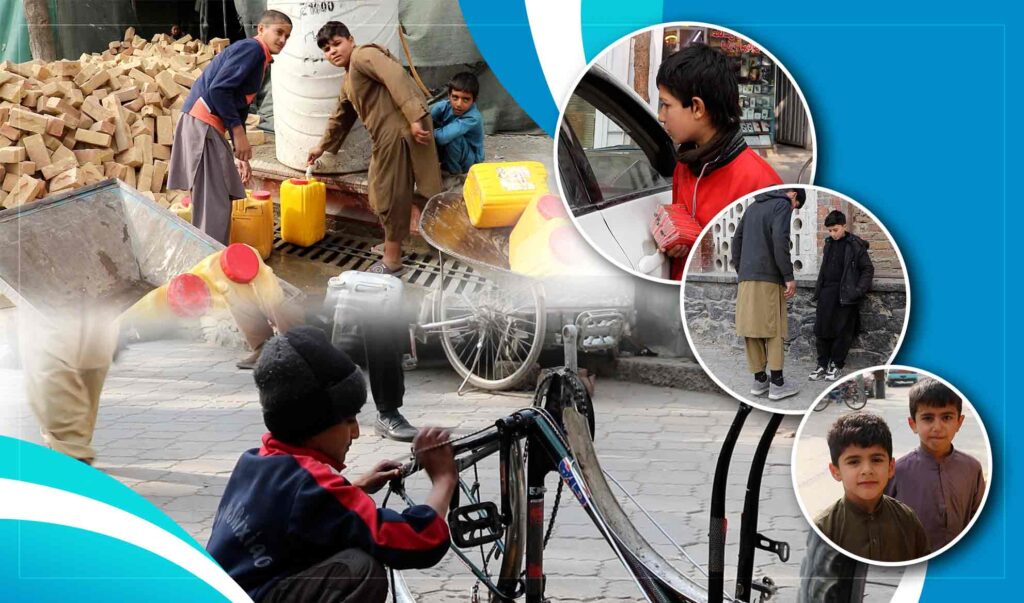

KABUL (Pajhwok): Many children in Kabul are deprived of school and recreation due to household responsibilities and work in the markets, despite education, play and healthy development being their fundamental rights.
Psychologists warn that such pressures can have serious consequences on their mental health and overall growth.
According to international laws, including the Convention on the Rights of the Child (CRC), as well as Islamic teachings, children have the right to education, proper upbringing and play.
Those prevented from enjoying these rights due to household or market work are effectively denied their legitimate human and religious rights. Families and society are responsible to ensure children access education, play and healthy development without undue pressure.
Heavy responsibilities robbing children of education, play
Mohammad Jamal (alias), an inhabitant of Kabul, said: “I am the youngest in my family. Whenever anyone has work, they call me—I don’t even get a minute to rest. My mother calls, my father, my siblings, even grandparents; whenever anyone has work, they call me, leaving me with no time to study.”
Jamal revealed he often feels exhausted from household chores.
“Many times, my teachers get angry at me, punish me and think I’m wasting my days and not studying,” he added.
He is not alone. Many children face similar pressures, as families fail to understand their situation, denying them education and recreation. Poverty forces some children to work, keeping them away from school. In the streets and alleys of Kabul, children are engaged in various jobs to help support their families.
Outside the “Barg Continental” restaurant in Shahr-i-Naw area of Kabul, an 11-year-old boy sits by a weighing scale, continuously calling out: “Aunt, weigh yourself; uncle, won’t you try? Ten afghanis per person; our machine works perfectly.”
He told Pajhwok Afghan News that he works in both hot and cold weather to earn money because his father could not cover the family’s expenses alone.
A fourth-grade student, he said: “I go to school at 7:00 am, leave at 10:00 am, and then work with my father until 6:00 pm. Some days I earn 50 afghanis, others 30, and sometimes even more.”
Living in a rented house in Taimani area of the capital, he also has to fetch drinking water from a nearby mosque because the household well has dried up due to drought.
The heavy responsibilities have left him with no time for study, play, or even thinking about his future. Teachers often punish him for incomplete homework and on some occasions, he has been physically punished.
Another 11-year-old boy, Hamza, sells plastic bags in the Qala-i-Fathullah area because his father has lost his eyesight.
Hamza and his younger brother have been unable to attend school due to financial hardship, though they study religious lessons. They earn up to 200 afghanis daily to support their family.
He expressed his wish to attend school like other children but said life’s hardships denied him that right. After returning home at 5:00 pm, he studies the Quran with his younger brother.
He loves to play football but family responsibilities leave him no time for recreation.
His only wish is for his father’s eyesight to improve and he hopes the Islamic Emirate of Afghanistan (IEA) will support needy families.
Experts: Healthy children today build a healthy society tomorrow
Mufti Shams-ur-Rahman Ferozan, a religious scholar, said: “The Prophet Muhammad (PBUH) said, ‘He who does not show mercy to our young and respect to our elders is not one of us.’”
He added children have both material and spiritual rights, including health, food, clothing, shelter, proper upbringing and a good name. Proper care during childhood ensures they can later contribute to society.
Dr. Sharafuddin Azimi, a psychology professor at Kabul University of Education, told Pajhwok that heavy household work negatively affects children, causing mental and psychological fatigue.
“Children’s brains are designed for play and learning, not for heavy work,” he said. Children forced to work feel less valuable than their peers, harming self-esteem.
Azimi added that overworked children often become timid, disheartened, anxious and low-energy. They are more prone to aggression and anger. Lack of play and recreation seriously affects brain development, social skills, emotional management, and self-confidence, resulting in frustration, demotivation, and fatigue in adulthood.
He urged families not to burden children with adult responsibilities, saying, “A healthy child today builds a healthy society tomorrow.”
Psychologist Parwiz Noori said limited participation in household duties could be beneficial if age-appropriate.
However, when children assume adult roles, it leads to serious developmental problems. Research shows child labour becomes harmful when it prevents play and education, disrupts sleep, causes psychological pressure, or demands tasks beyond the child’s physical and mental capacity.
He emphasised that recreation was essential and families, even with limited means, should focus on their children’s mental health by talking with them for 15–20 minutes daily, playing with them, and consulting them on small family matters.
kk/ma