

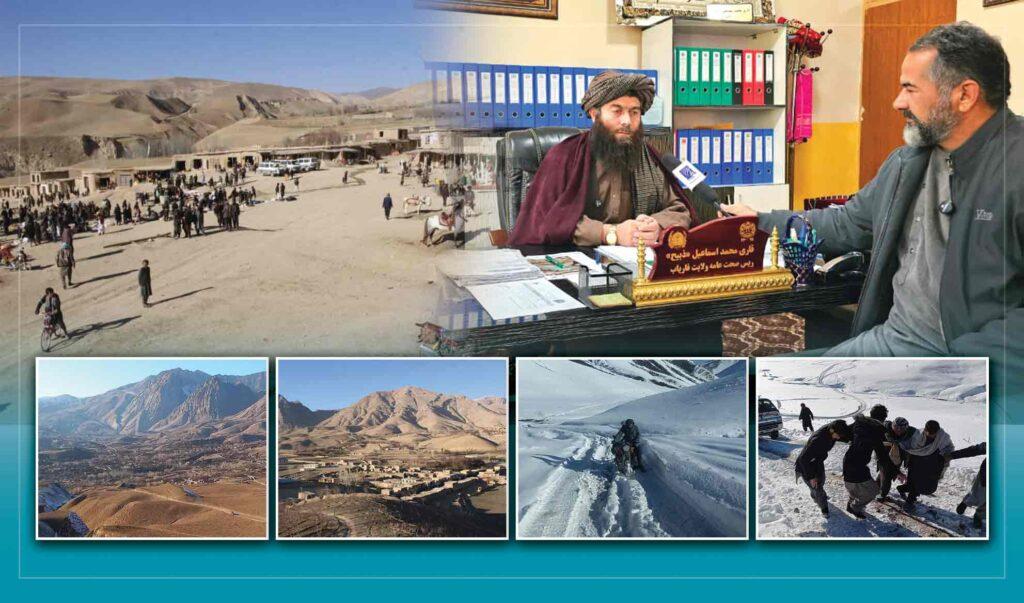

MAIMANA (Pajhwok): Some residents of remote areas in the Bandar and Lulash districts of northern Faryab province have raised concerns about the lack of health centres and the inaccessibility of roads. They say that to transfer patients to clinics in district centres, they are often forced to travel for hours along difficult routes using horses or mules—a situation that, in some cases, has resulted in loss of life.
A reporter from Pajhwok Afghan News conducted interviews with several residents of the mountainous areas of Lulash and Bandar districts to prepare this report.
The Head of Public Health in Faryab, while confirming the residents’ complaints, said that Bandar and Lulash have long been left behind in terms of development. He noted that the roads are difficult to traverse and, given the size of the districts and their populations, the existing health centres are insufficient.
However, according to the Ministry of Public Health’s plan, four hospitals with 30 to 50 beds each have been allocated by the Islamic Emirate of Afghanistan (IEA) to provide improved health services in these districts.
Bandar district of Faryab
Bandar, which separated from Lulash two years ago and was officially registered as a district within Faryab province, is located approximately 100 kilometres south of Maimana, the provincial capital.
Sayed Tajuddin, an influential figure in Bandar district, said that many areas, including Malghi, Lafrayi, and Koh-i-Tor, are located 70 to 80 kilometres from the district centre, amid valleys and mountain ranges. These areas still lack proper roads for cars and motorcycles, have insufficient health clinics, and face a shortage of doctors.
He added: “The Malghi area has a small clinic staffed with one doctor and one midwife, but services are insufficient. More than ten villages in Malghi are located in valleys six to seven hours away from the local clinic and 10 to 12 hours from the district centre clinic. Sometimes patients and pregnant women with serious complications have lost their lives due to the lack of access to essential health services. Koh-i-Tor and Lafrayi face the same problem.”
Similarly, Mawlawi Ghausuddin, a resident of Lafrayi, said the area has more than 20 small and large villages with 4,000 families but only one small clinic that does not meet basic needs.
He said patients have died en route, and residents are forced to travel 15 hours on horseback or mule to the district centre clinic; at least ten people die on this route annually.
He added that the Lafrayi clinic, staffed with two doctors and a midwife, serves only nearby villages, leaving the remaining settlements without access to health services due to distance.
Meanwhile, Mawlawi Mohammad Musa, a resident of Koh-i-Tor, said that more than a thousand households live in the area and are deprived of basic health services.
He explained: “There is no clinic or health post. The road to Bandar is impassable for vehicles and motorcycles, and it takes eight hours on horseback to reach the district centre.”
He added that repeated requests to previous government officials for roads, clinics, and schools received no attention.
Similarly, Mohammad Arif, a resident of Malghi, said approximately 20 villages with 5,000 families live there, yet there is no health centre to meet their basic needs.
He explained: “Malghi is 70 kilometres from Bandar, villages are located among valleys, there are no roads for vehicles, and the two operational health posts lack experienced doctors and essential medicines. To transfer patients to the district health centre, we must hire horses or mules for 2,000 afghanis.”
Qari Abdul Naser, the district governor of Bandar, confirmed the residents’ complaints: “Bandar has 67 villages and 99,000 inhabitants, but only three small clinics operate, which cannot meet the health needs of the population.”
He continued that these clinics are located in the district centre, Malghi, and Lafrayi, but the distance between clinics and villages is 50 to 70 kilometres, and the roads are impassable for vehicles and motorcycles. People are forced to transfer patients using horses, mules, or sometimes on their shoulders for 10 to 12 hours.
Regarding Malghi and Lafrayi, he said: “Each of these areas has 18 to 20 villages, with up to 6,000 families living there… Existing clinics cannot meet basic needs, forcing people to undertake exhausting journeys on foot or by mule to Bandar or neighbouring districts.”
He added that some patients and pregnant women from Malghi, Lafrayi, and Koh-i-Tor have died while being transferred to the district clinic or to Maimana city. Since vehicles cannot traverse these areas, people must hire horses or mules from Malghi and Lafrayi to Bandar, paying between 1,500 and 2,000 Afghanis.
He called on the Public Health Department and partner organisations to urgently address these problems, upgrade clinic capacities, and establish new health centres in underserved areas.
Lulash district
Residents and officials of Lulash district have also complained about the lack of health centres and services.
Mullah Dawood, a resident of the village of Alin in Lulash, said villages such as Alin, Qadoq, Nader, Khawja, Chah Ateh, Malmenjak, and Khazan, located in the Pasarcha area, are deprived of all social and welfare services, including roads, clinics, and schools.
He added that 20 days ago, a 65-year-old man with high blood pressure and a pregnant woman died while being transferred to the district clinic. Residents of Pasarcha remain deprived of roads, clinics, schools, telecommunications, and other basic services.
He said: “When snow falls in Pasarcha, the roads are blocked. We leave the area at 5 a.m. and reach the district centre in nine hours by mule or five hours by vehicle. The fare per person is 700 Afghanis. Life is extremely difficult for us.”
Mullah Amir Mohammad Haqqani, administrative chief of Lulash, said the district, with 64 villages and a population of 120,000, has only three clinics with limited services. He highlighted the poor road conditions: “Most villages in Lulash are six to seven hours away from the district centre by motorcycle, while the Lulash–Maimana route takes three hours.”
Response from the Public Health Department
Qari Mohammad Ismail Zabih, Head of Public Health in Faryab, acknowledged the complaints regarding the lack of health centres, doctors, and medicines in Bandar and Lulash.
He noted that the districts have long been underdeveloped, roads are difficult to traverse, and existing health facilities are insufficient given the population and area.
He explained that Bandar has one basic health centre, two small clinics, and two health posts, while Lulash has one comprehensive reinforcement health centre offering emergency surgical services, including caesarean and appendicitis operations, three small clinics in Sangin, Hashtomin, and Diwalak, and health posts in Chashma Sangin, Qadoqk, Hashtomin, Diwalak, Sangin, and Sayad Pas Arche.
He emphasised the need to establish basic health centres in Malghi and Lafrayi, noting that villages and hamlets in these areas are far from existing facilities and the roads are difficult.
He added that residents’ concerns have been raised in health sector meetings and formally submitted to the Ministry of Public Health.
He further stated that four hospitals with 30 to 50 beds each, equipped with standard facilities, have been approved by the leader of the IEA for Bandar and Lulash districts.
At present, Faryab province has one 100-bed provincial hospital, two district hospitals, 63 various health centres, and 25 health posts staffed by 253 doctors.
hz/sa


GET IN TOUCH
NEWSLETTER
SUGGEST A STORY
PAJHWOK MOBILE APP