



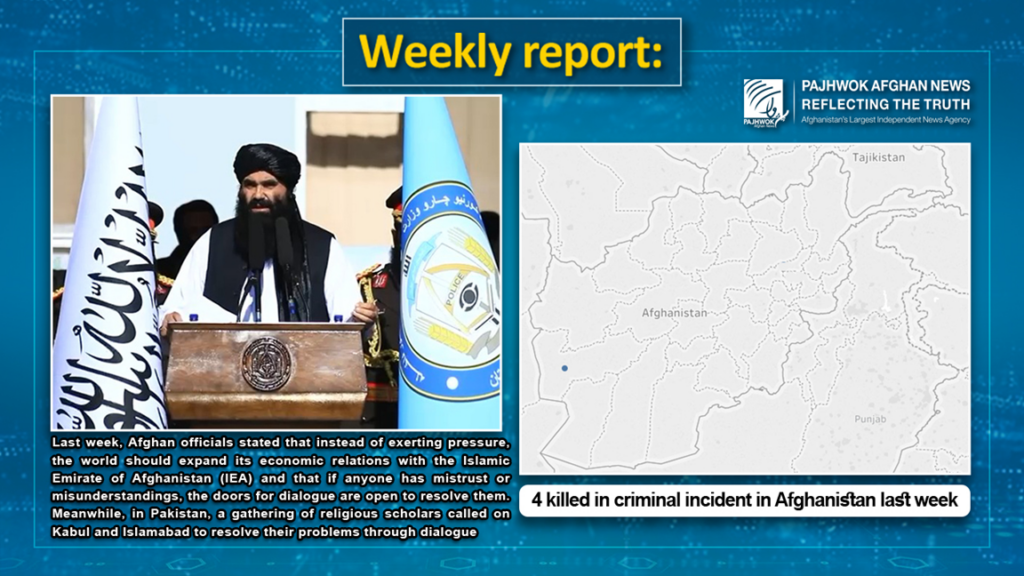

KABUL (Pajhwok): Last week, Afghan officials stated that instead of exerting pressure, the world should expand its economic relations with the Islamic Emirate of Afghanistan (IEA) and that if anyone has mistrust or misunderstandings, the doors for dialogue are open to resolve them. Meanwhile, in Pakistan, a gathering of religious scholars called on Kabul and Islamabad to resolve their problems through dialogue.
Key developments of last week:
- Pakistani religious scholars called for resolving tensions with Afghanistan through dialogue.
- A Pashtun jirga called for the reopening of the Chaman crossing.
- Mullah Baradar: The world should expand its economic ties with the IEA instead of sanctions and pressure.
- Haqqani: The current system is accountable to the nation and open to public scrutiny.
- Mawlawi Abdul Kabir: Over the past four years, 6.8 million refugees have returned, and 1.3 million people have been internally displaced.
- The UN reported a 95 percent reduction in poppy cultivation and opium production in Afghanistan since 2023, a development welcomed by the IEA.
- Afghanistan’s embassy in Japan is suspending its operations.
Casualties:
Last week, security officials in Farah province said that four people were killed in a conflict between two families in the provincial capital.
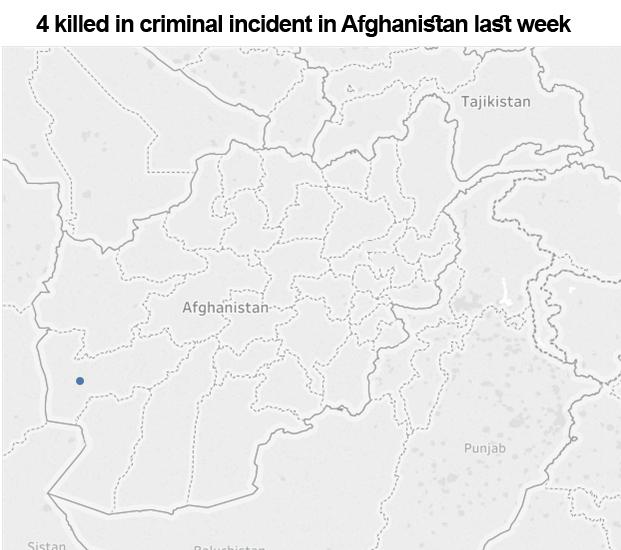
Pajhwok publishes weekly casualty figures from criminal and security incidents based on its reports; however, in the previous week, it did not receive any such reports.
Before the regime change in August 2021, hundreds of civilians, insurgents, and security personnel were killed or injured every week in the country.
IEA on international relations
Deputy Prime Minister Mullah Abdul Ghani Baradar on Saturday, during the inauguration ceremony of a commercial market project in Balkh, called on regional and global countries to adopt a softer approach and expand their economic relations with the Islamic Emirate of Afghanistan (IEA) instead of imposing unjustified sanctions and exerting pressure.
Similarly, last week, Afghanistan’s Minister of Interior, Khalifa Sirajuddin Haqqani, speaking at the graduation ceremony of Police Academy cadets, without naming any country, said that from time to time “threats” are directed at Afghanistan that cause concern among the nation.
However, he added that the leadership of the IEA is attentive to this and seeks to find a “reasonable solution” to current problems so that “in the future we do not fall into such misunderstandings with the world that people once again view Afghanistan as a source of threat, insecurity, and problems.”
The Minister of Interior said: “The doors are not closed for dialogue to resolve the existing issues in Afghanistan. We are working to address any distrust or misunderstandings reasonably and lawfully, God willing.”
Haqqani said: “This is not such an incompetent or unaccountable system that the nation cannot hold it responsible. Even if we currently have limited tanks, artillery, aircraft, air defense, and ground defense, thankfully, our determination and resolve are strong. We assure you of this, so do not worry and do not be concerned about anyone. By God’s grace, we have proven our resolve.”
Afghanistan-Pakistan ties
Last week, a gathering of Pakistani clerics, led by Jamiat Ulema-e-Islam (JUI-F) chief Maulana Fazlur Rehman, voiced concern over recent tensions between Pakistan and Afghanistan, stressing that the only sustainable and practical way to resolve disputes was through direct dialogue between the two neighboring countries.
They emphasized that officials of both countries should find positive and practical solutions to all issues so that relations between the “two neighboring and brotherly countries” return to normal and the ground is prepared for the continuation of travel and trade between them—something that would benefit both sides.
A jirga of Pashtun elders in Chaman has urged Pakistan to reopen the Spin Boldak–Chaman crossing to resolve the problems of thousands of stranded passengers and cargo vehicles.
Nearly two months ago, Pakistan violated Afghanistan’s airspace and carried out strikes on some areas, to which IEA forces responded with retaliatory attacks.
Following these tensions, several rounds of negotiations were held between Kabul and Islamabad in Qatar, Turkey and Saudi Arabia, but they yielded no positive results.
The IEA’s chief spokesman, Zabihullah Mujahid, had stated that the irresponsible behavior and lack of cooperation by the Pakistani delegation caused the Turkey talks to fail, despite the Islamic Emirate’s goodwill and the efforts of mediators. Pakistan has so far violated the ceasefire several times.
Afghan refugees
Last week, the United Nations High Commissioner for Refugees said that the fate of Afghan refugees in Pakistan remains unclear, their situation is concerning, and that in 2025 nearly 2.8 million Afghans were returned from Iran and Pakistan.
Similarly, Afghanistan’s Minister of Labor and Social Affairs, Mullah Abdul Manan Omari, discussed the resolution of Afghan refugees’ problems during a meeting with Iran’s ambassador in Kabul.
Last week, Iran’s Deputy Ambassador in Kabul, Seyed Hossein Mortazavi, during a meeting with the Governor of Herat, Sheikh Mawlawi Islam Jar, said that Tehran is working to expand and strengthen relations with Afghanistan and is trying to make the visa issuance process for Afghans easier and simpler.
This comes as last week Afghanistan’s Minister of Refugees and Repatriation, Mawlawi Abdul Kabir, said that over the past more than four years, 6.8 million refugees have returned to Afghanistan, and 1.3 million people have been internally displaced due to natural disasters.
UN report on reduction of narcotics, IEA response
Last week, the United Nations Office on Drugs and Crime (UNODC) said in its report that since 2023, a strict ban on poppy cultivation and opium production has led to an estimated 95 percent reduction in production in Afghanistan.
The report stated: “Since 2023, the strict ban on poppy cultivation and opium production in Afghanistan has, by estimate, resulted in a 95 percent reduction in production, and as a result, Myanmar has become the world’s most significant source of illicit opium production. The global shortage of opiates, particularly heroin in markets that were previously largely supplied by Afghanistan, may, after the reorganization of global supply chains and distribution networks, put upward pressure on opium prices in Myanmar.”
Afghanistan’s Ministry of Interior spokesman, Abdul Mateen Qani, welcomed the UNODC’s latest report and said: “The latest statements of the United Nations Office on Drugs and Crime, which say that since the IEA came to power—especially following the decree of the Islamic Emirate’s leader—drug production in Afghanistan has decreased by 95 percent, are true. We welcome and appreciate this because, as the Islamic Emirate promised, it is addressing this problem and will eliminate this scourge from its soil.”
Suspension of Afghan embassy in Japan
On Friday, Afghanistan’s embassy in Tokyo, Japan’s capital, announced that it will suspend its operations after January 31, 2026.
The Afghan Embassy in Tokyo announced it would suspend its activities after January 31, 2026, following consultations with the Japanese Ministry of Foreign Affairs.
In a statement, the embassy said all activities and services, including political, economic, cultural, and consular affairs, will be suspended after January 31, 2026, until further notice.
sa

GET IN TOUCH
NEWSLETTER
SUGGEST A STORY
PAJHWOK MOBILE APP