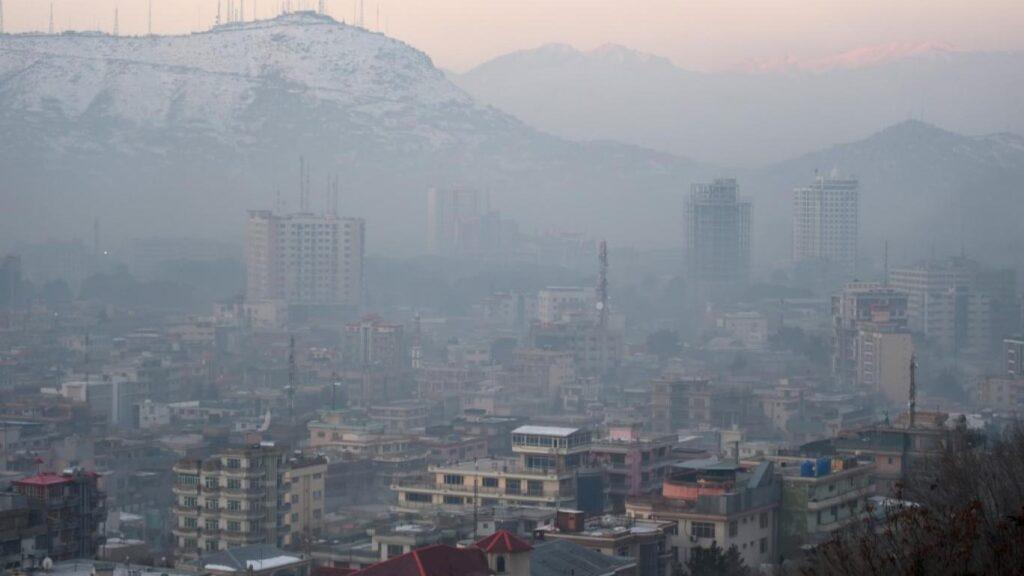

KABUL (Pajhwok): As winter approaches, many residents of Kabul have raised concerns over rising air pollution—a problem that, according to doctors, has serious and harmful consequences for public health. They advise that people use air-purifying masks when moving around outdoors.
Doctors say that the widespread use of cheap and low-quality fuels, the increase in polluting vehicles, and high urban population density have caused Kabul’s air to become severely polluted.
Dr Mahmood Khan Zazai, a family medicine specialist at Sarwari Medical Complex, told Pajhwok Afghan News that air pollution is one of the world’s major problems, and Afghanistan is no exception. It poses numerous harmful effects on people’s health.
He explained that every year, with the onset of winter, the use of low-quality, smoke-emitting fuels causes air pollution to rise. Highlighting the increase in harmful gases in the air, he added that air pollution can lead to respiratory problems, heart disease, and even cancer, placing children and the elderly at particular risk.
Dr Zazai advised that on days when air pollution is high, citizens should avoid unnecessary travel. He recommended the use of ventilated masks for protection and urged families to refrain from using low-quality, smoke-emitting fuels.
Similarly, Dr Nusratullah Arash, a specialist in internal medicine and allergies at a Kabul hospital, said that polluted air is harmful because it contains dangerous gases. He added that burning harmful materials contributes to air pollution and can cause allergies, shortness of breath, dizziness, headaches, and other health issues. He urged citizens to wear masks outdoors and, as far as possible, avoid using low-quality fuels for heating their homes.
Rising air pollution, respiratory problems, polluting fuels
Bibi Qudsia, a resident of Kheirkhaneh, Kabul, suffering from lung and chest problems, expressed concern that air pollution has reached levels where thick smoke and dust reduce visibility and make movement difficult, especially in the evenings. She said: “The air is so polluted that I experience severe shortness of breath and cannot go outside. Even taking medicine does not help.”
Shahbaz (a pseudonym), another Kabul resident, said: “The air in Kabul has become excessively polluted and is harmful to all of us.”
He emphasised that the weak economic situation forces people to use coal, tyres, old blankets, and other polluting materials to heat their homes, while the growing number of vehicles is a major factor worsening air pollution.
Nabila, a resident of Kabul’s 8th police district and mother of three, said that after her husband lost his job, they were forced to heat their home by burning plastic and old tyres.
She said: “My husband has been unemployed, and for three years we have been burning tyres and plastic; I have no choice.” She expressed hope that rainfall would help reduce smoke and air pollution. She added: “People are not to blame; the government should take action and provide wood and coal to low-income families in winter, so they are not forced to burn plastic and old tyres.”
Fuel sellers: Low-quality coal driving air pollution
Hamid, a fuel seller, said that coal is currently the best-selling fuel because it is cheaper, and most people cannot afford wood.
He added that coal produces thicker, more harmful smoke than wood, further contributing to air pollution.
Environmental officials step up monitoring to curb air pollution
Ahmadullah Shirzad, Head of Monitoring at the Environmental Protection Department, said that his office, in coordination with relevant departments—especially in Kabul and other major Afghan cities—carries out continuous monitoring throughout the year.
He explained that inspection teams identify polluting activities and take necessary measures. They also advise production centres, particularly factories, to install standard filters.
He added that specific plans are in place for Kabul during winter, and even high-rise buildings with central heating systems are monitored, with an emphasis on filter installation.
He said that based on this year’s experience, efforts will continue in the future to reduce problems caused by low-quality fuels and air pollution.
Shirzad also noted that monitoring of high-rise buildings and bathhouses continues, and almost all have installed filters. Meanwhile, smoke-emitting vehicles have been halted until they are repaired, and efforts are being made to ensure that the fuels used are of appropriate quality.
hz/sa