



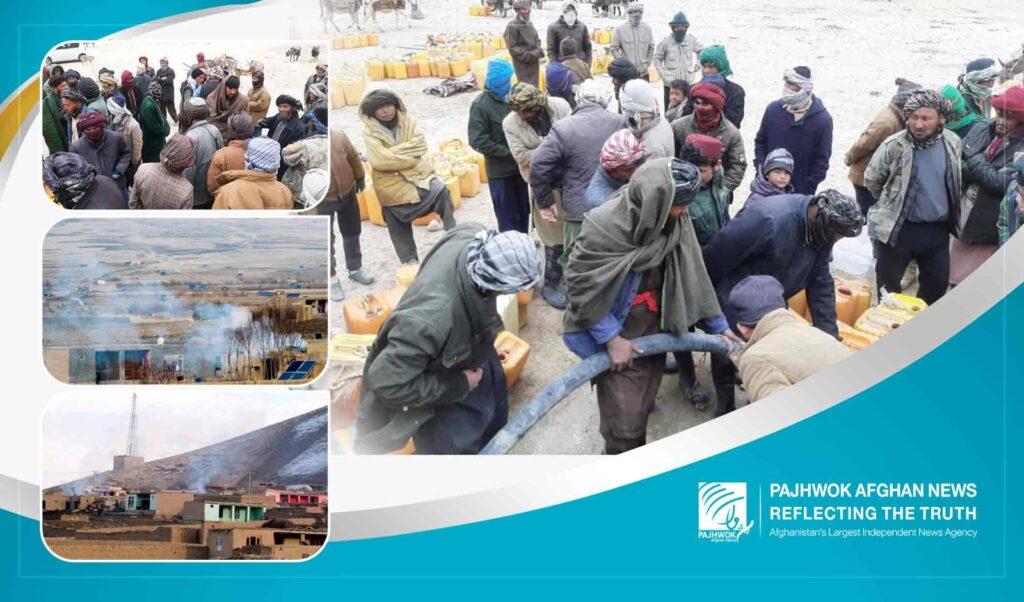

AIBAK (Pajhwok): Although recent rainfall has revived hopes among residents for a reduction in drought, people in some areas of Dara-i-Suf-i-Payin district of northern Samangan province say they are facing a severe shortage of water and are forced to walk for hours to obtain drinking water.
Prior to the recent rains and snowfall, a Pajhwok Afghan News reporter in Samangan interviewed residents of the villages of Maqsoud, Zirki, Lababi, Baghak, Zaidori, and Bayanan in Dara-i-Suf-i-Payin district.
Residents say that to obtain safe drinking water they must travel on foot or by pack animals for six to nine hours, and they are calling for urgent and sustainable measures to resolve the problem.
Meanwhile, officials say some programs are being implemented to reduce water shortages in the district.
Residents: Repeated droughts have made our lives extremely difficult
Din Mohammad, a 65-year-old resident of Maqsoud village in Dara-i-Suf-i-Payin, said the district, which in previous years had green landscapes, a pleasant climate, and fertile agricultural land, has now turned into a dry, colorless area with cracked soil due to consecutive droughts. He added that many residents who were financially stable have migrated.
Criticizing previous governments, he said there is no well or water tap in the village, and residents used to meet their water needs from pits filled with melted snow during winter, but those pits have now dried up.
He said he had come to a neighboring village to fetch water: “I heard a water tanker had arrived here. I walked for three hours, but when I reached the village, the water was finished and I had to return empty-handed.”
According to him, the lack of drinking water has forced many families with financial means to leave the village, while those who cannot afford transportation struggle severely to obtain water.
Similarly, Rozatullah, a resident of Tawqson Maqsoud village, raised the same concern, saying repeated droughts have caused serious difficulties in their lives.
He said he traveled for eight hours with two pack animals and a child to collect four barrels of water from the Chapchal area.
To prevent water waste, he said, used water from ablution and dishwashing is collected and reused for livestock.
“There are children in our village who have been deprived of schooling because they must travel long distances to fetch safe drinking water,” he said.
Rozatullah, who is a livestock owner, added that repeated droughts have also devastated agriculture, turning once-fertile lands into dry and cracked fields.
Meanwhile, Tashmorad, a resident of Zirki village, said that in previous years he cultivated wheat, barley, and chickpeas and earned a good income, but drought has now made his family’s livelihood highly vulnerable.
Experts emphasize urgent action to ensure sustainable water supply
Ustad Malik Fahd Qahramanzada, a social activist in the district, said that more than 60,000 families on both the eastern and western sides of the Dara-i-Suf-i-Payin river basin are facing a severe shortage of drinking water.
He attributed the crisis to the absence of nearby springs and rivers and the drying up of water pits due to insufficient rainfall.
“To address the residents’ problems, officials must launch urgent and comprehensive measures to ensure safe and sustainable drinking water in Dara-i-Suf-i-Payin district,” he said.
These measures include the immediate distribution of water tankers, rehabilitation and improvement of existing water sources, expansion of wells and rainwater harvesting systems, and long-term drought management planning to prevent a humanitarian crisis and forced migration.
Meanwhile, Ahmad Jawid, a lecturer at Samangan University and an environmental expert, warned that water shortages in the short term could lead to the spread of diseases, reduced agricultural production, and food insecurity, and in the long term could result in forced migration, chronic poverty, and environmental degradation.
He said that without effective water resource management and sustainable programs, these areas could become uninhabitable in the future, echoing calls for urgent and practical measures to improve access to drinking water and living conditions.
Officials: 80 percent of residents face water shortages
Qudratullah Baik, executive head of Dara-i-Suf-i-Payin district, said recent droughts have left nearly all residents facing a shortage of safe drinking water.
He said that although dozens of water tankers have been dispatched on an emergency basis by provincial authorities, these efforts are short-term and long-term programs are needed to address the problem fundamentally.
Referring to recent snowfall, he said that although snow has fallen in recent days, it has not yet benefited residents, as severe cold prevents people from collecting and using melted snow.
“In my view, this snow will only be useful for a limited time,” he said. “Fundamental solutions such as drilling deep wells and expanding water supply networks are required to resolve the water shortage sustainably.”
Meanwhile, Sheikh Abdul Rahim Sarbaghi, administrative chief of Dara-i-Suf-i-Payin district, said that 70 to 80 percent of residents are currently facing a shortage of drinking water.
He said that during a meeting at the provincial governor’s office with the participation of district residents, a decision was made to transport water to villages by tanker.
According to him, if the situation persists, residents will be forced to leave their homes. He added that while no human casualties have been recorded so far, people are compelled to travel for hours to obtain water.
Sarbaghi said livestock owners and farmers have been severely affected, forcing many to sell their assets to prevent livestock losses, and that many families are now surviving only with working pack animals.
sa


GET IN TOUCH
NEWSLETTER
SUGGEST A STORY
PAJHWOK MOBILE APP