

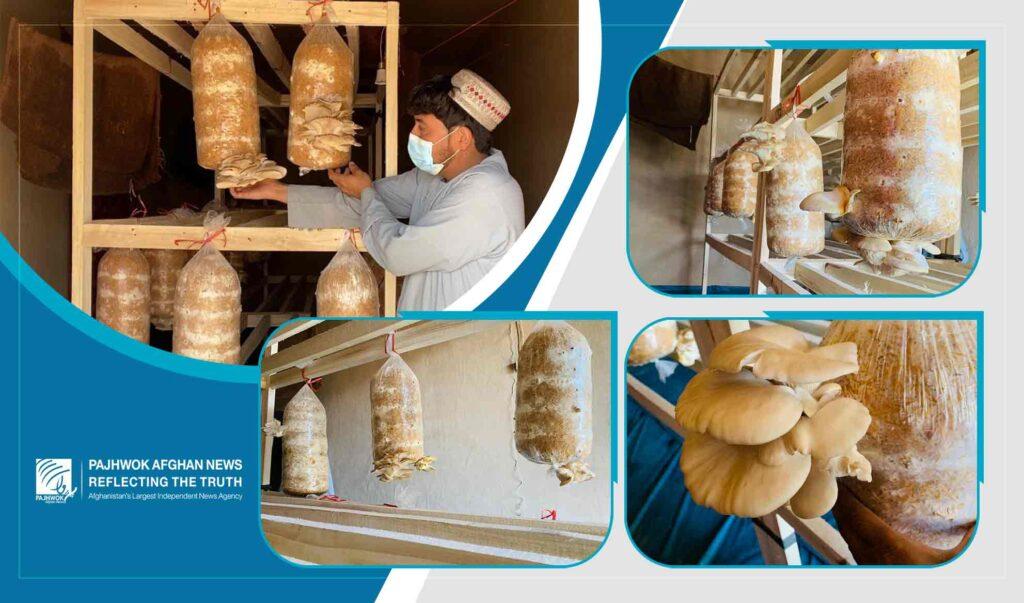

KABUL (Pajhwok): Dozens of farmers in southern Kandahar province have requested training in mushroom farming following a Pajhwok report promoting it as an alternative to poppy cultivation, the Agriculture, Irrigation and Livestock Department said Wednesday.
On 8 December, Pajhwok Afghan News reported on the benefits of mushroom cultivation in Kandahar, highlighting its potential in the context of climate change.
The report noted that mushroom cultivation requires low costs, offers high yields, and could serve as a viable alternative to poppy cultivation in the province.
Mohammad Hanif Haqmal, spokesman for the agriculture department, told Pajhwok that although mushroom farming is economically advantageous, it has not yet become widespread in Kandahar.
He explained that the main reasons for its slow adoption are farmers’ limited awareness and the lack of practical training.
Haqmal said that some time ago, the Dutch Committee for Afghanistan (DCA) provided selected Kandahar farmers with training, mushroom spores, and other necessary equipment, which produced promising results. These farmers were able to achieve good harvests at minimal cost.
He added: “After the Pajhwok report was published, dozens of farmers approached us, requesting training in mushroom cultivation so that this practice can expand and become a reliable source of income.”
Haqmal said efforts are underway to organize training programs for farmers on mushroom cultivation, enabling more of them to become familiar with the crop and start growing it practically.
Meanwhile, farmers have expressed strong interest in mushroom farming, noting that it can help ease their economic difficulties.
Nizamuddin, a farmer from Zherai district, said he had previously only heard the name mushroom but lacked clear information on cultivation methods or economic benefits.
“We had heard that mushrooms have a good market, but we didn’t know how to grow them, what the costs were, or how long it takes to harvest, so we hadn’t started. Now we intend to grow them,” he said.
Another farmer, Asadullah, noted that mushroom cultivation requires less time than traditional crops, and the yield reaches the market quickly.
Following the ban on poppy cultivation in Kandahar, the agriculture department has, on its recommendation, introduced alternative crops such as hing (asafoetida), saffron, mushrooms, persimmon, and pistachio orchards as profitable options.
hz/sa


GET IN TOUCH
NEWSLETTER
SUGGEST A STORY
PAJHWOK MOBILE APP