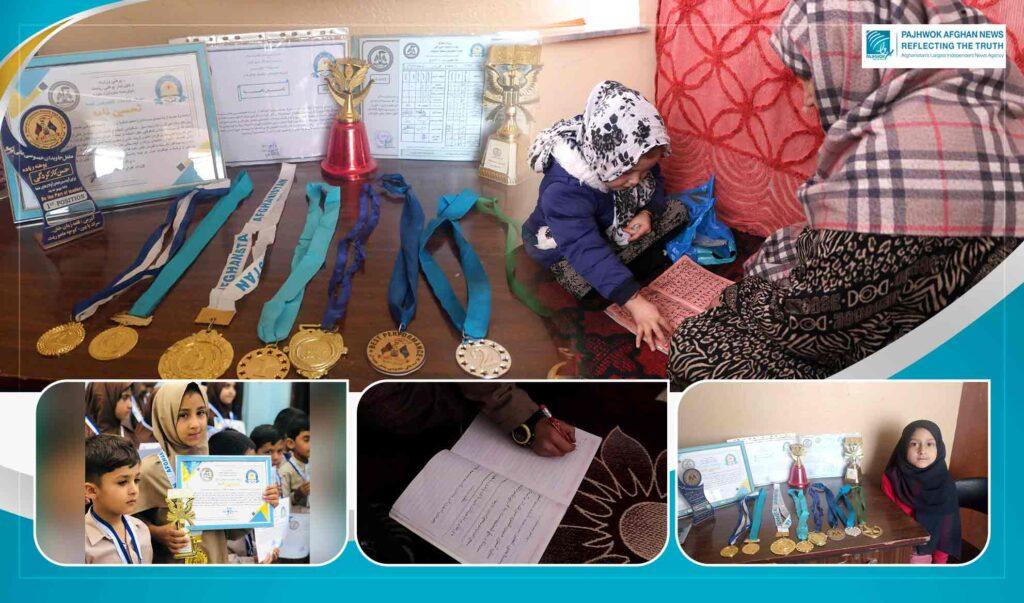

KABUL (Pajhwok): At a time when the quality of education is increasingly linked to family involvement, the story of an 11-year-old girl in Kabul demonstrates how purposeful home-based and informal education, parental support and continuous encouragement can foster academic progress, moral development and a bright future.
Hadisa, a resident of Kabul city who has consistently ranked first overall at her school for the past five years, is currently preparing for grade six while also attending a madrassa (seminary) daily.
With childlike enthusiasm but strong determination, she is engaged in learning and memorising the Holy Quran—a path that, supported by her family, promises a bright future.
Explaining how she achieved top position, she says: “When the teacher explains the lesson, I listen carefully, practise with my classmates and when I come home, I revise the lesson again with my elder sister.”
Hadisa says that before enrolling in school, her mother and elder sister had taught her first-grade subjects at home. When she joined school, her teacher assumed she had already studied for a year.
Hadisa, who also helps weaker classmates at school, adds: “In class, I help those who struggle with mathematics and Dari. They say they learn better from me.”
Referring to the certificates, cups, medals and gifts she has received for ranking first overall, she says: “I want to become a successful journalist, serve my people and also rank first at university. I hope the Islamic Emirate of Afghanistan (IEA) allows all girls to attend school above grade six.”
Hadisa’s elder sister, Hajira, says: “Hadisa is a very intelligent girl and always tries to learn new things.” She adds that Hadisa has good speaking skills and has served as an announcer at many school programmes.
Hadisa’s mother, Zakia Ibrahimi, says: “From early childhood, I realised Hadisa was intelligent and had a special interest in learning. When she was only four, she would pick up her sisters’ books and pens while they were studying. That was when I decided to begin teaching her.”
According to her mother, Hadisa joined kindergarten at the age of four but simultaneously studied first-grade textbooks at home under her mother and sister’s guidance.
“Another of Hadisa’s talents is presenting. When I noticed this, I encouraged her to record children’s programmes at home. Now she has good speaking skills and takes responsibility for presenting some school programmes,” she adds.
Hadisa has currently completed recitation of 25 Juzs of the Holy Quran and memorised up to the third Juz so far.
However, Hadisa is not the only child to benefit from parental support. Marjan, a five-year-old girl, is also learning under her family’s supervision.
Five-year-old Marjan sits in a corner reciting Quranic verses in a childlike but clear voice—an age usually associated with play, but for her, the start of a different path.
She is learning to read and write alongside Quranic studies under the guidance of her mother and elder sisters.
Marjan says: “Every day I go to the madrassa with my sister and memorise verses of the Holy Quran.”
Her sister, Fatima, says Marjan has memorised ten short chapters so far and continues enthusiastically.
Her father, Mohammad Nader, says: “Marjan is highly intelligent. We ensure she learns reading, writing, and arithmetic before enrolling in school. Her sisters have even started teaching her English and Pashto. Praise be to God, her learning ability is very high.”
Meanwhile, Abasin, a grade two student in Kabul, is another talented child who has progressed well with parental support.
He says: “My mother always helps me with my lessons. I do everything on time, I play and I study, and my teachers are very happy with me and like me.” Abasin had also learned basic lessons at home, particularly from his mother, before starting school.
Experts: Parental attention is key to children’s development
Qudsia Ghanizada, a high school teacher in Kabul, says: “As a mother and a teacher, I consider informal and home-based education the foundation of learning. Usually, children who perform well at school are those who have been taught at home by their parents.”
She adds that learning begins from birth—from eating, recognising the mother, speaking, and beyond. Parents should understand their child’s ability to absorb information. If this capacity is high, they should first provide religious education, then invest in areas where the child has skills.
Ghanizada stresses that parents should give equal attention to daughters’ and sons’ education, never discriminate between them, and provide equal learning opportunities.
kk/sa