



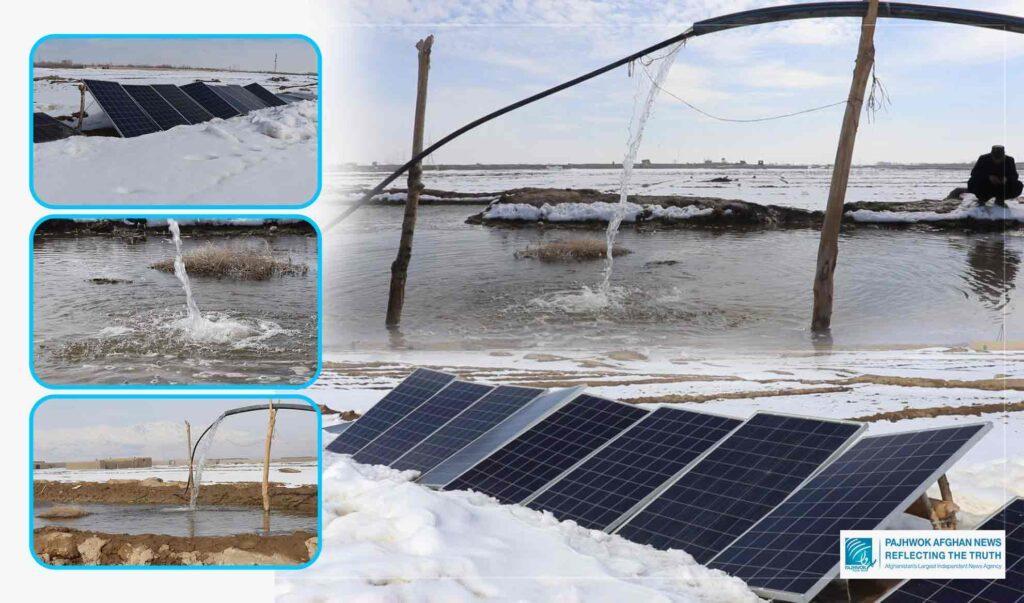

GHAZNI CITY (Pajhwok): Some residents and environmental experts in southern Ghazni province have raised concerns over the excessive extraction of groundwater for agricultural purposes using solar power, warning that the practice poses a serious threat to underground water reserves.
Rahmatullah, a resident of Qarabagh district, told Pajhwok Afghan News that while solar energy is an affordable and effective solution for irrigation, uncontrolled groundwater pumping could significantly lower the water table and eventually lead to the drying up of canals, wells and other water sources.
“In the province, the use of solar power to extract water has increased sharply, and even during winter people continue pumping water unnecessarily,” he said.
Murtaza, another resident, stressed that solar-powered wells should be properly managed to protect underground water reserves.
He warned that water levels had already dropped considerably compared to previous years and, if the situation persists, it could create serious challenges for agriculture and livelihoods. He urged the government to address the issue, cautioning that continued over-extraction could deplete water reserves.
However, some farmers argue that if water is not pumped during winter, underground water channels may become blocked, reducing water availability in summer.
A farmer, Raz Mohammad, said: “If we do not extract water from borewells during winter, the underground water veins become blocked, and in summer we cannot obtain sufficient water as before.” He added that farmers therefore feel compelled to continue pumping water throughout the year.
Water management expert Eng. Syed Yahya Soroush told Pajhwok that excessive and unnecessary extraction was leading to the rapid depletion of groundwater reserves and warned that, if the trend continues, residents may eventually be forced to leave their areas.
He noted that groundwater accumulates over thousands of years and cannot be replenished within a short period. “Even if more dams and check dams are built, they cannot be as effective for groundwater as natural sources. While dams help prevent floods and may recharge nearby aquifers, they cannot supply sufficient water to all lands,” he explained.
Soroush urged the government and relevant institutions to implement clear water management policies and place solar-powered wells under proper monitoring to safeguard natural reserves.
Responding to the concerns, Mawlavi Shafiullah Mansoor, head of the Ghazni Sub-Basin Authority, said public awareness campaigns had been conducted, but many people still failed to take the issue seriously. He added that efforts were under way to mechanise irrigation systems.
According to him, plans are in place to install water metres on each borewell to ensure better management and prevent waste.
Meanwhile, Zakaria Hotak, spokesman for the Ghazni Agriculture and Livestock Department, urged farmers to pay greater attention to water conservation.
Ghazni is one of Afghanistan’s key agricultural provinces, with around 80 per cent of its residents engaged in farming and livestock.
hz/sa

GET IN TOUCH
NEWSLETTER
SUGGEST A STORY
PAJHWOK MOBILE APP