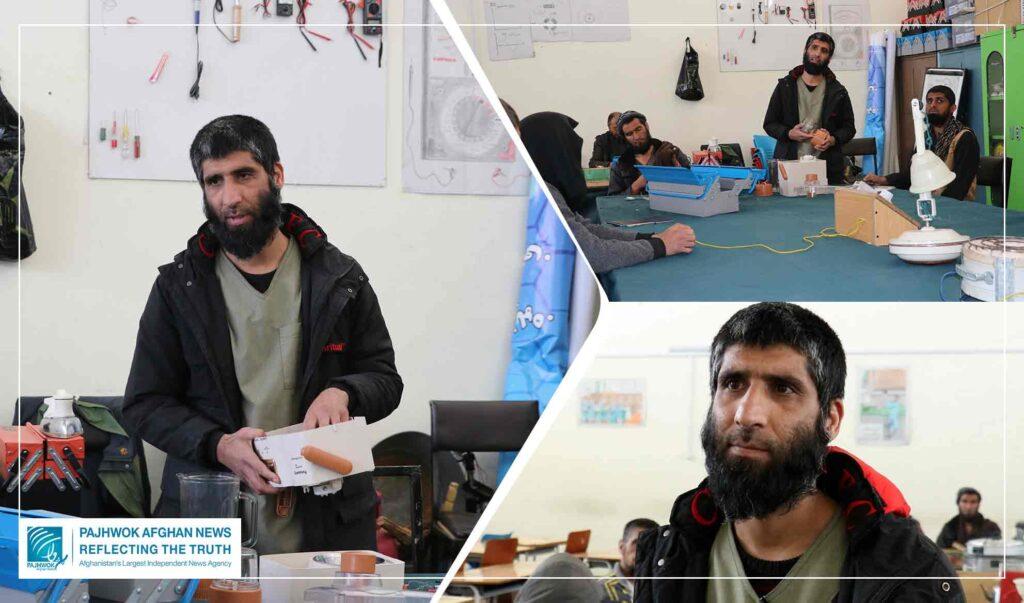

KABUL (Pajhwok): Thirty-eight-year-old Munir Ahmad – who has spent nearly half of his life addicted to drugs – says that in his youth, ignorance led him into addiction, causing him to lose a good life and social respect. However, he is now pleased to have undergone treatment.
Munir Ahmad, originally from Helmand and currently residing in Kabul, states that he has used various narcotics over the course of 18 years.
He reports that his parents are alive, and he has four brothers, a wife, one son, and two daughters.
This young man, who has engaged in learning at an electronics repair centre following treatment, said that he has completed some higher education in computer science and can also communicate at a basic level in English and Urdu.
Munir Ahmad spoke with the Pajhwok Afghan News reporter in both English and Urdu.
When asked why he turned to drugs, he said: “It was youth, recklessness, and ignorance. Some of my friends used drugs; I spent time with them and eventually became addicted myself.”
He explained that after becoming addicted, his economic problems and mental stress intensified.
Munir Ahmad states that before his addiction, he led a good life, was an active family member, worked, maintained social connections, and enjoyed respect in society, but after addiction, he lost all of this.
He said: “Every addict eventually reaches a day when they cannot find drugs. They try everything, steal, cheat, and deceive… Addiction is a practice that compels a person to do anything.”
Munir Ahmad reports that around three months ago he attended a rehabilitation centre called Omid, located in the Pul-i-Charkhi area of Kabul, where he received treatment. He is currently training in electronics repair at a vocational training centre named ‘Aghosh’.
He said: “I came to treatment because I was tired of using drugs; I had lost everything, faced economic difficulties, could no longer obtain substances, and was under mental strain. Even when I used drugs, they no longer affected me, and I no longer experienced the previous pleasure. Due to these hardships, I sought treatment and took refuge here to overcome this condition.”
According to him, quitting addiction was difficult at first, but gradually became easier, and his condition has now improved.
He added: “I deeply regret having started this habit, and when I recall the things I did while addicted, I become very upset, because addiction forces a person to commit acts that one feels ashamed of when remembered.”
He further stated that he is happy to have been cured, has regained hope in life, and, after completing vocational training, plans to resume a normal life with his family and children.
Munir Ahmad urged young people to protect themselves from the harmful practice of addiction, so that they do not encounter misfortunes like those who have fallen into it.
According to the Ministry of Public Health, a 2015 survey estimated that there were 3.5 million addicts in Afghanistan, though no precise survey has been conducted since then.
Dr Sharafat Zaman, spokesperson for the Ministry of Public Health, told Pajhwok that since the Islamic Emirate of Afghanistan (IEA) regained power, around 121,000 addicts across the country have received treatment.
He added that there are currently about 67 rehabilitation centres operating nationwide, with approximately 5,000 people undergoing treatment.
He stated that of these centres, 45 are for adult men, 14 for women and children, and 7 are specifically designated for young people.
The leadership of the IEA, in a decree issued on 3 April 2022, banned the cultivation of opium poppy as well as the use, sale, and trafficking of all types of narcotics.
sa