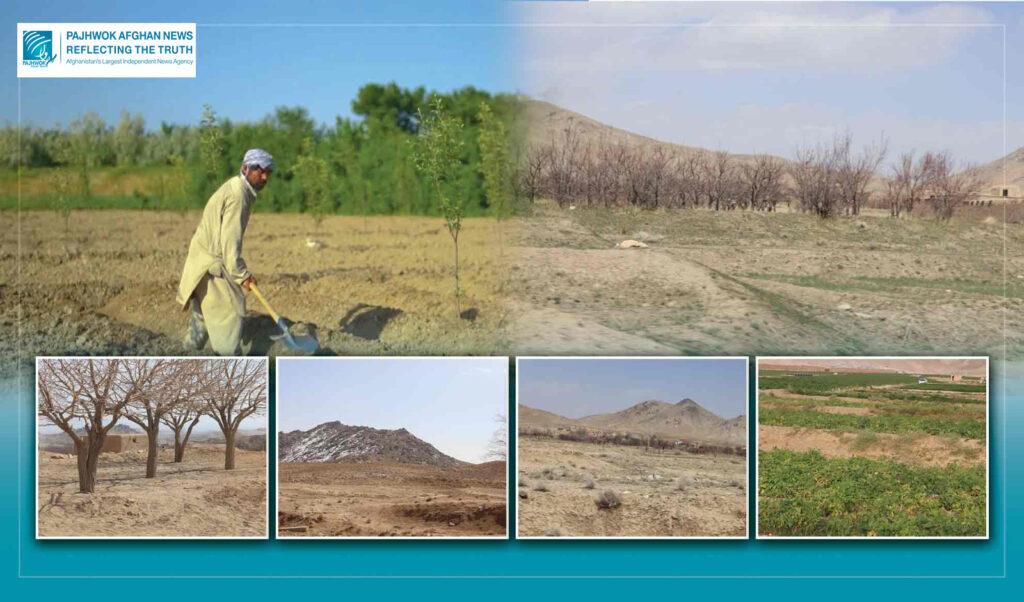

KABUL (Pajhwok): Some farmers in southern Ghazniprovince are calling for the implementation of projects providing improved seeds, standard fertilisers and water-management systems.
They say such measures could increase crop yields, strengthen farmers’ livelihoods, and reduce the negative impacts of climate change.
The Earth’s climate is changing rapidly. In some regions, rising temperatures are causing droughts, while in others they are resulting in severe storms, heavy rainfall, and floods.
Climate change and its impact in Afghanistan
Although Afghanistan contributes only 0.19 percent of global greenhouse gas emissions, it ranks fourth among countries most vulnerable to climate change. The agricultural sector, which provides livelihoods for nearly 80 percent of Afghans, has been heavily affected. Erratic rains and floods linked to climate change often destroy or reduce crop production.
Ghazni is among the provinces most severely affected, and local farmers are seeking support.
Mohammad Ali, a farmer in Khwaja Omari district, told Pajhwok Afghan News that the timely distribution of improved, high-yield seeds and standard fertilisersby agricultural departments and aid agencies could mitigate climate-related losses and increase agricultural output.
He also highlighted the importance of implementing basic water-management projects. “Constructing small dams and check-dams across different areas will help store rainwater and snowmelt, raise underground water levels, and keep farmland irrigated,” he said.
Lal Mohammad, another farmer in Khogyani district, explained: “If we receive quality seeds adapted to local climatic conditions, our yields will increase, crops will be more resistant to diseases, and we can supply better produce to the market.” He added that seeds should be distributed on time and either free of charge or at reasonable prices.
He emphasised that water is the greatest challenge and that small and medium-sized dams could store rainfall, reduce the impact of droughts, and ensure more sustainable agriculture. “Deep wells alone are not the solution; proper water management is key,” he added.
Eng. Hasebullah Samim, a climate-change expert, told Pajhwok that sustained measures in water management, improved seeds, and fertiliser use would not only strengthen farmers’ economies but also make the country more self-sufficient in food production.
Qari Zakaria Hotak, spokesperson for the GhazniAgriculture, Irrigation and Livestock Department, said thousands of farmers in the provincial centre and several districts have already received improved seeds and fertiliser.
He added that further programmes are planned to extend assistance to thousands more farmers.
He noted that drip irrigation has produced positive results in water conservation, and awareness campaigns will be conducted in collaboration with relevant agencies.
Meanwhile, Mawlawi Mohammad Shafiq Mansoor, head of the Energy and Water Department, said that over the past two years, 39 small dams and check-dams have been constructed in the provincial centre and districts with government and donor support.
He added that around 20 additional small dams and water-management projects are planned for next year to improve water storage and replenish underground water resources.
hz/sa