

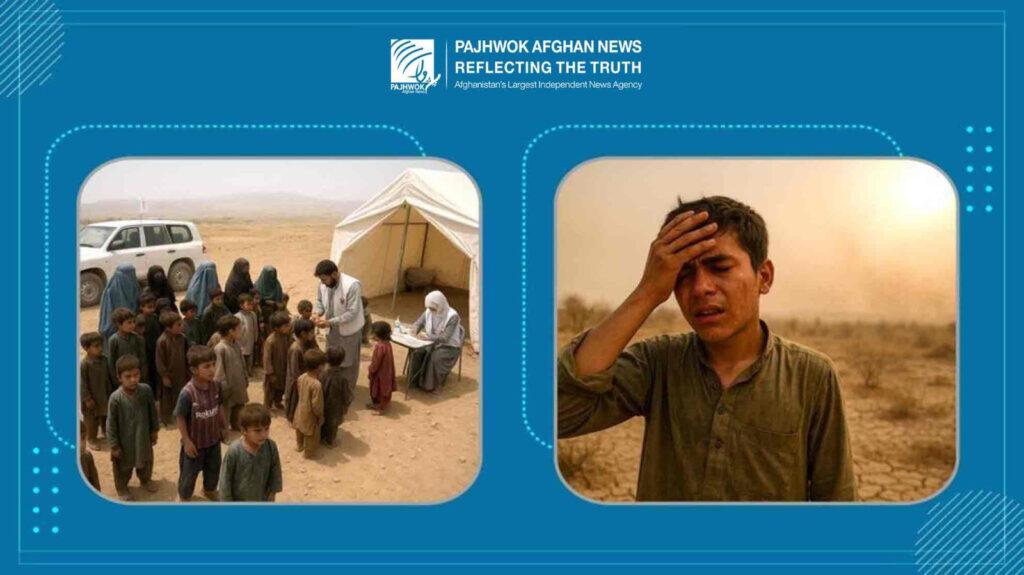

KABUL (Pajhwok): Environmental and health experts have warned that rising temperatures and unusual rainfall patterns are accelerating glacier melt, reducing snow cover, drying soils, increasing land erosion and triggering more frequent dust storms across Afghanistan, while also posing serious risks to public health.
They emphasised that, although Afghanistan has contributed little to global climate change, it remains one of the countries most vulnerable to its impacts, requiring international cooperation to address the issue and mitigate its effects.
The Earth’s climate is undergoing rapid changes. Global warming has caused droughts in some regions while provoking storms, heavy rainfall and floods in others.
It is also accelerating the melting of glaciers and raising sea levels. Studies indicate that climate change, particularly rising rainfall and glacier melt, may increase underground risks such as earthquakes and volcanic activity.
In May 2025, the Food and Agriculture Organisation(FAO) reported that snowfall in Afghanistan had reached a 25-year low at the beginning of the 2025/26 winter season.
The organisation noted that this posed a serious threat to agriculture and livestock, as many areas rely heavily on water from melting snow. United Nations statistics indicate that Afghanistan faced one of its most severe droughts in recent years during the previous year.
Environmental experts’ views
Environmental expert Najibullah Sadid told PajhwokAfghan News that the effects of climate change were clearly visible in Afghanistan.
He explained that the average annual temperature rise in Afghanistan and Central Asia was around two degrees Celsius higher than the global average, indicating the region was warming faster than much of the rest of the world.
Sadid added that in the past, due to Afghanistan’s geographical location, the country received heavy snowfall, which accumulated in the mountains and provided the main source of water.
However, rising temperatures have reduced snowfall, with rain increasingly replacing snow. According to him, rain is less effective as a water source because it often leads to floods and, due to inadequate infrastructure, quickly runs off.
He said higher temperatures are also causing glaciers to melt, noting that studies indicate approximately 14 per cent of Afghanistan’s glaciers disappeared between 1990 and 2015.
Rising temperatures accelerate snow cover loss, and even when snow falls, it melts rapidly. Excessive snowmelt can cause floods but is not easily utilizable by the population.
Sadid noted that increasing heat has reduced vegetation, dried soils and intensified land erosion, resulting in more frequent dust storms.
He said dust storms are now the third major environmental threat in Afghanistan after drought and floods.
He added that water-related diseases increase during shortages because people are forced to use contaminated water sources. Given Afghanistan’s current financial resources and capacity.
Sadid stressed that the country could not fully cope with climate change, and mitigation efforts remain largely limited to household and village levels, including environmental protection, wastewater management, safe water usage and preventing wastage.
He advised people to adapt to the situation, as climate change is largely the result of industrialised nations’ activities, and urged the global community to reduce greenhouse gas emissions to restore the atmosphere.
He recommended using protective equipment during dust storms, avoiding exposure during extreme heat, managing water consumption, constructing artificial reservoirs and trenches, collecting rainwater, improving vegetation and planting trees to strengthen local environmental protection.
Climate expert Syed Mohammad Sulaimankhaildescribed climate change as a global phenomenon with widespread and damaging consequences across Afghanistan.
He said the population is already paying financial and human costs due to the crisis. Sulaimankhailhighlighted that Afghans have experienced severe droughts, sudden floods, rising temperatures, reduced agricultural yields, melting glaciers, air pollution and other climate-related challenges.
He noted that declining rainfall patterns have led to five consecutive years of drought, preventing many farmers from sustaining their livelihoods. “Global warming reached record levels last year.
Kabul experienced unprecedented heat not seen in the past 100 years, and other major Afghan cities reported increased cases of heatstroke among children and adults,” he said.
Sulaimankhail stressed that although Afghanistan has contributed little to climate change, it remains among the most vulnerable countries and one of the least prepared. Addressing the phenomenon or mitigating its damage requires regional and global cooperation.
He urged the international community not to politiciseclimate issues, emphasising that ordinary people are bearing the brunt of its consequences.
“If we fail to address this dangerous phenomenon or natural disasters, we will witness increasing internal displacement, destruction of rural livelihoods, and the loss of ecosystems and biodiversity,” he warned.
Mohibullah Bahar, spokesman for the National Environmental Protection Authority (NEPA), told Pajhwok that the authority had organised around 1,700 awareness programmes on climate change in mosques, universities, schools and public spaces across all 34 provinces last year.
He added that NEPA has awareness departments in all provinces and that the programme continues.
Health impacts of rising temperatures, unusual rainfall
Dr Syed Farid Shah Rafiee, an internal medicine specialist at Wazir Mohammad Akbar Khan Hospital in Kabul, said higher temperatures and unusual rainfall increase the prevalence of certain diseases, particularly infectious illnesses, as warmer weather boosts populations of disease-carrying insects.
He said unusual rainfall also contaminates water sources, increases flooding, displaces populations, and limits access to healthcare services, all of which contribute to the spread of infectious diseases.
Rafiee identified digestive illnesses, diarrhoea, poisoning and respiratory diseases as the most common climate-related health concerns and advised people to consume safe drinking water during periods of extreme heat and fluctuating weather.
Dr Faridullah Omari, a trainer and infectious disease specialist at the National Antani Hospital in Kabul, said warmer conditions also increase the risk of flooding, reduce access to safe water and raise infection rates.
He added that higher temperatures boost populations of insects spreading diseases such as malaria, dengue fever and haemorrhagic fever.
Omari emphasised that preventing infectious diseases depends heavily on preventive measures, warning that infection rates could continue to rise without proper action. He advised people to drink safe water, avoid stale food, and maintain hand hygiene using clean water and soap to prevent infectious and other communicable diseases.
Meanwhile, a Pajhwok report noted that climate change has already negatively affected Afghanistan’s health sector, contributing to the spread of certain diseases.
Dr Wahdat Alkozai, head of curative medicine at the Ministry of Public Health, said infectious diseases have increased due to climate change, as such illnesses develop under specific environmental and temperature conditions.
He added that climate change has reduced water resources and agricultural production, leading to malnutrition, particularly among children.
kk/sa


GET IN TOUCH
NEWSLETTER
SUGGEST A STORY
PAJHWOK MOBILE APP