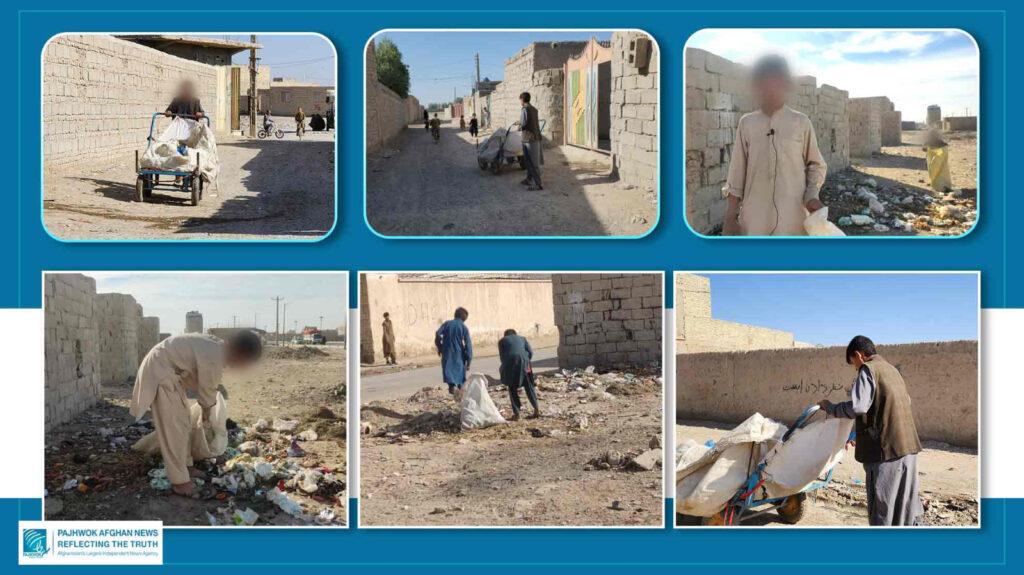

ZARANJ (Pajwak): Many young people and adolescents in the capital of north-western Nimroz are forced to work while continuing their education in order to support their families. Economic pressure, family responsibilities, and a lack of social support have caused the educational, academic, and personal dreams of many to be delayed or unattainable.
Decades of war across the country have led to widespread poverty and economic hardship, leaving millions disabled, widowed, or orphaned; Nimrozprovince has not been spared from these challenges.
The story of a teenager assuming parental responsibilities
Abdul Karim, a 16-year-old resident of Zaranj, has taken on the role of both mother and father for his sisters and brother since he was twelve. He attends school in the morning and works late into the night in the streets of the city to earn a living, while his mind constantly struggles between studies, poverty, and concern for his family’s future.
Abdul Karim explains that four years ago his father died in Iran after falling from a high-rise building at work. Two years later, his mother passed away from illness, leaving him responsible for the care of his siblings.
Currently a tenth-grade student at one of Zaranj’s high schools, he lives with his sisters and brother in a single room kindly provided by a neighbour.
He goes to school every morning and works until 10 p.m. to cover family expenses. Still, his thoughts continually shift between lessons and household worries.
He says: “I am in class and I enjoy studying, but inevitably my mind drifts to what we lack at home. I think about how much oil is left, we have no potatoes or onions, where I can get money for my sister’s medicine, we have no water…”
After school, Abdul Karim carries a small basket through the streets of Zaranj, collecting recyclable waste and stale bread to help support his family and provide food for his siblings.
He adds: “Some days I am so tired that I cannot do my homework. Sometimes my mind is so preoccupied with family problems that I forget what I learned today. I have no one to guide me; I have to manage the family, find food, and study all on my own. Life is not easy.”
At times, he experiences severe psychological stress and even wishes for death, but when he looks at his younger siblings, his mood changes and he regains hope. He says that sometimes, at night, due to exhaustion and mental pressure, he cries:
“I sit alone in a corner, talking to myself, imagining that maybe one day we will have our own home and life will improve, and I won’t have to walk all day just to find 100 Afghanis. That is why I continue my studies—to achieve my dreams.”
Youth caught between education, work and family responsibilities
Esmatullah, another resident of Zaranj, represents a generation caught between study, work, and family duties. He works during the day in a government office and performs hard labour at night in a garage to support his family of eight.
After completing his bachelor’s degree, Esmatullah had the opportunity to pursue a master’s, but poverty, work pressure, and family responsibilities forced him to leave school. His mornings begin with worries about life, and his nights end in fatigue and anxiety.
He says: “It is difficult for a young person to bear the responsibility of an eight-member family alone while also studying and working, never having time for themselves. I have lost sleep, and insomnia is driving me mad.”
He adds: “Sometimes I sit alone for hours thinking about the past and the future. Life’s pressures sometimes overwhelm me, but I cannot abandon my family.”
Despite all difficulties, Esmatullah continues to strive to improve his family’s life and provide for them.
Experts: Life’s heavy burden and the psychological pressure threatening some youth
Nizamuddin, a teacher and education expert in Zaranj,says that many of his students must study while working to support their families.
He adds: “There is a heavy burden on these children; some are so exhausted by household problems that they cannot complete their homework and are sometimes punished by teachers.”
He notes that some students, due to poverty or lack of guardians, attend school in appearance only; although their bodies are in class, their minds are preoccupied with family concerns. Last year, several students left school to work due to these pressures.
Nizamuddin says: “Some children are forced to choose bread over education, but through guidance and explaining the consequences of illiteracy, I have kept them in school.”
Meanwhile, Dr Sayed Khalil Shah Kazemi, a neurologist and mental health counsellor, states that the combined pressures of work, study, and family responsibility can have serious effects on the mental health of adolescents and young adults.
He explains: “When a teenager is forced to take on the responsibility of providing for a family at a young age, this pressure can lead to chronic stress, anxiety, and a sense of hopelessness.”
According to him, adolescence is a phase when individuals should focus on learning, personal growth, and building their future; yet economic pressures and family responsibilities leave their minds consumed with survival and daily struggles.
He adds that prolonged pressures can result in mental fatigue, reduced focus, and even depression: “When a young person works late into the night and goes to school early in the morning, the body and mind do not get enough rest and recovery. As a result, focus, motivation, and hope for the future decline.”
He believes that support from family, community, and educational institutions can play a vital role in alleviating these pressures.
sa