

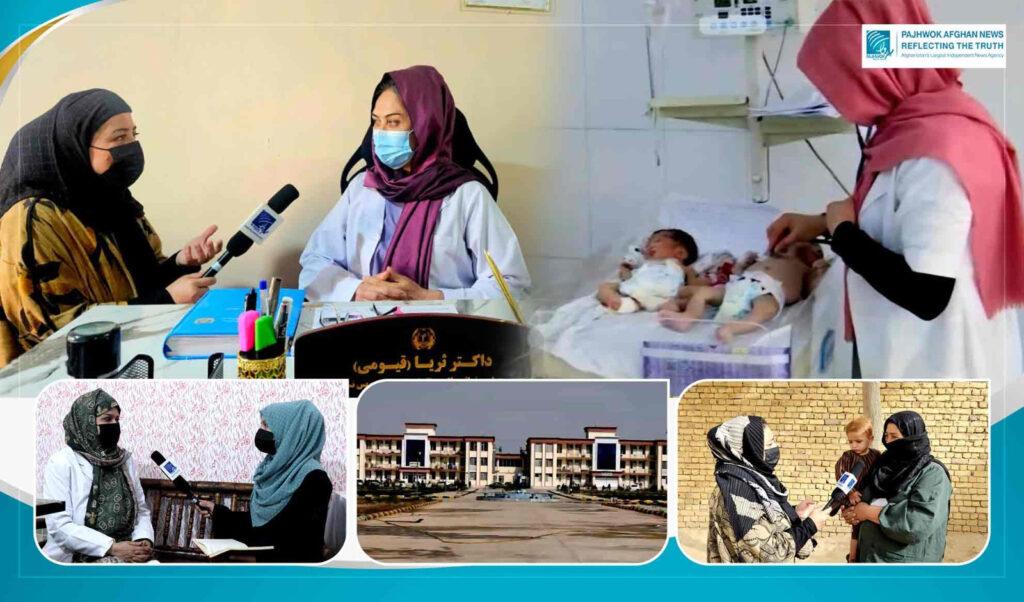

SHIBERGHAN (Pajhwok): A number of mothers in northern Jawzjan province say poverty and a lack of awareness about proper nutrition during pregnancy are putting both their own health and that of their children at risk, while health specialists stress that a balanced diet during pregnancy is vital for safeguarding the mother’s health and ensuring the healthy development of the foetus.
Malnutrition remains one of the serious public health challenges in Afghanistan and has a direct impact on children’s growth and the health of mothers.
Its main causes include poverty, lack of sufficient and diverse food, insecurity, low awareness among families about healthy nutrition and limited access to health services, particularly in rural areas.
Drought and rising food prices have also reduced families’ ability to meet their daily nutritional needs, placing pregnant women and young children at greater risk.
Jawzjan is not exempt from this challenge and some mothers have faced difficulties due to inadequate nutrition.
Zahra, a 30-year-old resident of Khwaja Du Kohdistrict, recalled: “My first pregnancy passed with poor nutrition. Most days I survived on bread and tea. That was why my baby was born very small and without breathing, and I lost him.”
She lamented economic hardships and explained that after two years she is pregnant again and hopes not to face the same experience.
She added: “I came to see the doctor. The doctor told me that I should eat more fruit, vegetables, dairy products and eggs, and the clinic also provided me with nutritious supplements.”
Meanwhile, Fatima, 28, a resident of Nawabad village in Shiberghan, said: “During my first pregnancy I had little appetite and I used iron and folic acid supplements, but I still felt weak. Now I have learned that I must eat fruit, vegetables, drink enough water and use affordable alternatives such as beans and eggs.”
She added that economic problems often prevent her from purchasing meat or fresh fruit. “But the midwife told me that lentils, beans and eggs can also be good substitutes,” she remarked.
Similarly, Shakiba, a 36-year-old resident of Shiberghan and a mother of four who was holding her young child, shared her experience: “When I was pregnant, my husband was working in Iran and I was alone. Most days I had nothing proper to eat. I wove carpets myself and only ate bread and tea. Sometimes there was a little rice or potato. There was no doctor or midwife to tell me what I should eat and I thought that was enough.”
Looking at her child, she continued: “When my son was born, he was very small. Now he is three years old, but he is like a one-and-a-half-year-old child. The doctor says his body is weak because I did not eat enough nutritious food during pregnancy. He is always ill and becomes tired quickly and even his speech started late.”
She explained that she now follows the doctor’s advice and uses nutritious but affordable foods so that the child expected to be born in three months will be healthy and her own health will also improve.
Meanwhile, Dr Soraya Qayoumi, a gynaecology and obstetrics specialist at the provincial hospital in Jawzjan, explained: “During pregnancy, the mother’s body is like an active factory that must both maintain its own energy and provide the necessary nutrients for the foetus to grow. A lack of proper nutrition can lead to low birth weight, premature delivery, anaemia, high blood pressure and even the loss of the foetus.”
She added: “In the first three months, a lack of folic acid may cause brain and spinal abnormalities in the foetus. In the second and third trimesters, a deficiency of iron and protein can lead to general weakness, fatigue and depression in the mother.”
Dr Qayoumi emphasised that proper nutrition does not simply mean eating more, but choosing healthy and balanced foods.
She advised pregnant women to avoid excessive consumption of tea, coffee, soft drinks and fatty foods and instead consume fruit, vegetables, dairy products, legumes and lean meat.
Similarly, Dr Farzana Durani, a gynaecology and obstetrics specialist in Kabul, highlighted that proper nutrition during pregnancy plays a crucial role in the health of the mother and the healthy growth of the foetus.
She warned that when a mother does not receive balanced and sufficient food, both her own health and that of the baby are placed at risk.
According to her, poor nutrition can cause anaemia, general weakness, reduced energy, immune system problems and an increased risk of infections in the mother. For the foetus, it may result in low birth weight, delayed growth in the womb, premature birth and even some developmental disorders.
She urged mothers to maintain a balanced diet that includes protein, fresh vegetables, fruits and grains, iron-rich foods such as meat, legumes and green vegetables, adequate calcium for the baby’s bone development, sufficient water intake and supplements recommended by doctors such as iron and folic acid.
She also cautioned pregnant women against consuming very fatty and salty foods, unhealthy items and soft drinks.
She noted that mothers may suffer from severe anaemia, weakness, dizziness and other pregnancy complications if proper nutrition is not maintained. For the newborn, the risk of low birth weight, weak immunity and growth problems increases.
She pointed out that many mothers seeking treatment with severe anaemia, weakness or low foetal weight have a history of inadequate nutrition. After improving their diet and taking supplements, their condition usually improves.
According to her, during pregnancy the mother’s body requires greater amounts of protein, iron, calcium, folic acid and vitamins. If nutrition is adequate, the foetuswill grow better and healthier.
However, Dr Sharafat Zaman, spokesman for the Ministry of Public Health (MoPH), told PajhwokAfghan News: “At the beginning of 2025, some international organisations estimated that around 3.7 million children and pregnant women were suffering from malnutrition.”
“However, according to data we received at the end of 2025 from 3,200 health sites across the country that provide services in the field of malnutrition, the number of pregnant and breastfeeding mothers and children suffering from malnutrition is about three million,” he added.
He said that among the three million people suffering from malnutrition, 1.3 million have moderate malnutrition, 700,000 suffer from severe malnutrition and nearly one million pregnant and breastfeeding mothers suffer from acute or moderate malnutrition.
He spoke about the expansion of services addressing malnutrition and explained that before the re-establishment of the Islamic Emirate of Afghanistan (IEA), 800 health centres were operating in this sector, but today the number has increased to 3,200.
“Our goal is to ensure that mothers and children currently suffering from malnutrition receive proper treatment and services. We are trying to produce the necessary nutritious food for malnourished mothers and children inside the country, and what is very important is to ensure continuous services for patients with the help of health organisations,” he stated.
Zaman described raising public awareness about malnutrition as essential and said awareness and prevention programmes in this field would also be expanded.
kk/sa


GET IN TOUCH
NEWSLETTER
SUGGEST A STORY
PAJHWOK MOBILE APP