

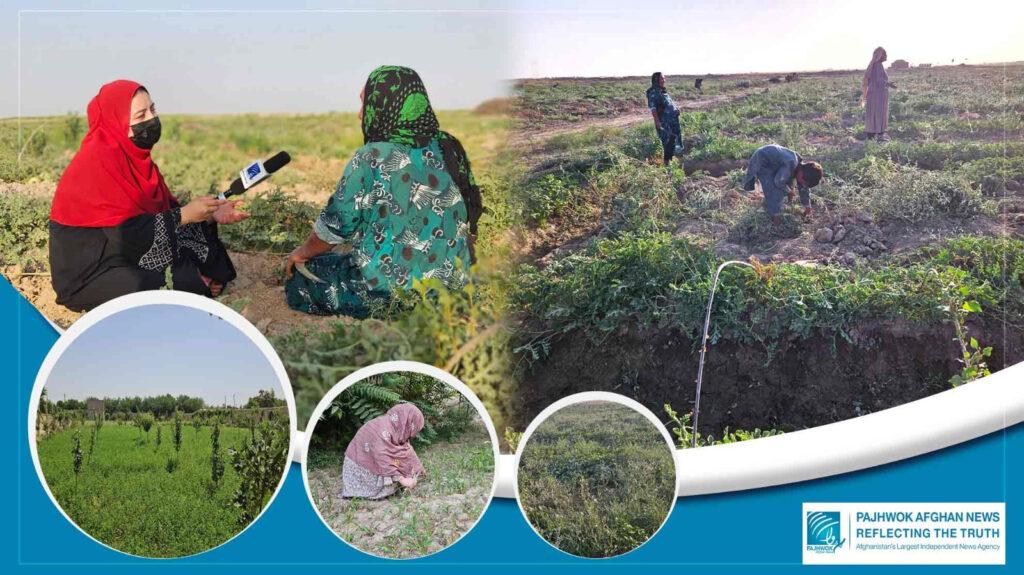

SHIBERGHAN (Pajhwok): In northern Jawzjanprovince, rural women, through work in farming, livestock rearing and dairy production, play a crucial role in supporting their families’ economies. From cultivating wheat and sesame to saffron and dairy products, these women not only keep their households running but also play a key role in the local economy.
They are calling for greater support and assistance.
Hasian, 40, a female farmer from Qura village near Shiberghan city, said: “We have three jeribs of land, and we grow wheat, sesame, and some vegetables such as coriander, spinach, and spring onions. Part of our harvest is consumed at home, and we sell the rest in the market.”
Speaking about economic challenges, she added: “My husband and son work in the fields, and I help them along with my daughter. If we get a good harvest throughout the year, we keep some for family consumption and sell the rest.”
She noted that many women in her area work alongside their husbands in the fields and said: “Working in agriculture not only supports the family economy but also enables women to be more active in the community.”
She called on the government and agricultural support organisations to provide women farmers with effective training in planting, crop care, and efficient harvesting methods, while also supplying improved seeds and chemical fertilisers to farmers.
Similarly, Shabnam, a female farmer from Kheirkhanavillage near Shiberghan, who cultivates saffron annually, expressed satisfaction with this year’s harvest. However, she noted that many farmers, particularly women, face economic challenges and require greater support.
She said: “I have been working in saffron cultivation for about four years. In previous years, the harvests were not very satisfactory, but this year I cultivated saffron on two jeribs of land, and fortunately, the yield has been good. We have also been able to sell our products mostly through exhibitions.”
According to Shabnam, the income from saffron sales has significantly helped her six-member family, and she hopes that with continued work and the necessary support, she can increase production and income in the coming years.
On the other hand, Fatima, 38, another resident of Shiberghan, said: “We have a few goats and cows, and we produce yoghurt and cheese from their milk. Sometimes we sell these products in the market, and our neighbours also buy from us, which helps cover some of the household expenses.”
Fatima called on the Islamic Emirate and aid organisations to provide greater support to her and other women farmers.
She added that if she were provided with a cow, she could earn more income by keeping it and selling milk and other dairy products.
She believes such support could improve her family’s economic situation and enable her to cover a larger portion of daily household expenses.
Experts believe that with increased investment and greater support for women, agricultural production can be enhanced, thereby strengthening family economies.
Mohammad Rasul Sardash, an agricultural expert in Jawzjan, said women play a very important role in farming, and in many rural areas, a significant portion of agricultural work is carried out by women. From planting and crop care to harvesting and preparing produce for the market, women have an active role.
He noted that to strengthen this role, women need access to training, improved seeds, chemical fertilisers, and market opportunities.
He added: “If women farmers are provided with regular training and technical and financial support, not only will agricultural production increase, but this will also improve family economic conditions and contribute to the growth of the local economy.”
The Jawzjan Department of Agriculture, Irrigation, and Livestock has also outlined the steps taken to support women farmers and its future programmes.
Zabihullah Kheirandish, spokesperson for the Directorate, said that multiple measures have been taken to empower women farmers.
According to him, with the cooperation of partner organisations, more than 250 greenhouses have been established in the areas surrounding Shiberghan city and its districts, creating employment and boosting family economies.
He added: “In Jawzjan, over 500 women are actively involved in greenhouse work, saffron cultivation, and other agricultural sectors. In the future, we plan to launch additional training and support programmes for women farmers to increase their contribution to agricultural development and the local economy.”
He emphasised that women in Jawzjan play a vital role in agriculture, and their activities, from crop cultivation to livestock and dairy production, have a significant impact on family economies and on improving their living standards.
hz/sa


GET IN TOUCH
NEWSLETTER
SUGGEST A STORY
PAJHWOK MOBILE APP