

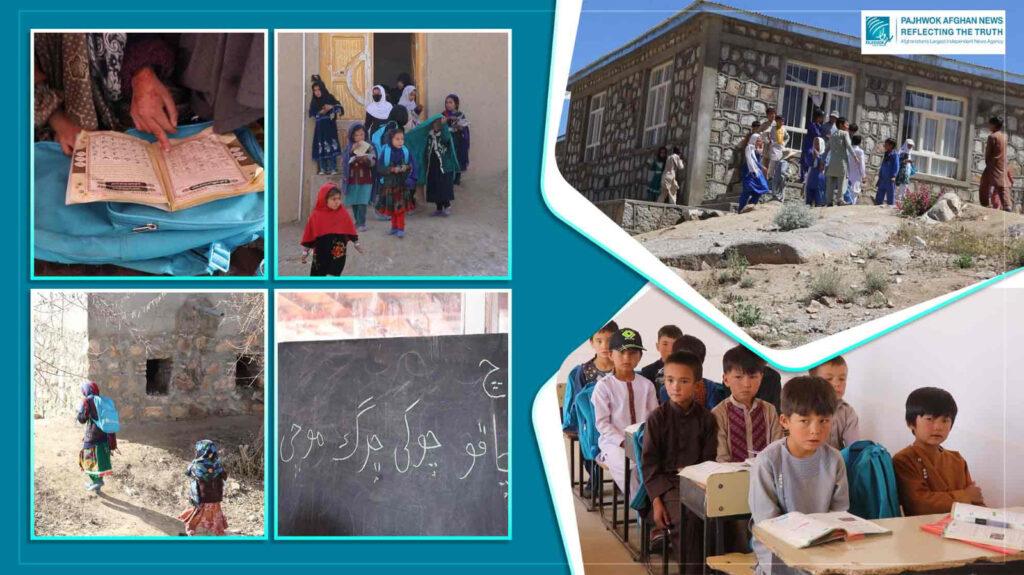

GHAZNI CITY (Pajhwok): Residents of Khogyanidistrict in southern Ghazni province say that due to a shortage of schools and teachers, hundreds of children are being deprived of education and face serious challenges.
Meanwhile, officials acknowledge the problem and say efforts are underway to hire new teachers and expand educational facilities.
A tribal elder, Haji Rozi Gul, told Pajhwok Afghan News that Khogyani district comprises around 120 villages, many of which are located in mountainous areas, making travel between communities difficult for students. Despite this, only four formal schools are currently operating in the entire district.
“The number of schools is very limited. Many students have to travel long distances for education, but some families cannot send their children because of the difficult routes,” he said.
Another tribal elder, Mohammad Arif, described the shortage of schools and teachers as a serious issue, noting that the number of students in existing schools is very high.
“In some classes, more than 100 students sit together, and one teacher has to teach them all. Under such conditions, the quality of education declines,” he added.
Social affairs analyst Abdul Mateen Ghaznavi told Pajhwok that in areas with large populations and scattered villages, priority should be given to establishing small community classes alongside primary and middle schools.
“When more than 100 students sit in a single classroom, the teacher cannot properly teach everyone. This negatively affects the quality of education and discourages many children from continuing their studies,” he said.
According to him, the government and aid organisations should work together to increase the number of schools in remote areas, address the shortage of teachers, and provide a suitable learning environment for students.
Meanwhile, district governor Mullah Mohammad Naeem of Khogyani district also acknowledged the problem, saying the lack of schools and teachers has created numerous challenges for students.
“There are four schools in the district, and some of them even lack boundary walls, toilets, water, books and other basic facilities,” he said.
He added that around 50 teachers are currently working in these four schools, which is insufficient for the entire district. Some large areas such as Sheikh Agha, Khairabad and Sayedan have no schools at all, leaving hundreds of children without access to education.
Mawlawi Nasir Ahmad Hossaini, head of the Education Department, told Pajhwok that besides the four formal schools, 15 community-based classes are operating in the district with support from UNICEF.
He said rural madrasas have also been established in some areas, but the existing facilities still do not meet the district’s educational needs.
He added that the shortage of teachers remains a serious challenge and there are plans to recruit up to 25 new teachers next year to partially address students’ problems.
Khogyani district is one of the mountainous districts of Ghazni, where limited educational facilities have long been a major concern for residents.
hz/sa


GET IN TOUCH
NEWSLETTER
SUGGEST A STORY
PAJHWOK MOBILE APP