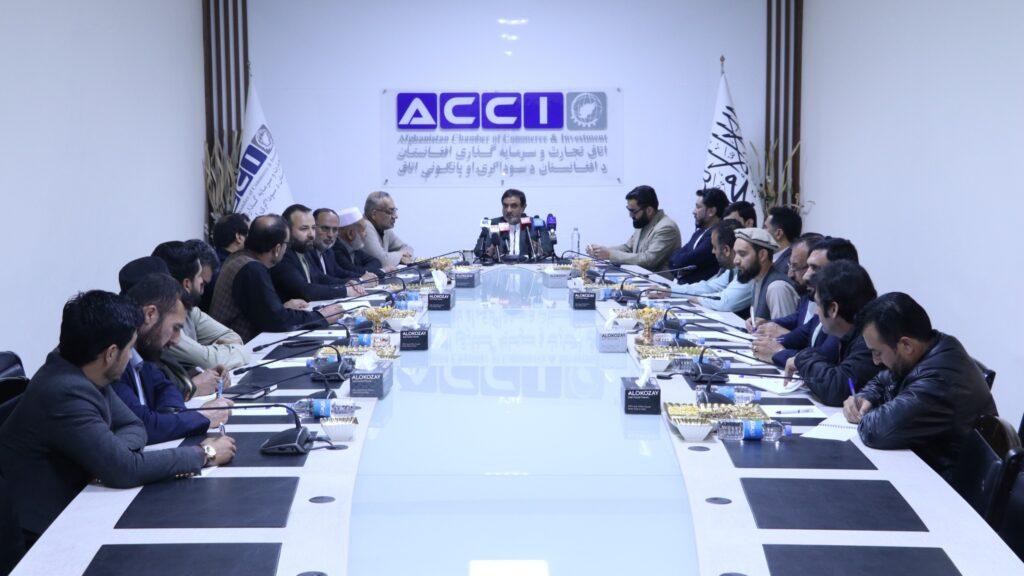

KABUL (Pajhwok): Director of the Afghanistan Chamber of Commerce and Investment Sayed Karim Hashimi on Thursday urged traders to increase imports and stockpiles of essential goods to prevent shortages, citing regional and global instability.
He made the remarks at a joint meeting with traders in the capital Kabul.
Hashimi noted the private sector was expected to play an active and responsible role in meeting the basic needs of the population.
“We ask all traders to pay special attention to importing and supplying essential goods needed by the people under current conditions,” he said.
He stressed the need to ensure a continuous and sufficient supply of key items such as fuel, gas, cooking oil, sugar, wheat, flour and rice and called for increasing strategic reserves for at least the coming weeks to avoid shortages.
He emphasised all imported goods must meet quality, health and technical standards and have valid expiry dates, urging traders to strictly avoid importing or supplying substandard or expired products.
Hashimi added the private sector, as a key partner of the government, had consistently supported its policies and appreciated the facilities provided by the Islamic Emirate of Afghanistan (IEA) for traders, investors and industrialists.
He also urged IEA to create more opportunities to strengthen the private sector and take serious measures to address challenges faced by traders, investors and industrialists both inside and outside the country.
Responding to a query about rising prices of food and fuel, he described claims that traders were responsible as “rumours and propaganda.”
“I can assure that prices of essential goods such as flour, rice and oil are 30 to 40 percent lower than in neighbouring countries,” he added.
Asked whether traders were hoarding goods, he replied: “No, I can categorically say there is no hoarding in the country. Prices are regulated through chambers of commerce and industry. We are serving the people. Stockpiling exists, but it is different from hoarding.”
On the reason for recent price increases, Hashimi explained: “Yes, prices have risen by about five per cent. The main reason is the closure of the Torkham crossing. Traders have been forced to import goods through alternative routes such as Chabahar Port, where transport costs are higher.”
He further noted that following the closure of trade routes with Pakistan, the private sector had signed agreements with Kyrgyzstan and Turkmenistan for goods, with Iran for gas, and with Russia and Kazakhstan for food supplies.
kk