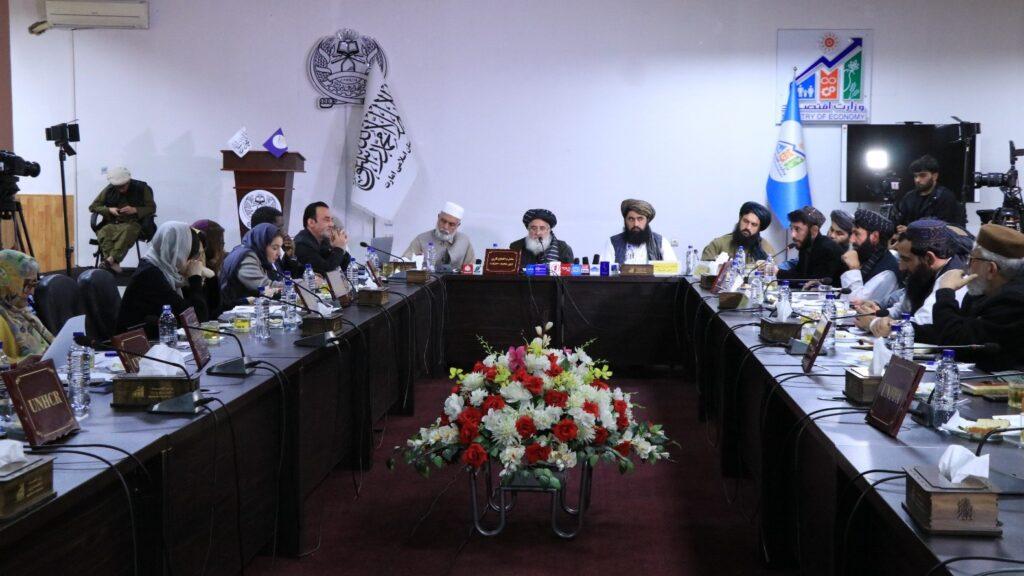

KABUL (Pajhwok): The Minister of Economy, during a coordination meeting with officials from United Nations agencies and national and international organizations, stated that more than 27,000 Afghan families across nine provinces have been displaced as a result of attacks attributed to Pakistan’s military.
In recent months, Pakistan has reportedly conducted artillery and airstrikes in violation of Afghanistan’s sovereignty. Afghan forces have responded with retaliatory actions.
These developments have resulted in significant civilian casualties and displacement. The deadliest reported incident involved a strike on a drug treatment center in Kabul, where more than 400 patients were killed and approximately 250 others injured.
On Thursday, the Ministry of Economy convened a meeting titled: “Coordination on Mobilizing Emergency Assistance from United Nations Agencies and National and International Non-Governmental Organizations for Internally Displaced Persons Affected by Recent Bombardments.”
The meeting was attended by representatives from various domestic and international organizations.
Qari Din Mohammad Hanif, Minister of Economy, stated that alongside recent regional developments, Pakistan has carried out what he described as hostile actions against Afghanistan in recent months.
He added that at least 27,344 families have been displaced in the provinces of Nuristan, Kunar, Nangarhar, Laghman, Paktia, Khost, Paktika, Zabul and Kandahar.
According to Hanif, many of these families are currently living without access to basic necessities, including adequate food, clothing, shelter and healthcare.
He noted that the Islamic Emirate of Afghanistan (IEA) has taken measures, within its capacity, to address the economic and livelihood challenges facing displaced populations. However, he urged United Nations agencies and partner organizations to provide immediate humanitarian assistance.
Hanif further alleged that the use of heavy weaponry in populated areas has resulted in civilian casualties and the displacement of hundreds of families. He condemned these actions as a serious humanitarian violation and contrary to Islamic principles.
Tajuddin Oyewale, head of UNICEF in Afghanistan, emphasized the need for both sides to pursue peaceful solutions at this critical juncture.
He also noted that, in addition to displacement, infrastructure damage has occurred, including impacts on at least 10 health facilities, though he did not specify their locations.
Oyewale reaffirmed UNICEF’s commitment to supporting displaced populations and expressed hope that Afghan authorities would facilitate access to remote areas to enable effective aid delivery.
He called on international donors to increase their support to UNICEF to strengthen its response capacity.
At the conclusion of the meeting, participants agreed to work toward a coordinated plan to address the needs of internally displaced persons and returning populations.
sa