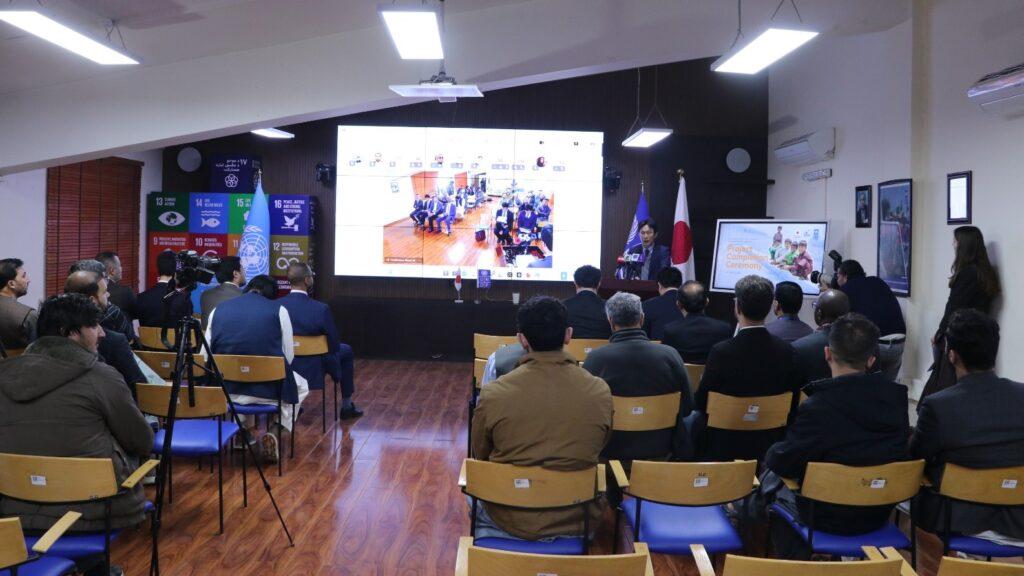

KABUL (Pajhwok): Japan-funded UNDP projects over the past four years created thousands of jobs, supported businesses and improved infrastructure in Afghanistan, benefiting over one million people, but officials say sustained support remains essential.
The UNDP representative and Japan’s ambassador in Kabul said three Japan-funded projects had significantly strengthened livelihoods—particularly for women—through job creation, business support and improved social infrastructure, but warned that continued assistance was necessary.
Stephen Rodriguez, UNDP representative in Afghanistan, told a press conference in Kabul on Tuesday that the projects, now completed, were part of a long-standing partnership between the Government of Japan, JICA and UNDP.
He said the initiatives led to notable improvements in social infrastructure, facilitated the growth of local businesses, created employment opportunities and enhanced livelihoods across the country.
“More than 2,200 businesses have been supported, over one million Afghans have benefited directly and indirectly, more than 11,000 jobs have been created or sustained, and nearly 150 social infrastructure facilities have been built,” he added.
Rodriguez described the achievements as vital, but warned that Afghanistan’s socio-economic situation had deteriorated due to tensions with Pakistan, the return of migrants and global economic instability. He said these factors, along with escalating tensions involving Iran, threaten the modest economic gains made over the past two years.
He also noted that restrictions on women’s rights have further exacerbated the impact of the crisis on women.
“In this situation, support from Japan and JICA is extremely important, especially as some donors have reduced or halted their programmes,” he said, adding that Japan has continued to stand by the Afghan people.
Rodriguez stressed that sustained funding was crucial for long-term development, including assessing Afghanistan’s export potential to Central Asia and identifying value chains to help diversify export markets.
Kenichi Masamoto, Japan’s ambassador to Afghanistan, said the projects resulted in the construction or rehabilitation of about 800 small-scale infrastructure schemes, the creation of 9,000 jobs, and support to 3,000 micro, small and medium enterprises (MSMEs). He added that more than 1,100 former poppy farmers were assisted with alternative livelihoods.
He said the achievements demonstrated the strong commitment of Japan and UNDP under the Doha Process framework.
“Our partnership will continue and be strengthened,” Masamoto said, noting that Japan signed a new $5.6 million agreement with UNDP last November for a two-year project aimed at improving women’s livelihoods through economic activities in border areas.
He said the initiative would directly benefit Afghan women and vulnerable groups.
sa