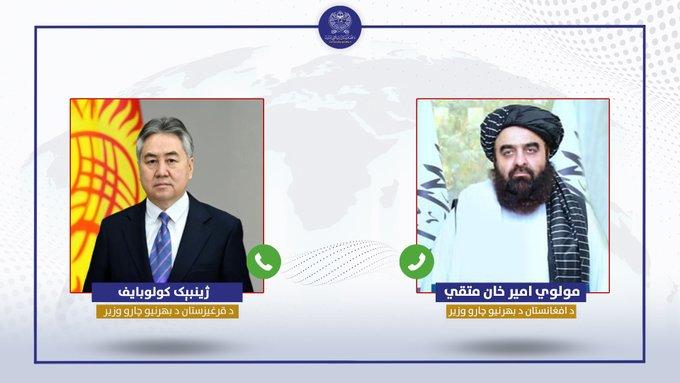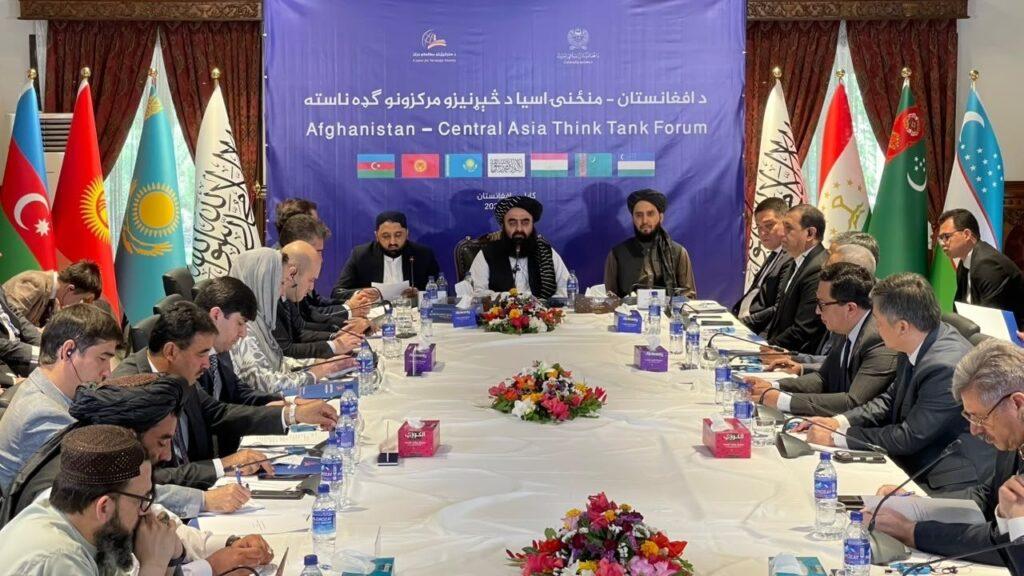

KABUL (Pajhwok): Minister of Foreign Affairs Mawlawi Amir Khan Muttaqi has emphasised expanding academic and research cooperation, developing a joint roadmap, strengthening regional connectivity and promoting indigenous narratives for the future of regional cooperation.
He made the remarks at a meeting attended by heads, researchers and policymakers from strategic studies centres of Afghanistan, Central Asian countries and Azerbaijan in Kabul on Tuesday.
The meeting was organised by the Strategic Studies Centre of Afghanistan’s Ministry of Foreign Affairs (MoFA).
It brought together heads, researchers and policymakers from institutions affiliated with the presidential offices of Uzbekistan, Turkmenistan, Kazakhstan, Kyrgyzstan, Tajikistan and Azerbaijan.
Addressing the gathering, Muttaqi expressed hope that the meeting would help identify and strengthen areas of joint academic, research and intellectual cooperation among regional institutions and contribute practical proposals to government decision-makers.
“Given the developments and challenges facing the global order, the current international system has reached a sensitive stage in history,” he observed.
“On the one hand, various misconceptions and conflicting narratives have emerged, while on the other, efforts towards collective cooperation and multilateralism are increasing.”
He noted that relations between Afghanistan and Central Asian countries, including Azerbaijan, had expanded significantly on the basis of a pragmatic, opportunity-driven and cooperation-oriented approach.
“Today, we have gathered not merely as representatives of our countries, but as intellectuals and thought leaders of a shared geographical region,” he remarked.
According to him, experts and researchers from think tanks should formulate a comprehensive roadmap for future cooperation, making collaboration among regional research institutions an unavoidable necessity rather than an option.
Muttaqi pointed out that the region was facing climate change, water scarcity, air pollution and other shared environmental challenges.
“These threats do not recognise political borders,” he said, urging research institutions to provide governments with joint solutions based on accurate data and scientific analysis.
He also highlighted the impact of ongoing conflicts on economic supply chains, transport networks, and food and energy security.
In such circumstances, he said, academic and research institutions could serve as intellectual partners and drivers of regional diplomacy by offering practical solutions for managing disputes and strengthening regional integration.
The Foreign Minister described Afghanistan as a natural bridge between Central and South Asia, with significant potential for regional connectivity.
He stressed that projects such as CASA-1000, TAPI, TAP, the Lapis Lazuli Corridor, the Afghan–Trans railway and other regional transit initiatives should be supported through detailed economic studies and research-based assessments.
He emphasised that research centres should clearly demonstrate the shared benefits of these projects to strengthen mutual trust among countries.
“Our shared opportunities, challenges and future require indigenous and locally driven narratives,” Muttaqi maintained.
He added that Afghan and Central Asian researchers should themselves become the narrators of the region’s realities, opportunities, and challenges through coordinated research cooperation and the continuous exchange of findings.
Referring to the first Afghanistan-Central Asia Consultative Dialogue held in Kabul on April 5, 2026, he stated that the event had provided an important political framework for regional cooperation.
However, he stressed that a specialised, research-oriented mechanism was also needed to translate political commitments into practical and implementable proposals.
Muttaqi explained that the main objective of the meeting was to provide a platform for analytical discussions, expert exchanges, and policy recommendations on the future of regional cooperation.
He added that the forum should help enhance mutual understanding between the Islamic Emirate of Afghanistan and Central Asian countries, including Azerbaijan, while promoting research-based proposals, regional connectivity, trade, investment, cultural exchange and cultural diplomacy.
According to him, academic and research cooperation is the most sustainable and cost-effective form of diplomacy among nations.
He noted that many major political, economic, and regional initiatives first emerge in academic forums and think tanks before becoming official government policy.
“Our historic responsibility today is to establish sustainable frameworks for cooperation through regular meetings, joint research programmes, information-sharing, and stronger links among research institutions,” he asserted.
Muttaqi added that Afghanistan believes a stable, prosperous, and secure future for the region can only be achieved through cooperation, mutual trust, regional connectivity and a shared understanding of collective interests.
He concluded by saying Afghan researchers and intellectuals are ready to cooperate with scholars from other countries, particularly those from Central Asia and Azerbaijan.
He expressed hope that the meeting would mark the beginning of a new chapter in regional research cooperation and contribute to stronger academic dialogue, knowledge-sharing, and the identification of new opportunities for collaboration.
kk/sa