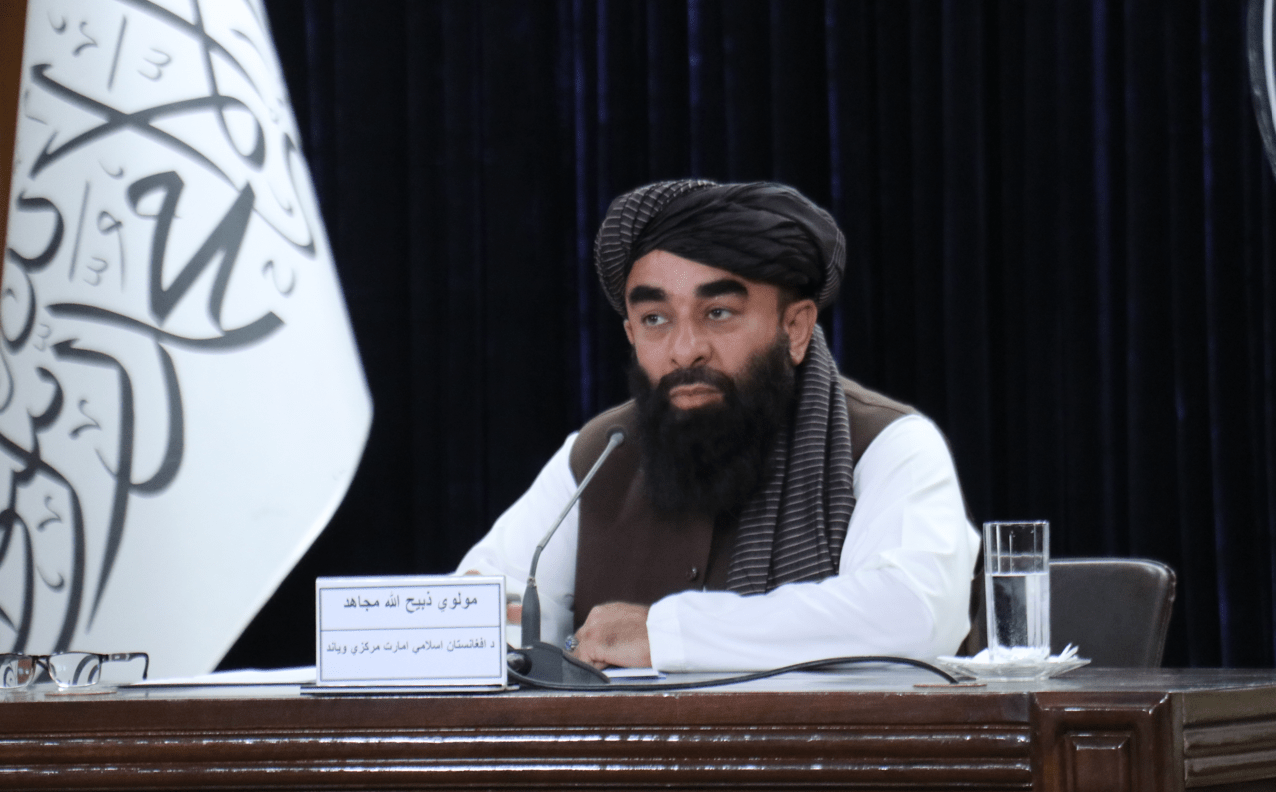
KABUL (Pajhwok): Chief spokesman of the Islamic Emirate of Afghanistan (IEA) on Sunday presented the key achievements and activities of the ministries of education, higher education, and borders and tribal affairs, as well as the Academy of Sciences, the Technical and Vocational Education Authority and the National Examination Authority during the 1447 Hijri lunar year.
IEA chief spokesman Zabihullah Mujahid presented the activities of each institution separately during the “Government in the Media Mirror” programme.
Ministry of Education
During the 1447 Hijri lunar year, 238 new buildings were constructed for schools and religious seminaries across the country, while 970 school and seminary buildings were repaired and rehabilitated.
A total of 7,620,640 students were enrolled in public and private schools during the year.
Meanwhile, 2,444,752 students were studying religious subjects at seminaries.
During the same period, literacy programmes were provided to 93,509 people through 4,973 literacy centres nationwide.
A total of 82,832 returnees were also enrolled in Islamic and general educational institutions and benefited from educational services.
According to the figures presented, the total number of public and private schools and religious seminaries reached 38,562 in 1447.
During the year, 283,665 certificates were issued to applicants, while 48,323 certificates were sent to the Ministry of Foreign Affairs (MoFA) for authentication and verification.
Capacity-building and training programmes were conducted for 31,934 teachers, 4,499 principals, 3,380 school directors and heads, and 23,261 members of school councils.
A total of 10,602 people were appointed to various positions, including 5,481 teachers, 2,010 seminary instructors, 2,017 administrative staff, and 1,094 teacher-training and academic staff.
To improve transparency, speed up procedures and provide better services to applicants, 42 different systems were updated, activated and placed under continuous monitoring.
Ministry of Higher Education
During the 1447 Hijri lunar year, 126,952 students were enrolled in public universities and 85,227 in private universities.
A total of 110,064 academic documents were issued to students, including 56,064 diplomas, transcripts and internship grade certificates for students of public universities and 54,000 such documents for students of private universities.
During the year, 158 training programmes were organised for students, while 1,000 lecturers were referred to short- and long-term training programmes.
In addition, 290 lecturers were referred to master’s programmes and 94 to doctoral programmes within the country.
A total of 137 lecturers who had completed master’s and doctoral studies abroad returned to Afghanistan and resumed their duties during 1447.
Sixty lecturers were also appointed to public and religious universities, while four doctoral and five master’s programmes were established at public universities, along with three master’s programmes at private universities.
On the instruction of the IEA supreme leader, faculties of medicine were established for the first time at the public universities of Badakhshan and Ghazni. A traditional medicine faculty was also established for the first time at Kabul University of Medical Sciences, while Al-Noor Private University was established in Khost and the Abdullah bin Abbas (RA) Religious University was established in Kunar.
A total of 22 projects were implemented nationwide to expand public and religious universities and provide necessary facilities, while work on several other projects was progressing rapidly.
During 1447, 633 new positions were created in modern technology and sciences, including engineering, computer science and artificial intelligence.
A list of 1,555 outstanding university graduates was also prepared and submitted to the office of the IEA leader for possible employment in government institutions.
National Examination Authority
During 1447, 53 university entrance examinations (Kankor) were conducted nationwide, with 189,169 candidates taking part.
Facilities were introduced to simplify the examination process. A form that was previously distributed in person is now available online, allowing applicants to obtain it more easily.
The process for filing complaints, which was previously conducted in person, has also been simplified and moved online. Complainants can now submit their complaints online, with cases to be addressed within three working days.
The processing of transcripts and documents for verification of religious scholars’ educational levels has also been streamlined. The process, which previously involved 37 steps and took 14 days, has been reduced to 23 steps and seven days.
Similarly, the process for correcting the names and personal details of 12th-grade graduates has been reduced from 42 steps and seven days to 32 steps and three working days.
Technical and Vocational Education Authority
During 1447, nine educational centres were repaired and rehabilitated. Five specialised educational centres for blind and deaf students were also established in Sar-e-Pul, Nimroz, Kunduz, Ghor and Badghis provinces.
A total of 77,885 people were enrolled in technical and vocational education centres, including 31,773 students in secondary schools and 46,112 in technical and vocational institutes.
During the year, 3,470 blind and deaf students received education at specialised centres.
In addition, 11,910 people benefited from technical and vocational training programmes aimed at improving job skills, creating employment opportunities and providing the market with a skilled workforce.
During 1447, 812 graduates of technical and vocational training centres were employed by government institutions and companies, while more than 10,000 graduates were referred to institutions as interns to gain practical experience.
Ministry of Borders and Tribal Affairs
During 1447, the Ministry of Borders and Tribal Affairs enrolled 2,580 new students in its educational institutions, bringing the total number of students to 7,643.
A total of 994 students also graduated from the ministry’s educational institutions during the year.
Afghanistan Academy of Sciences
During 1447, 14 scientific and research projects were completed in the fields of Islamic, human, natural and technical sciences, while 164 scientific and research papers were completed and published.
The academy also organised 100 scientific and research conferences and six scientific and research seminars.
During the same period, 10 scientific and research works were translated from foreign languages into Afghanistan’s official languages. The translation of Imam al-Mawardi’s Al-Ahkam al-Sultaniyyah was also completed, as was the first volume of the Pashto Literary Encyclopaedia. In addition, a procedure for handling banking cases was drafted.
Work on another 192 scientific and research projects are ongoing.
sa