KABUL (Pajhwok): Officials of the Islamic Emirate of Afghanistan (IEA) have underscored the private sector’s role in economic development and job creation, describing it as a key pillar of the country’s economy and a major driver of production and economic activity.
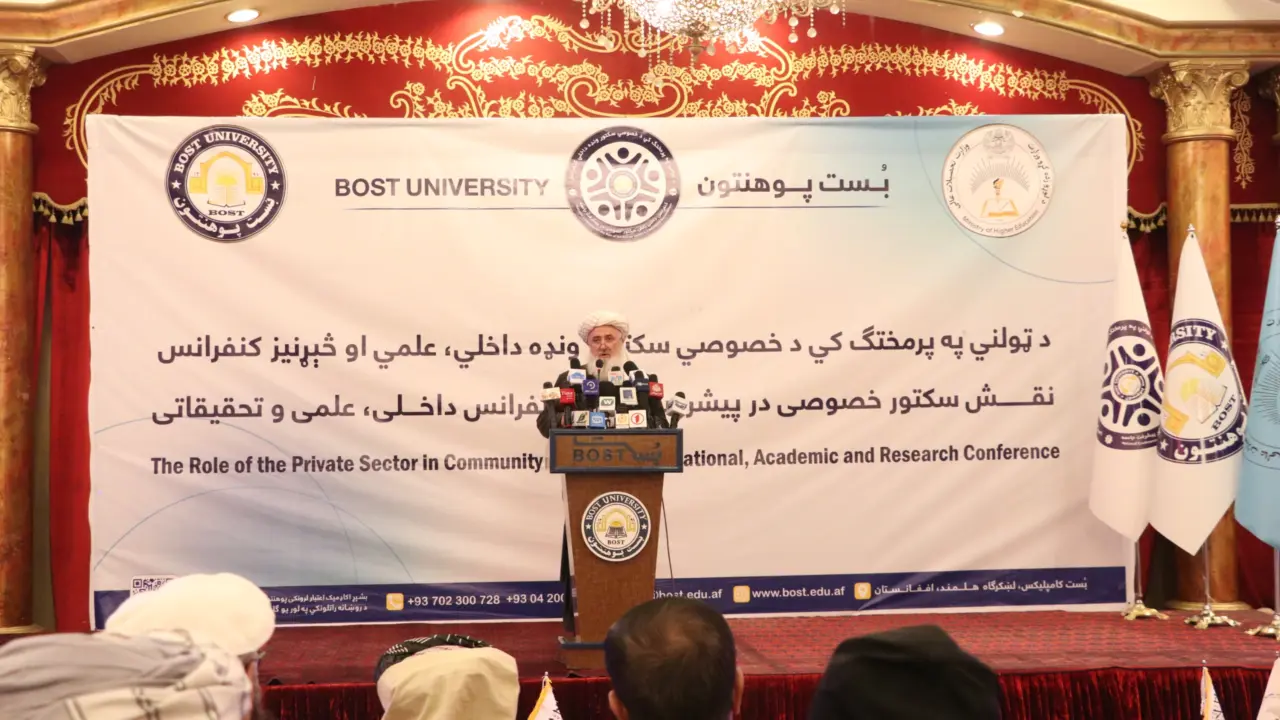
The remarks were made at a conference titled “The Role of the Private Sector in Social Development: An Internal, Scientific and Research Conference”, held in Kabul on Wednesday.
Economy Minister Qari Din Mohammad Hanif said economic and social development was a fundamental need for every country.
He said sustainable development depended on increasing production capacity, creating lasting job opportunities and improving productivity.
Hanif described the private sector as a key pillar of the economic system and an important driver of production, economic activity and value creation.
He said the conference was particularly relevant given Afghanistan’s current economic situation, adding that the country was at a crucial stage in efforts to revive its economic capacity, boost domestic production, create jobs and achieve sustainable growth.
He said the priority should not be merely to increase economic growth, but also to improve its quality and ensure that its benefits reached the people.
Hanif said universities should go beyond education and academic and professional activities by helping identify economic opportunities, examine obstacles to production and investment, and develop practical solutions based on the country’s needs.
Deputy Minister of Information and Culture for Publications Mawlawi Hayatullah Muhajir Farahi said the private sector played an important role in every economic system, adding that even developed countries depended on it.
He said the IEA believed the government and private sector should work together, and that the government was committed to facilitating the sector’s activities.
Farahi said joint efforts by the government and the people would soon produce positive results, adding that academic institutions also had an important role to play.
Deputy Minister of Higher Education for Academic Affairs Sheikh Ziaur Rahman Madani said academic institutions should be established to serve the people and society.
He said graduates should use their knowledge and skills to serve their people and country.
Madani described academic professionals as the nation’s intellectual assets and said they should be respected, as the country’s development depended on their contribution.
Kabul Governor Mawlawi Aminullah Obaid said the Islamic Emirate’s administration was under the leadership of a single emir and that people could travel freely between different parts of the country.
He also claimed that ethnic divisions had been eliminated and that the Islamic Emirate exercised authority throughout Afghanistan.
Obaid said Afghanistan had previously relied on imports but had now also become an exporting country under the Islamic Emirate.
Ahmad Popal, founder of Bost University and head of the Afghanistan Association of Private Universities, said the conference aimed to strengthen cooperation between the private sector and the Islamic Emirate, build capacity, create opportunities and address existing challenges.
He said it also sought to promote cooperation among private businesses, academic institutions, investors and industrialists.
Popal said the private sector played a significant role in economic development, job creation, investment growth, capacity-building and improving the quality of goods and services.
He stressed that cooperation between the government and the private sector was essential for achieving national self-sufficiency.
sa