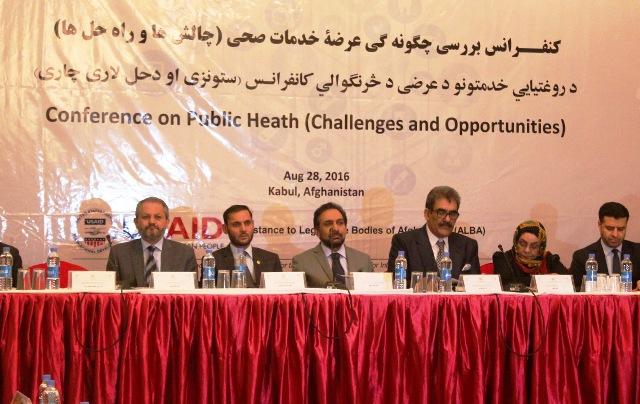
KABUL’s population lacks access to healthcare services and medicines imported to the country are of poor quality and most of drugstores are open without pharmacists, officials said on Thursday.
Nisar Ahmad Haris, who heads of the Meshrano Jirga sector, most of Afghans still lacked access to health services.
He said most of the drug stores were run by unprofessional people and even by children in some areas.
The lawmaker said his commission had assessed and found most of drug stores in central provinces and capital Kabul selling poor quality and expired medicines.
Pointing to the absence of maternity clinics in most parts of the country, he said a number of doctors were working in the field without having legal documents.
Education documents of most of foreign doctors working with private hospitals had not been reviewed, he said.
Ahmad Zia Massoud, president’s special representative for reforms and good governance who was present in the conference, said: “A nation cannot resolve their problems until they enjoy a good health, besides education, healthcare is also an important sector that needs government’s attention.”
Despite positive changes in the health sector during the past 14 years, some curable diseases still threatened people’s lives due to the absence of health centers in some parts of the country, he added.
Massoud pointed to limited access of people to health services, import of poor quality food and medicines, high mortality rate of mothers and children and administration corruption and said: “The medicines offered to our people create more health problems instead of treating them.”
He asked officials of the Ministry of Public Health (MoPH) to pave the ground for investment in the health sector and prevent capital flight to foreign countries.
He said Afghan and foreign investors and traders were ready to invest in the health sector in Afghanistan. There were enough professional health specialists in the country, but modern technology and high quality medicine were not available, he added.
Meshrano Jirga second deputy chairman Eng. Hasibullah Kalimzai said that proper health services could not be offered to the nation until corruption was decisively fought in all parts of the government.
MoPH Minister Dr. Firozuddin Firoz, said, “We confirm some problems in the health sector, but we have achievements as well, currently 60 percent of Afghans have access to health services.”
MoPH officials say only nine percent of people in the country had access to health services 14 years ago.
However, Firoz said 40 percent of people who still lacked access to health services would be provided with 370 complex clinics in the next six months across the country. He did not provide more details about the program.
A complex clinic is equipped with beds for a limited number of patients, a laboratory, treatment of malaria and other diseases and provides healthcare to serious pregnant mothers.
Firoz said the healthcare budget for each person stood in Afghanistan at five US dollars compared to 25 dollars in regional countries.
His ministry with available resources could not provide effective services to people, the minister admitted, saying parallel departments had created problems in controlling quality of medicines imported to the country.
However, he assured a quality control laboratory would be activated in Kabul city soon. “The laboratory is unique in the country and border provinces would be also equipped with the facility,” he added.
About private hospitals, the minister said, currently 128 private hospitals were operational in Kabul. All private hospitals in the capital were under close assessment of the ministry, he added.
But Firoz said effective health services could not be offered until corruption was eliminated and health workers hired on merit.
Currently 14,000 drug stores are active across the country, with 4,000 being run by pharmacists and the rest by non-pharmacists, he said.
The minister said they could not suspend activities of drug stores not run by pharmacists because they had been issued licenses. But he added the ministry would try to prevent irresponsible drug stores over the next five years.
mds/ma
GET IN TOUCH
NEWSLETTER
SUGGEST A STORY
PAJHWOK MOBILE APP