KABUL (Pajhwok): UN assistance mission in Afghanistan (UNAMA) on Thursday said although violence significantly decreased since the Taliban seized power in August last year, more than 2,000 civilians still suffered casualties during the period.
During the last ten months, the UN diplomatic mission said human rights have been violated in various areas, but the caretaker government rejected this claim.
At least 700 civilians were killed and another 1,406 wounded during the same period, the report said, outlining the human rights situation in Afghanistan over the past 10 months.
According to the report, the civilian casualties were mainly caused by improvised explosive device (IED) attacks attributed to the Islamic State ( IS) and unexploded ordnance.
IS attacks targeted ethnic and religious minority communities, setting off explosives close to places where people go to school, worship and go about their daily lives.
A number of civilians killed in a US drone attack ahead of their chaotic withdrawal in August, plus airstrikes by Pakistani military forces in eastern Afghanistan in April, are also included in the report.
Alongside civilian casualties, the UN also documented hundreds of cases of extrajudicial killings, arbitrary arrests, and detentions, as well as torture and ill-treatment carried out by the Taliban.
The report also highlights the Taliban crackdown on journalists, freedom of speech as well as severe restrictions on women and the harsh human rights situation.
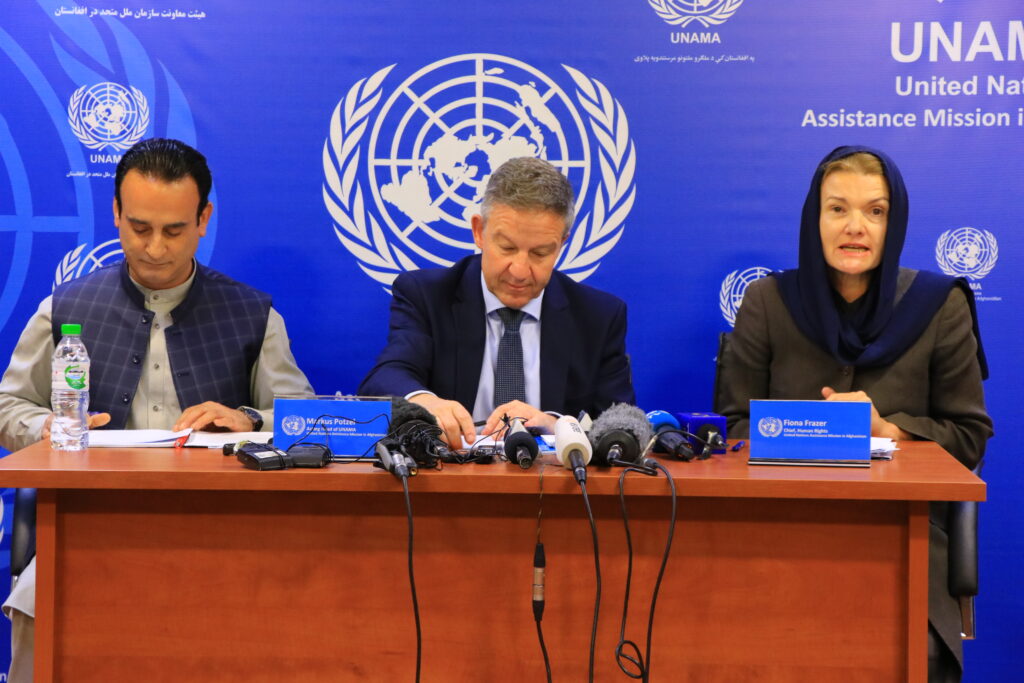
Presenting the report at a press conference, Acting Special Representative of the United Nations Secretary-General for Afghanistan, Markus Potzel, said it was possible that all Afghans live in peace and rebuild their lives after 20 years of armed conflict.
“Our monitoring shows despite the improved security situation since August 15, the people of Afghanistan, especially women and girls, are deprived of their human rights.”
He said though the ruling authorities had taken some steps to protect and promote human rights, such as the general amnesty for former government officials and security forces, the December 3 decree on women's rights and laws on the treatment of prisoners, but they were also responsible for widespread human rights abuses.
He said violation of women's rights was one of the most significant aspects of the ruling administration. Since August 15, the full participation of women and girls in education, the workplace, public and other aspects of daily life has been gradually limited and in many cases completely eliminated. .
The UNAMA findings, confirm many of the concerns voiced over the direction of human rights under the Taliban 11 months ago, after foreign forces pulled-out and the elected government collapsed.
The ruling authorities have limited dissent by cracking down on protests and curbing media freedoms according to the report. The report condemns arbitrary arrests of journalists, protestors, and civil society activists.
“The rights to freedom of peaceful assembly, freedom of expression and freedom of opinion, are not only fundamental freedoms, they are necessary for the development and progression of a nation”, said Fiona Frazer, UNAMA Chief of Human Rights.
“They allow meaningful debate to flourish, also benefiting those who govern by allowing them to better understand the issues and problems facing the population.”
Eleven months after Afghanistan’s abrupt transition to Taliban rule, the erosion of women’s rights is one of the most notable aspects of the de facto administration to date.
Women and girls have seen their rights to access education, the workplace and participate in public life, restricted. Not allowing girls to go to secondary school means that a generation of girls will not complete their full 12 years of basic education, UNAMA highlighted.
“Education is not only a basic human right, but the key to the development of a nation,” said Potzel.
UNAMA is concerned about the impunity with which members of the ruling authorities appear to have carried out human rights violations.
According to the report, those worst affected, were those linked to the former government and its security forces, with 160 extrajudicial killings confirmed, as well as 178 arbitrary arrests and detentions, and 56 instances of torture.
The human rights situation has been exacerbated by a nationwide economic, financial and humanitarian crisis of unprecedented scale. At least 59 per cent of the population is now in need of humanitarian assistance – an increase of six million people compared with the beginning of 2021.
But the caretaker government rejected the UNAMA report to be false, inaccurate and based on false information.
Government spokesman Zabihullah Mujahid added it was true that the Islamic Emirate had announced a general amnesty and under its umbrella, tens of thousands of military, political and intelligence workers of the previous administration enjoyed a peaceful and comfortable life in the country and there was no threat to them.
Mujahid says that after seizing power by the Taliban, no one has been threatened in the name of the media or journalist, although the Ministry of Vice and Virtue only asked them to broadcast within the framework of Islamic principles.
ma
GET IN TOUCH
NEWSLETTER
SUGGEST A STORY
PAJHWOK MOBILE APP