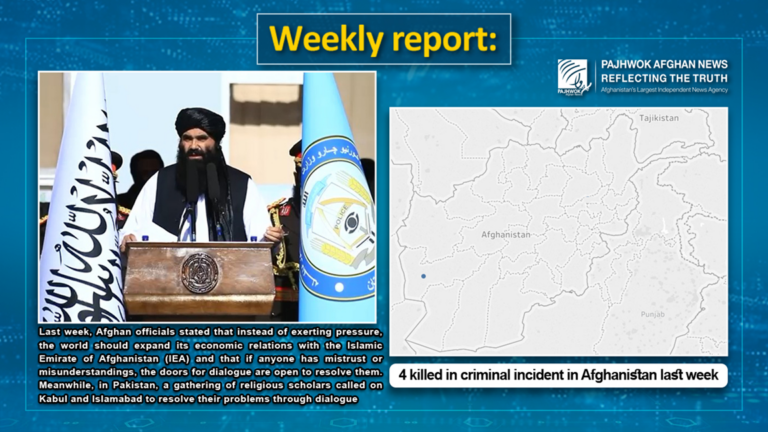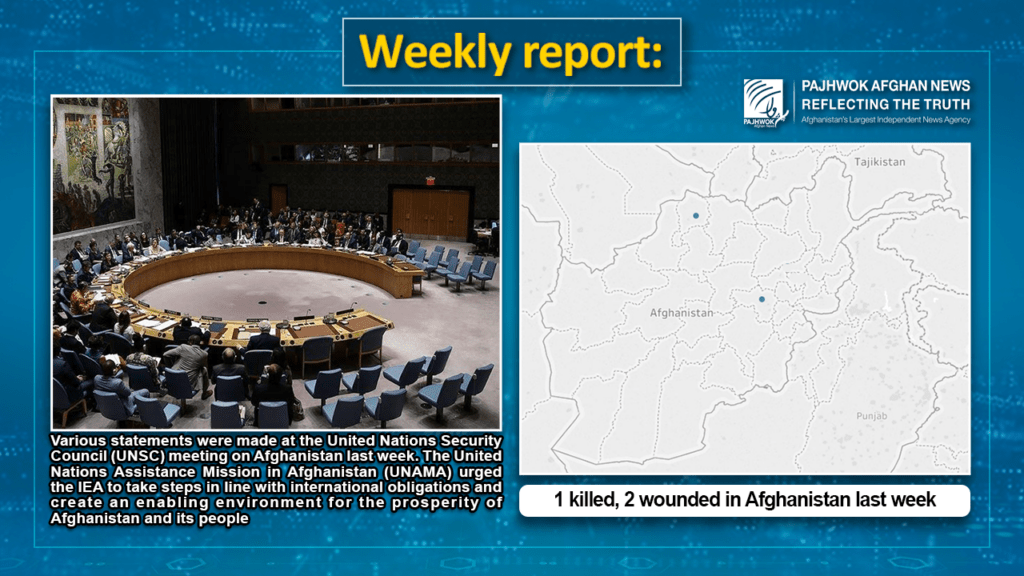

KABUL (Pajhwok): Various statements were made at the United Nations Security Council (UNSC) meeting on Afghanistan last week. The United Nations Assistance Mission in Afghanistan (UNAMA) urged the IEA to take steps in line with international obligations and create an enabling environment for the prosperity of Afghanistan and its people.
Australia also imposed sanctions and travel bans on four IEA officials, while the Afghan government condemned these sanctions.
Last week’s key events:
- Different statements by UNSC members on the situation in Afghanistan
- UNAMA: Realization of human rights paves the way for Afghanistan’s prosperity
- UNAMA raises concerns over human rights; Mujahid says all Sharia-based rights of Afghans are protected
- Australia imposes sanctions on four IEA officials; IEA says such countries do not recognise or uphold human rights
- Doha Forum highlights Afghanistan’s role in regional connectivity
- EU announces €25 million in assistance to Afghanistan
Casualties:
Two people were wounded in an explosion caused by an old mortar shell in central Maidan Wardak province. A man committed suicide in northern Jawzjan province.
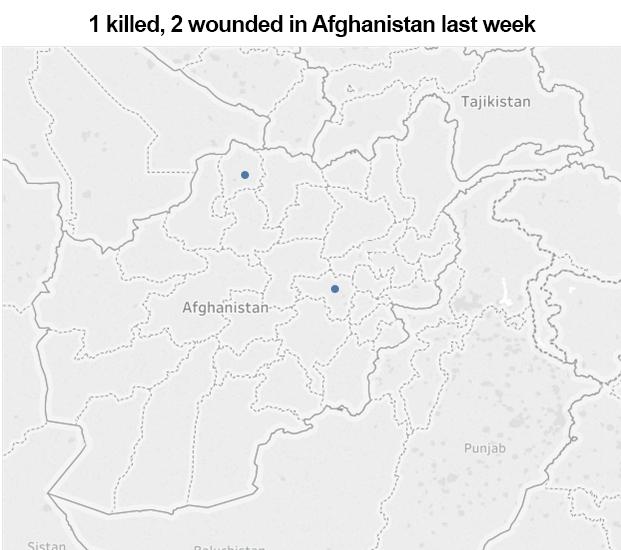
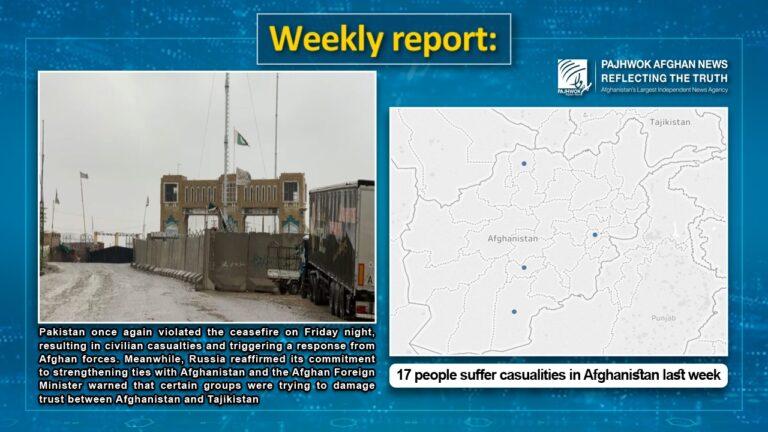
In the previous week, 17 people had been killed or injured nationwide. Before the 2021 regime change, hundreds of civilians, insurgents, and security personnel were killed or wounded on a weekly basis.
IEA reactions to UNSC meeting
Last week, the UNSC discussed Afghanistan’s humanitarian, economic, and security situation. UN officials and representatives of various countries stressed the need to address challenges, support livelihood programmes, and strengthen regional cooperation.
Acting Head of UNAMA Georgette Gagnon raised concerns over the continued suspension of girls’ secondary and higher education, stating that more than 23 million Afghans would need humanitarian assistance in 2026.
Several other participants also voiced concerns over human rights in Afghanistan.
The UK representative noted that British officials travelled to Kabul in October to “press the Taliban to reverse these decrees,” adding that London has committed $201 million for essential life-saving services for the 2025–26 financial year.
The US representative alleged that “the Taliban manipulate international aid, ignore the needs of the people, and show no regard for their international commitments.”
He argued that if the IEA obstructs UNAMA’s mandate, the Security Council should consider “restructuring the mission.”
However, China’s permanent representative to the UN said the situation in Afghanistan had remained “stable,” stressing that continued engagement between the international community and Afghanistan’s current government was more important than ever and should be further strengthened to improve conditions in the country.
Russia’s Permanent Representative, Vasily Nebenzya, reiterated the need for a realistic and comprehensive approach rooted in objective analysis and balanced assessment.
He called for meaningful and constructive engagement that reflects the needs of the Afghan people, avoids double standards, and is built on precise and trust-based dialogue with the Islamic Emirate. Afghanistan, he added, cannot overcome its current crisis without collective and depoliticized international support.
India’s Permanent Representative, Parvathaneni Harish, affirmed his country’s consistent role as a “steadfast” advocate of peace and stability in Afghanistan.
He underscored that coordinated regional and international cooperation is essential, and that effective engagement with all relevant stakeholders is critical to advancing peace, stability, and development.
The IEA welcomed the positions of countries that supported positive engagement at the UNSC and criticised negative stances, stressing that such approaches would yield no results.
Hamdullah Fitrat, deputy spokesman for the IEA, said: “Emphasising positive engagement by some countries is a good step and the only way to build trust. Afghanistan also seeks positive engagement with all countries, and those with incorrect positions should adopt a realistic policy. Negative approaches have produced no results in the past.”
UNAMA statement on Human Rights Day, IEA response
Marking International Human Rights Day, UNAMA urged the IEA to take steps to align with international obligations and create an enabling environment for the prosperity of Afghanistan and all its people.
In response, Zabihullah Mujahid, chief spokesman for the Islamic Emirate of Afghanistan, said the rights of all Afghans are guaranteed in accordance with Islamic Sharia.
He said: “The IEA considers itself obligated to provide these rights, as this is the command of Allah Almighty,” adding that rights are “fully ensured in Afghanistan.”
However, he also argued that Afghans are not required to adopt interpretations of human rights that vary across societies and countries.
Response to sanctions on four IEA officials by Australia
Last week, Australia imposed sanctions and travel bans on four IEA officials, citing the deteriorating human rights situation in Afghanistan, particularly for women and girls.
Australia’s Department of Foreign Affairs and Trade named the sanctioned IEA officials as: Minister for the Propagation of Virtue and the Prevention of Vice Muhammad Khalid Hanafi; Minister of Higher Education Neda Mohammad Nadeem; Minister of Justice Abdul-Hakim Sharei; and Chief Justice Abdul Hakim Haqqani.
In response, the Ministry of Vice and Virtue and Complaints (MoVVC) condemned Australia’s decision to impose sanctions, saying such actions show that these countries and organisations “neither understand human rights nor are committed to them.”
Doha Forum
Last week, a panel discussion on Afghanistan at the Doha Forum—attended by a representative of the IEA—stressed the country’s economic development through regional connectivity.
The 23rd edition of the Doha Forum, which kicked off on Saturday and concluded on Sunday in the Qatari capital, brought together around 5,000 participants from 162 countries.
On the second day of the forum, representatives from the IEA, Qatar, and Uzbekistan spoke during a panel dedicated to Afghanistan.
Director of Strategic Studies at the Ministry of Foreign Affairs (MoFA) of Afghanistan, Abdul Hai Qanit, said the world has achieved positive results in economic interactions with Afghanistan.
Referring to recent tensions between Afghanistan and Pakistan, the official said Kabul seeks dialogue to resolve issues.
Special Representative of Uzbekistan’s President for Afghanistan Ismatullah Irgashev said his country considers “Afghanistan an opportunity, not a threat.”
He said: “Including security, Uzbekistan cooperates with Afghanistan in various fields. Trade between the two countries has reached $1.2 billion over the past nine months. Afghanistan has also increased its exports through Uzbek border crossings.”
Continued assistance
Last week, the European Union provided €25 million in assistance to the World Food Programme in Afghanistan, while the 24th shipment of Turkish humanitarian aid—containing 1,300 tonnes of food and essential supplies—arrived in the country.
Meanwhile, EU Director-General for Civil Protection and Humanitarian Aid Andreas Papaconstantinou met Director of the Afghan Red Crescent Society Shahabuddin Delawar.
The discussions focused on increasing humanitarian support and enhancing bilateral collaboration.
European Union Special Envoy for Afghanistan Gilles Bertrand met Afghan Foreign Minister Mawlawi Amir Khan Muttaqi.
Bertrand praised the IEA’s four-year achievements in the areas of stability, security, and the economy, assuring continued EU assistance and calling for expanded cooperation to attract major foreign investment to the country.
kk/sa