
ZARANJ (Pajhwok): Shortages of safe drinking water, healthcare facilities, schools and roads have created severe hardships for thousands of residents in parts of northwestern Nimroz province.
Residents, criticising years of neglect by the former government, are calling on the Islamic Emirate of Afghanistan (IEA) to take immediate and practical steps to address their most basic needs.
Access to potable water, standard roads, education and health services constitutes some of the most fundamental social rights of citizens and forms the backbone of welfare and social justice in any society. The provision of these services is widely regarded as a core responsibility of the government.
However, more than four decades of conflict have resulted in long-lasting neglect of many villages and remote areas, leaving large segments of the population deprived of essential public services.
A Pajhwok Afghan News reporter in Nimroz spoke with residents of Syed Abdul Salam, Rustam Khan, and Bay Naz villages in Zaranj, the provincial capital, as well as Abdul Baqi Sasoli, Naroui, and Walidad villages in Kang district.
Residents identified the lack of safe drinking water, educational and health facilities, and poor road infrastructure as their primary challenges. They blamed the previous government for indifference and urged the IEA to give serious attention to these sectors.
Shortage of safe drinking water
Mawlawi Mohammad Juma Islamyar, head of the Abdul Baqi Sasoli village council in Kang district, said balanced development had not taken place in many parts of the district, leaving several villages without clinics, schools, or proper roads.
He added that residents also lacked access to potable drinking water.
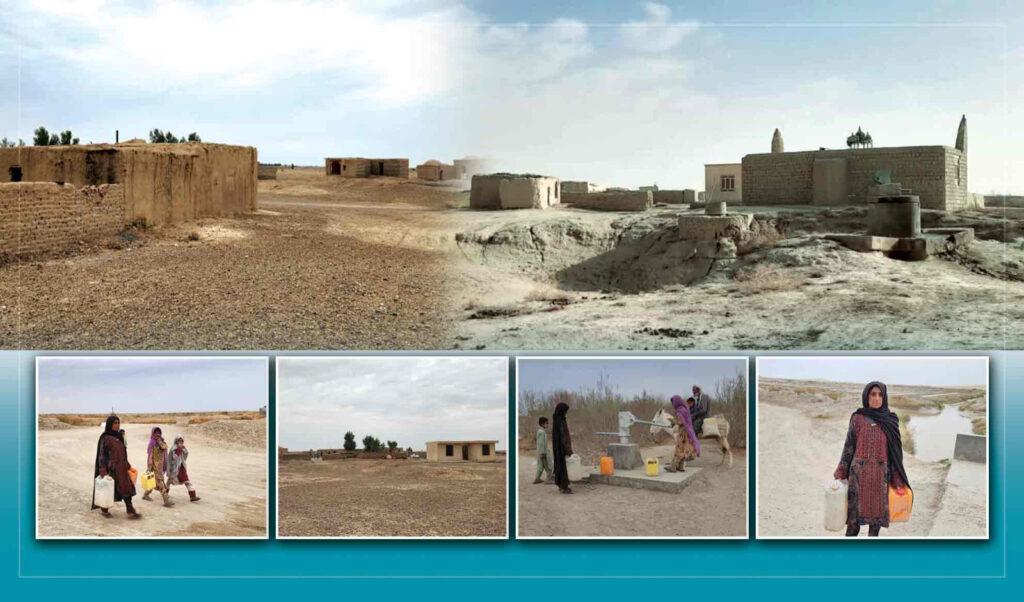
Describing the northern villages of Kang district — including Abdul Baqi Sasoli — as among the most deprived areas, he said: “In most of our villages, we have neither safe drinking water nor water for agriculture. All our land has dried up.”
According to Islamyar, the absence of clean water has led to widespread microbial diseases, particularly during the summer months.
The problem is not confined to Kang district; similar conditions exist in several villages of other districts and even in parts of Zaranj city.
Mohammad Nabi, a resident of Syed Abdul Salam village east of Zaranj, said dozens of families live in the village, but the lack of safe drinking water remains one of their most pressing concerns.
Blaming the former government for neglect, he said: “We have many problems, but the most serious one is drinking water. There is still no piped water in our village. There is only one well, and its water is salty and undrinkable.”
He explained that residents are forced to purchase water, but many families cannot afford it due to economic hardship and are compelled to use salty water instead.
“Some families bring water from the city or neighbouring villages, but others neither have money nor the means to transport it. They are forced to drink salty water,” he added.
Jamila, a 40-year-old resident of Bay Naz village in Zaranj, said that despite being only 10 kilometres from the provincial capital, the village has no piped drinking water. Some families, she said, resort to using canal water for drinking, causing frequent microbial illnesses among children.
On the other hand, Abdul Ghafoor, a resident of Chakhansur district, has complained about the poor condition of the road connecting the district to the provincial capital, saying that a journey which used to take around 40 minutes now takes up to an hour and a half.
He added that the road had previously been gravelled but was damaged by floods, leaving it with numerous potholes and uneven surfaces. He urged authorities to construct a proper, durable, and standard road.
Ghulam Mohiuddin, a resident of Rustam Khan village, said: “We are forgotten people. Over the past 20 years, neither the previous government nor aid organisations did anything for us. We ask the IEA to pay attention to our area. We want water.”
Similarly, Mohammad Isa Baloch, a resident of Naroui village in Kang district, said 15 families live in the village, yet there is not a single drinking water tap.
“Every day we bring four barrels of water from Abdul Rahman village. The journey takes an hour by animal. We are suffering greatly. If the government or organisations had dug even one well in each village, our situation would be different. Under the previous government, nothing was done due to corruption,” he said.
Heath services, roads
Residents of several remote villages in Nimroz said the absence of government health centres posed serious challenges to their daily lives.
Mohammad Nabi said there was no health facility in Syed Abdul Salam village, forcing patients to travel to Zaranj for treatment.
“We are about 10 kilometres from the provincial capital. Most people are poor, and transportation costs around 500 afghanis, which many families cannot afford,” he said.
Jamila also complained about the lack of health services, noting that neither government agencies nor aid organisations had ever provided consistent support to her village.
“Mobile health teams and vaccination services either come very rarely or not at all,” she said.
She recalled cases in which women had died on the way to the provincial hospital due to severe bleeding during childbirth and the absence of nearby health facilities.
Jamila said residents must walk nearly two kilometres to reach the main road along the Lashkari canal, as there is no standard road inside the village.
Lack of secondary, high schools
The absence of secondary and high schools is another major concern for residents of these villages.
Mohammad Nabi said that although Syed Abdul Salam village has a school, it lacks a proper building and offers classes only up to grade four. Due to staff shortages, the school has just one principal and two teachers.
He added that children must travel to Zaranj to continue their education beyond grade four, but the long distance forces many to drop out.
Ghulam Mohiuddin said: “There is no school at all in our village. Education is our right, and we want our children to be educated.”
Similarly, Mohammad Sabir, a resident of Walidad village, said dozens of children had been deprived of education due to the absence of a school.
“We have always been forgotten. We ask the IEA to do basic work for us poor people. If the government cannot act immediately, it should at least, with the help of organisations, build a clinic and a school and construct roads,” he said.
Economic expert: Urban focus had deprived villages
Rahmatullah Barkzai, an economic expert, said weak local governance and an excessive focus on urban development were among the main reasons for deprivation in parts of Nimroz province.
He stressed that the government must ensure equitable service delivery across all areas.
Barkzai also cited public unawareness and cultural poverty as factors exacerbating deprivation, noting that in some areas residents had failed to take collective action to improve their villages despite having the means to do so.
“Deprivation is not solely the result of government neglect. In many cases, people have prioritised personal interests over the development of their communities,” he said.
Economic Department: Projects planned
Director of the Economy Department, Mawlawi Abdul Rashid Shahidyar, acknowledged that some remote villages had not received adequate attention in the past.
However, he said the IEA had included public welfare projects for these areas in the provincial development plan.
“Balanced development in both the provincial capital and the districts is among our key objectives,” he said. “The plan includes road repairs, construction of schools and clinics, and cash-for-work projects. We hope these proposals will be approved and incorporated into the 1405 budget.”
He added that his department had proposed 40 development projects in the 1403 solar year plan, some of which had been implemented, while others remained pending due to budget constraints.
Shahidyar also referred to projects implemented in cooperation with Japan and the United Nations, including the construction of two clinics and one school on the outskirts of Zaranj, as well as road construction projects in Kang and Chakhansur districts.
kk/sa